


I recently had a revolutionary thought pass through my mind as I was changing my laptop background — I'm sure many of you have experienced the very same thing. I was scanning through a Google image search, eloquently titled "cool space pictures" when I stopped looking through these albums like so many collections of interesting looking lights and suddenly saw these photographs for what they truly were: a glimpse at a universe that we'll never truly know in our lifetime. It made me wonder how often I had taken this ability for granted, to scroll through these pictures without a second thought as to the technology required to bring the furthest reaches of the cosmos into our personal lives.
Our first advancements into astrophotography began even before the invention of cameras. The first instrument that allowed us the ability to look further into the night sky was the telescope. While difficult to pin down the very first design, the first application for a patent on a telescope can be traced back to Hans Lippershey in 1608.
Lippershey was a Dutch eyeglass maker and was quite prepared to create the glass lenses needed for a refracting telescope. Refracting telescopes worked in nearly the same way as modern-day eyeglasses. A primary lens would collect light from an outside source, and focus it into a secondary lens that then straightens the light so that the user can discern an image.

The telescope designed by Lippershey was only able to magnify distant objects by a factor of three, but this technology slowly gained traction, and began to see widespread use. The first images returned from these early telescopes were the sketches made by pioneer astronomers such as Galileo Galilee.

Early sketches such as the one above show how, even without the technology we currently possess, detailed information could still be gathered.
Unfortunately, telescopes can only be made more powerful with larger lenses, and in the case of a refraction telescope, the size of the lens directly correlates to the length of the telescope itself. This issue, coupled with the difficulty of adjusting the larger instruments to use in observation, called for the need of a major breakthrough in the physical design of the telescope itself. This breakthrough came through in the invention of the reflective telescope.

This design allowed much larger diameter lenses, as the lens could be attached to a metal plate at the base of the telescope.
Even with all of these advancements, we were still limited in our ability to look into space, and no matter what work was done to the telescope, the problem would remain.
All light that travels through space to reach our eyes on the ground must also pass through our atmosphere. And if there is one thing our atmosphere excels at, it is scattering light in every direction. This posed a progressively larger problem for astronomers, as they turned their eyes ever outward, searching the universe for more and more distant objects.
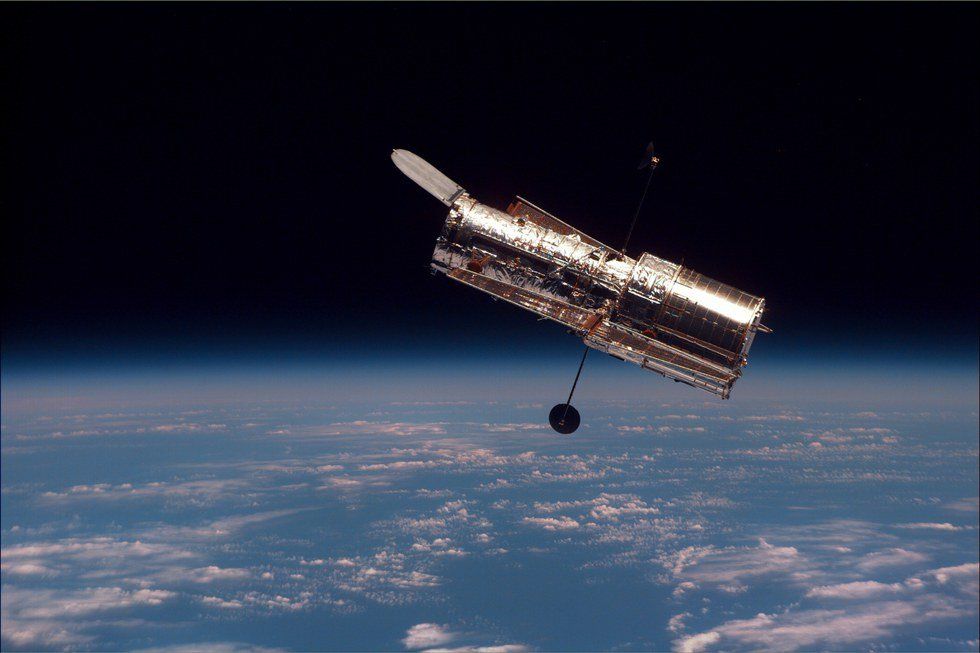
The images returning were distorted at best, at worst completely unintelligible. The need for a telescope outside the reach of our atmosphere was growing with every passing year. Multiple space agencies launched a series of satellites to observe shorter wavelength radiation, such as X-Rays, but there was not a space-based observatory dedicated to visible light imagery. NASA spent years pushing for Congress to fund their project, and on April 24th, 1990, the Hubble Space Telescope as launched.
The world waited with bated breath to see what incredible imagery would be returned from this orbiting observatory, and all of humanity was rewarded with....this.

"I mean, it looks kinda space-y...ish?"
Needless to say, the results were less than impressive. It turned out that the mirror being used to focus light was misaligned by 1.3 micrometers, or 25 times smaller than the width of a human hair. NASA scrambled to fix this issue, as many already saw the project as a white elephant, with no actual results to justify the billions of dollars spent developing the tech.
Multiple missions were sent to fix this issue, requiring teams of astronauts to reach the same level of accuracy as the multitude of ground workers. To give you an idea of the accuracy required in this operation, the mirror's curvature was allowed to deviate by 1/800,000 of an inch. In other words, if the curve of the mirror was expanded to the scale of the earth, the largest deformities could be no greater than six inches tall.
At long last, the repairs were finished, and the images that returned were nothing short of stunning.


And if any of you were wondering what that fuzzy galaxy ended up looking like?

The Hubble Space Telescope means much more than the scientific discoveries it's helped propagate. It's provided a link to the cosmos for the everyday person like you and me. Listening to numbers and figures is well and good, but being able to visualize the expansiveness of our universe is something that we should never take for granted.
There are no plans to retire the Hubble any time soon, but NASA plans to launch another observatory, bigger and better than any space-based telescope in orbit now. The James Webb telescope, planned for launch in late 2018, will have a lens diameter of 6.5 meters, as opposed to Hubble's 2.4 meter lens. The Webb telescope is planned to launch into orbit at a point between the Earth and the Sun, where the gravity between the two bodies will pull equally on the observatory. This area is called a Lagrangian point, and by placing the satellite here, it will keep a stable orbit away from the Earth, allowing it to constantly receive information, without passing behind the shadow of the Earth every 45 minutes.
The advancement of our technology for visualizing the cosmos is ever increasing, and with it, our knowledge of the universe we live in. With telescopes like the Hubble, and the James Webb, alongside other orbital observatories, we slowly pull back the veil that's clouded our vision since we first looked up at the sky.

















