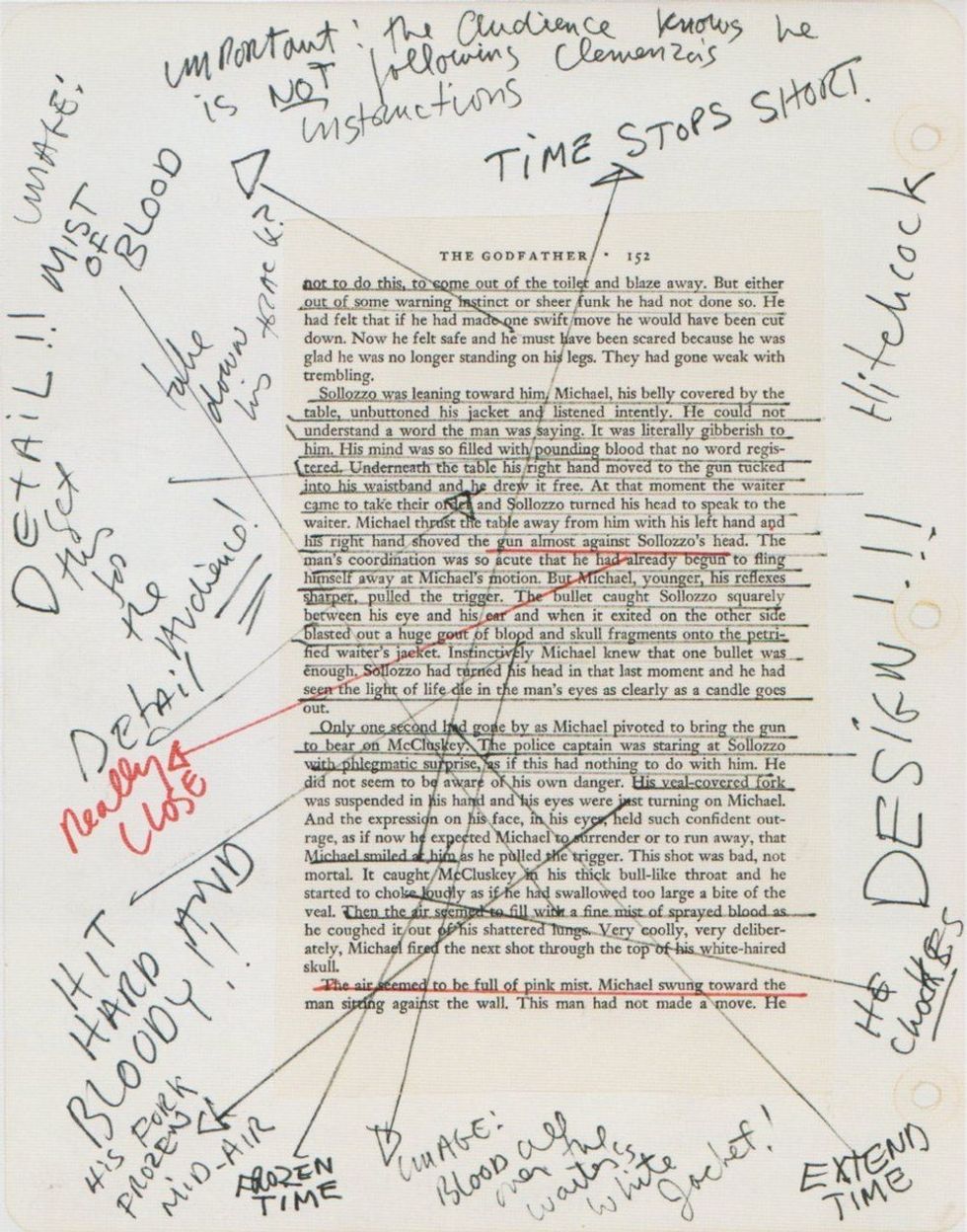
Francis Ford Coppola’s The Godfather Notebook is a large volume, in which you are able to see the process the director went through on how best to tackle the Mario Puzo book. In it, he explains his technique for bringing the book to the screen. Originally a student of theatre, Coppola took the idea of a prompt-book and applied it to his early work on The Godfather, before the screenplay was written, before any actors were chosen, long before there was any indication that this was to be the greatest American film ever made. He has said that while making the film, he needn’t have even looked at the script; this notebook, which has now been published for all of us to see, was all that he needed while directing.
Looking through this book is an insight into the creative mind of one of America’s great directors. Alongside this particular classic, Coppola can also boast The Conversation, The Godfather Part II and Apocalypse Now. These three films were made unfathomably close together (both The Conversation and Part II were up for Best Picture in the same year, the latter beating the former), and all three can claim to be masterfully handled films, perfect examples of the power of visual storytelling. Sure he has had some flops, declared bankruptcy and has seemed to have basically retired from filmmaking, but there is no denying the influence the man has had. He led the charge for a new wave of filmmakers in America in the ‘70s, dedicated to producing films that were personal, introducing a new era of movie-making that was not shackled by the hold of major Hollywood studios; in short, creating films that bore the individual mark of the ‘director’. It was the beginning of independent filmmaking.
However, we learn from the notebook that it was not an easy ride for the 30-year-old to get The Godfather made the way he wanted. Problems consisted of the studio not wanting Al Pacino for the crucial role of Michael Corleone, reportedly favoring the likes of blonde, Hollywood-types, like Robert Redford or Ryan O’Neal. As well as this, Coppola had to live and work under the constant pressure of knowing that he was not the first choice for the job. It is suggested that the only reason he was chosen was because of his Italian-American heritage, which could be used by the studio as some sort of moral victory over discrimination. Of course there was trouble with the ever problematic Marlon Brando, whose asking price was apparently too much for the studio to put out for such a small film.
Despite these problems, the finished film is a grand, operatic piece of storytelling. Of course, character is the cornerstone of any good film. Despite the dirty business of the Mafia, we view these characters with admiration. We respect them. Brando’s performance is subtle, yet exudes enormous amounts of power. We celebrate as Michael exacts revenge and murders the cop who broke his jaw. We are glad to see his opponents taken out one by one, as he accepts the role of Godfather. This film was revolutionary in popular entertainment, in creating characters that blurred our perception of ‘good’ and ‘evil’. This film began, or rather reawakened, the idolization of gangsters in film. All this could not have happened, were it not for Mario Puzo’s book.
Coppola’s tedious technique of cutting square holes into white paper in order for him to paste pages of Puzo's book provides fascinating insight. The pages, which are visible from both sides, give him margins to draw lines and make notes from. We read a line of Puzo’s creation, then follow a scraggly line off the printed book onto the white margins, where Coppola has made some small note or observation, helping him streamline the story and create the beginnings of a structure for his own film. Comments like ‘Mist of blood’ or ‘Key scene’ allow a glimpse of those moments where an idea formed, a scene visualized, prompted by Mario Puzo’s words. We see first-hand how he broke each scene of the book down into a basic synopsis, how he wanted each scene to communicate a certain message, the imagery and tone; all are a close and careful study on how best to turn words on a page into cinematic images.
The notebook’s greatest achievement is showing first-hand the difficulty and intense preparation that must take place in order to create a film. What is also evident is a sense of unbridled imagination, as well as the power of collaboration. We witness him take the craftsmanship of Mario Puzo and turn it into his own piece of art. What I enjoyed most was reading a section of the book, seeing what Coppola’s thoughts on that particular section were, and recalling how he eventually shot it for the film. It is the pleasure of seeing and understanding the process that makes this book so great and makes you appreciate the film, and filmmaking as a whole, even more.
Perhaps it is time to forgive him for The Godfather Part III.