


There are many ways to arbitrarily group people. But the grouping method we’re talking about today is how people do things. In my experience, there are two kinds of doers. One is a step by step kind of person and the other is an all-in-one-haul kind of person. It’s sort of like sprinters and distance runners. Short-term doers do a little bit every day until it’s done. Long term do-ers plan out a huge block of time to get done whatever they need to get done then and there.
I am the latter type of person. I can sit for hours focusing on one thing, getting a week of homework done in one long ten-hour Saturday. But after three years of college, I’ve found myself burned out. I imagine this can happen to the first type of people, too, but I particularly recommend my cure for third and fourth (year) college-degree burns for people who like to stay busy and work, work, work until everything is done.
The prescription: Make lists!
1. Write down everything that you have to do. And I mean everything.
If you have to clean, go to the bank, do laundry, read for classes, or finish projects — write it down! Write down stuff you forget (as soon as you remember it — so you don’t forget again!) like to feed the fish or water the plants. Write down stuff you do on an everyday basis, like brush your teeth. (Or at least things you should do on an everyday, or twice a day basis — at least.)
I found that when I wrote things down, they became more obligatory. So, “do laundry” written in my Book of Lists wasn’t a suggestion or something I should do, it was something I needed to get done. I struggle with depression. And depression steals your motivation. Writing lists has been one little tool in my belt that I use to get the old brain-body-machine running again when it slows down to a halt. It doesn’t always work, but it’s always something harmless to try to do to help myself.
Note: Please do not write things like "eat lunch," "go pee," "drink water." And if you do, you need to treat those items differently. Listen to your body. Don't hold off on eating when you're hungry because you're focusing on your to-do list. And don't sure your to-do list as an excuse not to eat. Denying yourself important life sustaining activities is not ok. Take care of you.
2. Break down big tasks into smaller tasks.
Yes, it makes your list look longer. And yes, that can be intimidating and can steal away your motivation. But (and this is a big but), the smaller your listed tasks are, the more you get to cross off and the more accomplished you feel. Soon, that intimidation turns into validation. You got stuff done. Go you!
For instance, when I write papers, I always start with the bibliography. So that’s one item on my list. Subsequently, other items are “pull quotes/info from source one,” “get info from source two,” and “figure out your thesis.” After each thing is accomplished, I cross it off and move onto the next thing. It’s affirming to look back at your long list and see that, yep, you’re making progress. The blinking vertical line on the almost blank computer screen is lying to you. You’ve actually made progress. I break down other tasks similarly. I don’t write “laundry,” I write “put clothes in washer,” “move clothes to dryer,” “bring clothes to room,” and “fold clothes and put away.” This technique of breaking things down into tiny little parts is especially good for tasks you do not enjoy. Crossing out part of the daunting task bit by bit is like repeatedly stabbing the dragon. It’s less overwhelming to think, “I have to annotate my first source in my bibliography,” than it is to think, “I have ten full page annotations due in five hours.” When your brain (and parasympathetic nervous system responses) are not overloaded, you can think more clearly and calmly and as a result, you get more done.
Note: It is perfectly acceptable to make "watch the latest episode of [insert favorite show here" one of the items on your list. It's OK to take breaks and have things like "paint something" or "go on Tumblr for 15 minutes" written down on your paper. (Well, maybe stay away from Tumblr. That place just sucks you in. Say goodbye to your to-do list.) I'm an all-at-once kind of person, so it's hard for me to be ok with not doing something productive all the time. But it's really OK to stop and take a break. Your brain works better when it's not mad at you for forcing it to function at high capacity for ungodly amounts of time!
3. Don’t go in the order you wrote it down!
You need to reorder or number your list. When I write lists, I write down everything that comes to mind as it comes to mind. I add on to the list as the day moves forward and I remember other things I should give some attention to at some point. But often times that means that all the things I have written at the top of the page have something to do with school and are brain-draining and require a lot of focus. So doing everything from top to bottom is an awful idea. Either rewrite your list or number the existing list in an order you can manage — one that gives your brain a break. Alternate brain-work with body-work. For instance, work on the first question of your worksheet, then vacuum your room. Next, fill out the second question, and then clean off your desk (which you’ve been telling yourself to do for eons, but now that it’s written down, and you actually have other work you need to be doing, it seems that there is really no time like the present!).
This switching back and forth between think time and moving time is good for both your mental health and your physical health. You’re working with your attention span instead of against it. You’re not sitting slouched over a book or a laptop for a long period of time. And, plus, your room will never be as clean as it will be when you have a big project due! Having a clean, organized environment helps you relax and de-stress — which helps you get more done.
Let's review: Make lists.
1. Write down everything.
2. Make each thing small and manageable.
3. Do it in an order that doesn't strain your brain or your body.
When you do this, it'll look something like this mess:
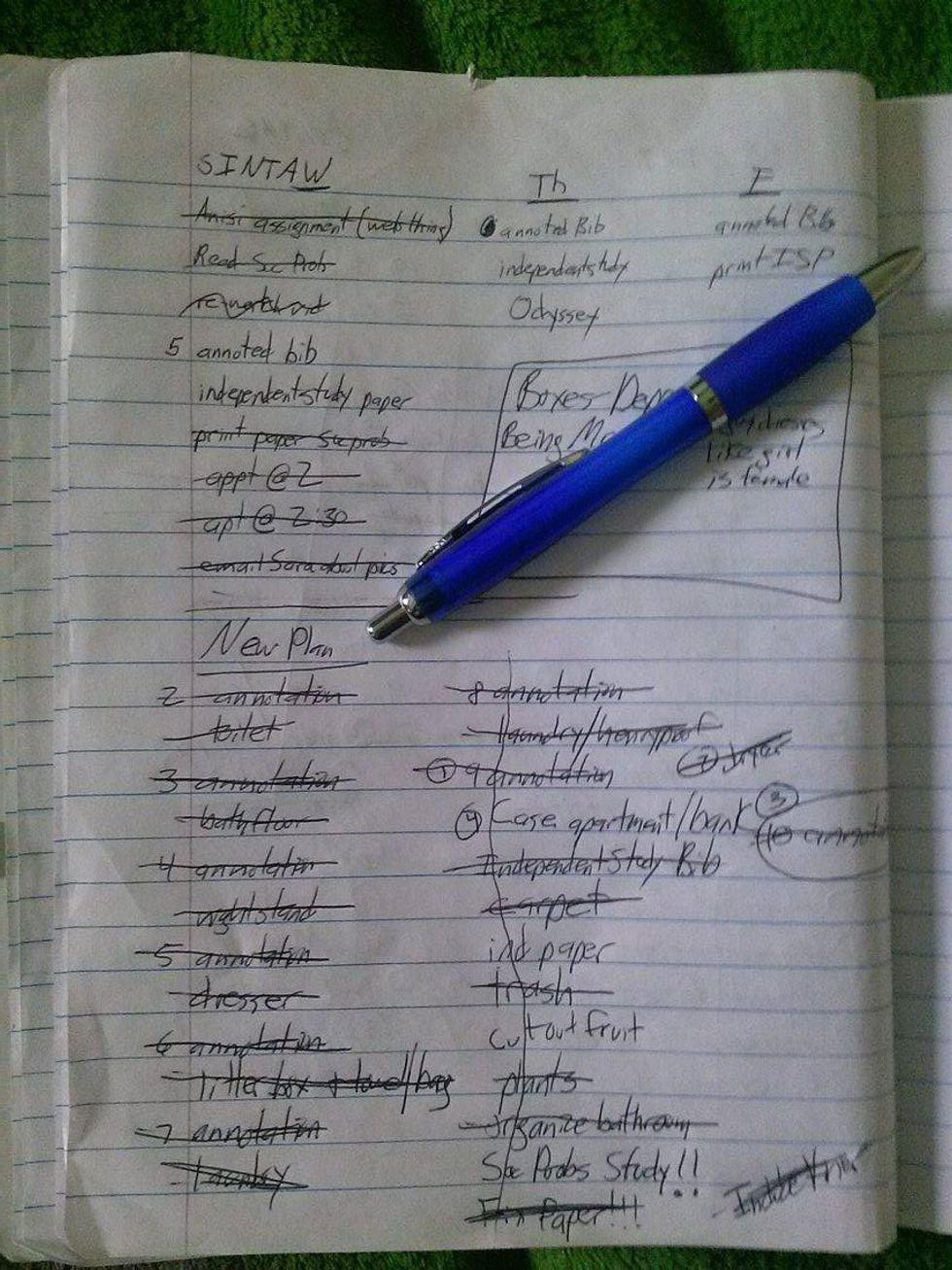
And that's OK!
Attention: This prescription can be filled at any local college or university. It is recommended to be used by people of school and/or work age. Small children should not have to-do lists.
Side Effects may include a sense of peace and/or accomplishment. A sense of mastery and/or control over your life.
Warning: List-making may become an addiction or obsession. Always organize your life with care and consult the Nobel Peace Prize Nominations committee (is that a thing?) if you get more than one hundred things accomplished in a day and request a gold star sticker.















