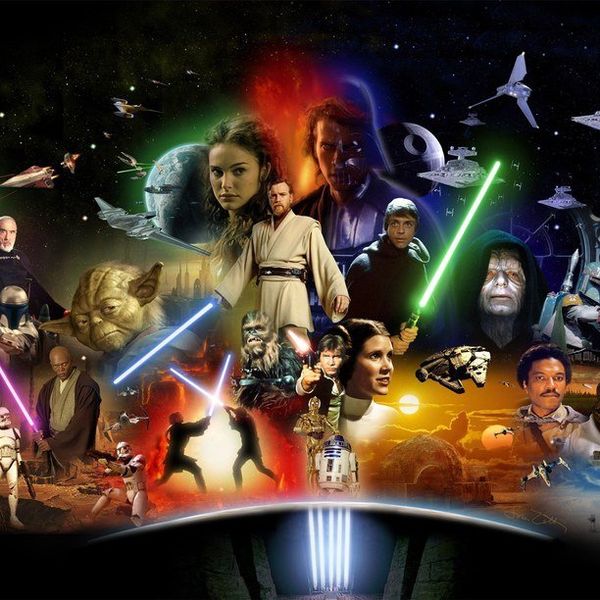
Of the films American popular culture has deemed classic, the Star Wars saga (George Lucas) is seated on the highest pedestal and is the most fondly remembered of them. The three films, A New Hope (1977), The Empire Strikes Back (1980), and Return of the Jedi (1983), each appear to showcase the same plot line, where a young Luke Skywalker discovers he has Jedi powers and is sent on multiple missions to destroy both the Empire and his father Darth Vader. However, each film is so cleverly created and woven into one another that when watched in sequential format, they form the masterpiece George Lucas is so highly praised for.
The effect they have created on America’s culture and, to some extent, the world’s culture can only be described as profound. Decades after their release, we still commonly hear phrases such as “may the force be with you” or “the force is strong in our family.” And even today, there is a holiday on May 4th where the common phrase to use instead of “good luck” is “may the fourth be with you,” an obvious allusion to the films. Many seminars, books, and cultural exhibitions exist that dedicate their entirety to the Star Wars saga, and if that’s not enough, there are mass groups of people that have taken Stars Wars fan clubs up a notch and made the films the center of their cult. Star Wars has not only become another classic that Americans watch on occasions, but a cultural entity, interwoven into nearly all aspects of American life.
The foundation of a popular culture lies in any mass social movement, typically built upon entertainment, that not only grabs the younger generation’s attention but a large majority of the adult generation’s as well. Movies, over the past century, have become the new focal point of America’s attention and have become popular cultures new medium. To most, they provide relaxation, stress relief, and escape, while to others they provide serious meditation, study, and even a job. Joseph Campbell author of The Hero with a Thousand Faces, elaborates on this subject in an interview with American journalist and political commentator Bill Moyer discussing Star Wars' role in our culture. He states that a person is “told exactly what to do, every bit of the time… you’re always doing what you’re told to do, and so you count the days to your holidays, since that’s when you’re going to be yourself.”
Movies now a days can be viewed as holidays, or at least they are coveted as much as holidays. They provide a safe haven for us to be ourselves, which constitutes another reason for their popularity in modern culture. Due to this phenomena, Star Wars was able to reach massive audiences and because of its cinematic qualities, it became a hit. Yet a hit only makes a film a classic, not a culturally revolutionizing event.
Star Wars' fame and cultural influence did not originate solely from its imperial star destroyers, Jedi knights, or even the notorious Death Star. It came from beneath the screen, where a lost ideology comprised of ancient fables is present. Joseph Campbell and Bill Moyers’ interview extends on this idea as well, saying, “Part of the success of Star Wars… wasn’t just the production value… it was that it came along at a time when people needed to see in recognizable images the clash of good and evil. They needed to be reminded of idealism, to see a romance based upon selflessness rather than selfishness.”
Moyers implies in this statement, that during the time of Star Wars' release, America was facing a moral crisis. The world was growing more and more violent and common morals were evolving towards savagery, as represented in the evolution of film. Society as a whole was growing more and more indecent and idealism had been lost. When Star Wars came along, it redeemed the barbaric culture of those decades. Its reward for doing so was high praise and a place among the list of great moral doctrines. Within its seemingly basic plot lies the millennium old story of the hero with a thousand faces that Campbell describes in his book. The Monomyth of the heroic story that tells of men’s strength, weakness, and ability to survive, which always ends with a moral conclusion intended to be used as a teaching tool. This template and the variables such as characters and setting Lucas used proved to be the perfect formula for what now is deemed as the greatest heroic epic of our time. And so Star Wars became not only a classic but moral rejuvenation for our culture. That was back in the 1980s; Star Wars now has evolved into something much more and much different. It changed its focus from cultural cleansing to political realization.
After the first trilogy was released, the Reagan administration ended, which was thought of as the last great presidential era, and the Bush and Clinton administrations took over. During this time the term big government began to slip out of people mouths, and no longer was the government considered to be on the people’s side. Bureaucracy took over and Americans began to fear all forms of government in their lives. This situation is mimicked by the Empire and the rebels, although in a much more dramatic setting. The Empire represents big government and the rise of the bureaucracy, where Darth Vader and Darth Sidious represent the highest level of bureaucrat.
Joseph Campbell agrees with this idea and directly states that within Star Wars “Darth Vader is a bureaucrat, living not only in terms of himself but in terms of an imposed system.” Because of this subconscious knowing, we immediately side with Luke Skywalker’s cause and reject Darth Vader’s completely. We are Luke Skywalker, rejecting the Empire's belittling and hindering tactics by rebelling against the system, although in our case we rebel in a figurative way. To escape the clench of bureaucratic enslavement we hold on to our own ideals and as Obi Wan Kenobi states and Moyer and Campbell support, “Do it ourselves, by trusting our feelings and ourselves.” It’s as if the film a decade or two after its release still speaks to society and offers advice. Star Wars consciously and subconsciously speaks to us in such a way that we realize we are able to govern our own lives away from our own big government, and able to enjoy the luxuries and rights that we deserve.
By the time the second trilogy was made -- Star Wars: The Phantom Menace (1999), Attack of the Clones (2002) and Revenge of the Sith (2005) -- Star Wars became the ultimate social enlightenment tool. If we were to watch it, we would see old morals, mirrored political standings and situations that offer insight into our lives. Insight that would provide a possible lesson on how to live life with more meaning and less friction from outside influences. And because of its social, cultural, and political exchange between fantasy and reality, we have embraced it as a film saga that communicates in and out of our lives, much like the force lives in and out of everything, something that is bigger than ourselves, more than just a couple of cool movies.