

"A single death is a tragedy; a million is a statistic."
–Unclear original source, commonly misattributed to Josef Stalin
Yesterday, about 150 thousand people died. That is a lot of people. Imagine everyone that you know dying, multiply that by 100 and you might come close to experiencing the awful, painful tragedy of what happened yesterday.
You probably did not burst into tears after reading that paragraph. You might even feel slightly irritated at my attempt to "guilt" you into sympathy for a bunch of people who you do not know. But if one of your friends died, then you would probably be devastated. Why?
There is a simple answer. Unlike your friends, those 150 thousand people lived outside of your "Monkeysphere":
First, picture a monkey. A monkey dressed like a little pirate, if that helps you. We'll call him Slappy. Imagine you have Slappy as a pet. Imagine a personality for him. Maybe you and he have little pirate monkey adventures and maybe even join up to fight crime. Think how sad you'd be if Slappy died…
Now imagine 100 monkeys.
Not so easy now, is it? So how many monkeys would you have to own before you couldn't remember their names? At what point, in your mind, do your beloved pets become just a faceless sea of monkey? Even though each one is every bit the monkey Slappy was, there's a certain point where you will no longer really care if one of them dies.
So how many monkeys would it take before you stopped caring? That's not a rhetorical question. We actually know the number.
The size of your "Monkeysphere" — the group of individuals that you can care about enough to maintain a stable relationship with — is actually measurable, as the anthropologist Robin Dunbar discovered almost accidentally less than three decades ago.
Near the end of the 1980s, Dunbar had no idea that his name would soon be splashed across dozens of article headlines and linked to a key concept in psychology. He was simply trying to test different theories of why mammal brains are so much bigger than other brains. To test if the importance of social relations was a significant factor, he looked at the relationship between primates' brains and the size of their social groups. After finding that the size of a primate's neocortex can predict the size of its social group, he decided to put the human brain into his equation to predict the size of a human's social group:
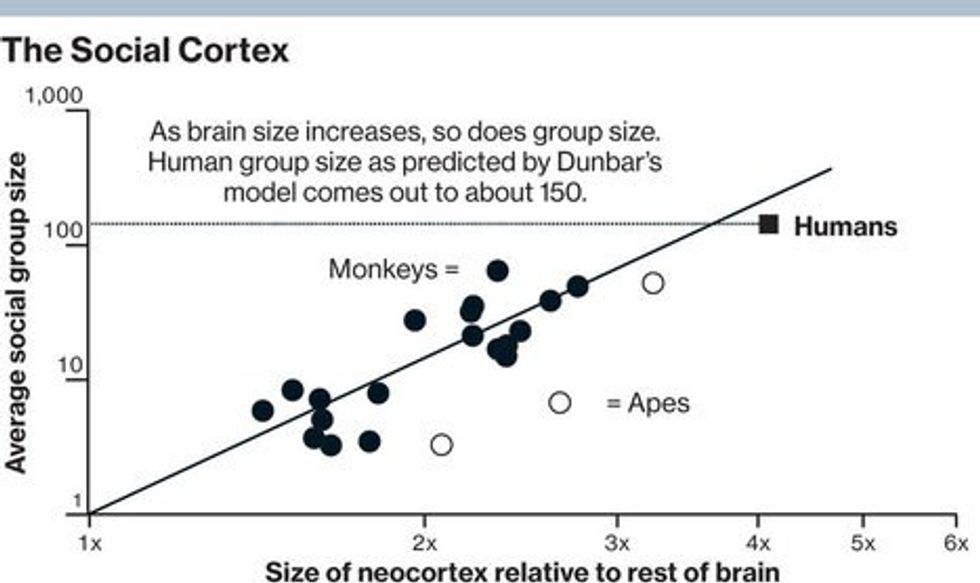
His now-famous finding is that you can only care about 150 people (give or take about 50), at least enough to have a stable relationship with them. Intrigued by this concept, Dunbar looked into the issue and found his number 150 cropping up everywhere:
We find it in the typical community size of hunter-gatherer societies, in the average village size in county after county in the Domesday book, as well as in 18th-century England; it is the average parish size among the Hutterites and the Amish (fundamentalist Christians who live a communal life in the Dakotas and Pennsylvania, respectively).
Dunbar also found that the average social network in Western society, based on exchanges of Christmas cards, is about 150. Still, he was not the only one to find this number. Using trial and error, the company behind Gore-Tex found that they could prevent social problems between employees by having 150 or fewer people in any one building.
Dunbar's number has not changed with the advent of social media, despite that many people have thousands of "friends" on Facebook. In fact, the term "Dunbar's number" was coined on Facebook when people were noticing that they did not know who some of their "friends" were. Even on Twitter, users maintain 100 to 200 stable relationships at most.
Further research has found that the numbers can be scaled up or down by a factor of about three based on the closeness of the relationship. At one end, you can have up to five intimate friends, and at the other end you can match names to faces for up to 1500 people.
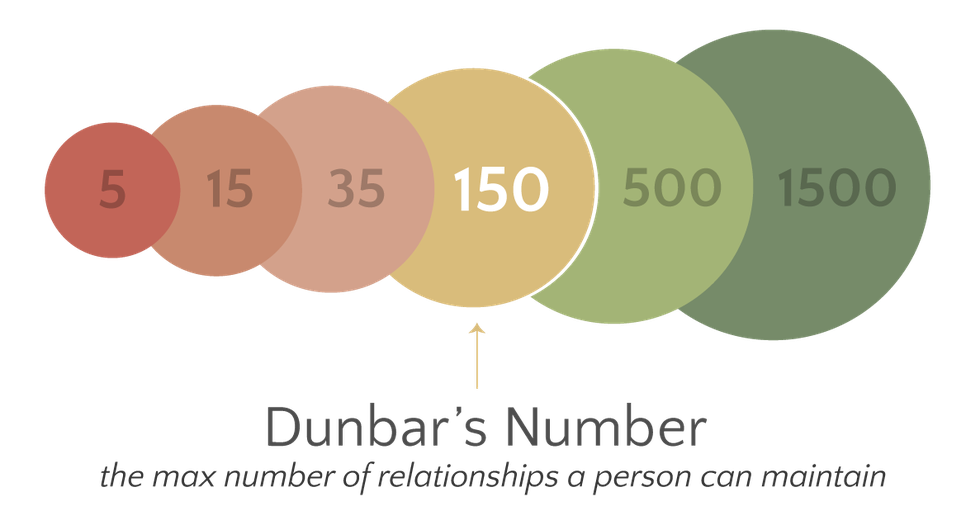
Dunbar's number deserves the hype that it has received. After all, it shows one of the fundamental problems with human society. You do not care about the person five seats to your left in a crowded theater for the same reason that murderers are usually indifferent to their victims' suffering: your empathy is limited by the size of your brain. You are morally limited by nature.
Fortunately, we do not and should not have to rely on our natural instincts to be good people. Dunbar's number provides a startling example of where our moral instincts can betray us, but that is why humans created political systems using logical rules and incentives to regulate how people act towards those they do not care about.
A million may only be a statistic to our morally inept brains, but we can compensate by understanding our limits and using logical tools such as statistics to work around them. Even if hearing that 1,000,000 people died does not make us feel the pain that their loved ones felt, we can and should recognize the tragedy in the numbers.
For more information on this subject, check out some of the following resources:
The New Yorker: "The Limits of Friendship"
ASAP Thought: "How Many Friends Can You Actually Have?"
Motherboard: "Your Brain Can Only Handle a Few Close Friends"
The Agile Elephant: "Dunbar’s Numbers and Organising for Social Business"