


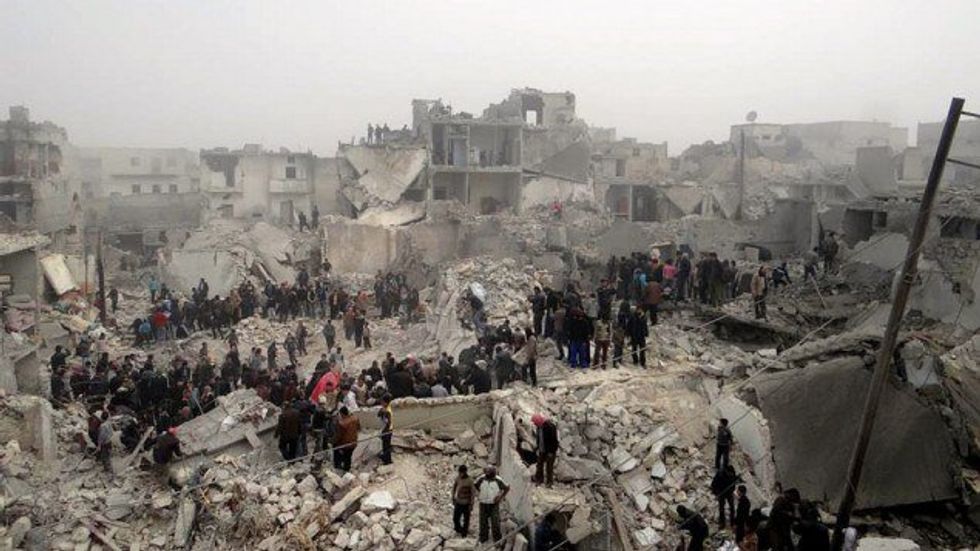
Since March 2011, there has been a civil war raging in Syria. The goal of the rebels is to oust President Bashar al-Assad from power. As of August 2015, the United Nations estimated that the death toll is now over 250,000 civilians. After two years of fighting, in August 2013, the U.S. State Department estimated that nearly 130,000 people, many of which who were innocent civilians, died in this conflict.
Our government became disgusted and considered military action because of one particular event that occurred in August 2013 -- the poison gas used to murder of approximately 1,300 villagers near Damascus. Why? Not, why did Syria’s government do this to its own people (which is horrible on its face), but why did the U.S. government only seriously begin contemplating military action after a poison gas attack against 1,300 people when 10 times that many had already died more than two years earlier? According to CNN, it was at this point that U.S. Secretary of State John Kerry and President Barack Obama indicated that they were considering taking more decisive action in the face of the poison gas attack. What were we waiting for? Why so long?
In response to possible military intervention from the United States, Bashar al-Assad then agreed to remove Syria’s arsenal of chemical weapons through a United Nations and Organization for the Prohibition of Chemical Weapons (OPCW) mission, which was completed a year later. Regardless of this mission, OPCW still reported that the Syrian government used toxic chemicals in attacks between April and July 2014. In northern Syria, the Islamic State has also been suspected of utilizing homemade chemical weaponry. The 2012 Geneva Communique was implemented in January 2014 after Russia, the United States, and the United Nations met in Switzerland to establish a governing body based on mutual consent in Syria. However, these talks did not last and ended in February 2014. According to BBC, the United States led a coalition of air strikes in Syria to “degrade and ultimately destroy” Islamic State in September 2014. Up to Oct. 11, 2015, there have been 2,473 U.S.-led air strikes in Syria according to the BBC Institute for the Study of War, U.S. Central Command.
My generation was raised with wars in Iraq and Afghanistan -- drones, roadside bombs, suicide bombers -- but now we have Syria, the noble land northeast of Israel, according to UNESCO. It is the home of perhaps the world’s oldest continuously inhabited city, Damascus, on the road to which Saul became Paul, and which most people think of as a Muslim country, but which has a significant Christian minority, and an incredible cultural history.
Well, in the face of all of this horror, the world has wondered what to do, tried to ignore it, tried to negotiate with the parties involved, all to no avail. But it wasn’t until those 1,300 people died in a government-led August 2013 poison gas attack (about 1 percent of total deaths in this conflict) that President Obama and several world leaders began to talk seriously about a “red line,” bombing the government forces, sending a peacekeeping force or something -- a need to finally act. Why then? What am I not understanding here?
Here is what I think I understand. Killing 130,000 men, women and children (basically fighting to oust a dictator who has killed and repressed his citizens on other occasions in the past) is apparently okay with most of the world, at least okay enough to not make it everyday front page news; that is,until poison gas became the weapon. Do you already see how insensitive the discussion can become?
How can 1,300 gassing deaths finally tip the scales for the world to consider acting after 130,000 deaths did not? Those 1,300 deaths finally brought threats of military intervention from the United Nations, the United States and others.
Did we not just say to the Syrian Regime, “Okay Bashar, we’ll back off of this discussion of bombing you, invading you and removing you from power if you just stop killing villagers with poison gas? Now, run along and go back to old-fashioned killing with bombs, guns, knives and missiles, and you can have another 130,000 bodies in no time, and we can look the other way.”
Haven’t we already proven that? Over 130,000 people died before the gas attack, and all we did was grumble. When 1,300 died from gas, the world screams about human rights, dignity and establishing democratic principles in Syria. To date over 4 million Syrians have fled their home country to seek refuge and over 7 million more have been displaced within their own country. Who is to decide that one form of mass killing is apparently tolerable, but another method crosses a line? The Syrian Observatory for Human Rights reported that since March 2011, over 11,000 children and 7,000 women have been killed. National Public Radio claims that this war has been most devastating for children in regard to not only the degree of death, but their basic quality of life.
Maybe we have a desire to witness a certain kind of war, one with lots of dismemberment, orphaned children and burned cities. A weapon such as poison gas somehow could change the possible outcome so that we do not get to actually witness the kind of war that our minds can grasp. We all understand the movement of forces, house-to-house combat, the slow rise of casualty numbers, to get the outcome we want. Gas changes all of that -- small budget, unpredictable spread of the poison, faceless victims, bullets become useless in that environment. The side with the most sophisticated weaponry might not win. The big military hardware and weapons companies can’t think like that! This is war! Submit it to any scrutiny. There is no fairness or cheating. It is beyond concepts of fairness or cheating. The goal is death, period, of your enemy, by any means. If you can’t or don’t want to do this, then don’t! The death of someone in June by a roadside bomb is no less a crime than a gas death in August. Death, by whatever means, was the goal. Should America or the world tolerate one more than another?
Let us not forget that in Cecile B. DeMille’s monumental 1956 movie "The Ten Commandments," the Angel of Death is portrayed as a green poison fog slowly creeping through the streets, killing the first born of all those who did not smear the blood of a lamb on their door. In the Old Testament, it was the last Plague that Pharaoh could endure before freeing Israel. Again I ask, “What am I not understanding here?” In the movie and children’s Bible stories, poison gas is the hand of God punishing evil. Perhaps Bashar al-Assad was only using a Biblical punishment, well-worn and time-honored. You know, they say the walls of Jericho fell to blasts of trumpets. Could musicians become war criminals someday? Isn’t that last statement of mine ridiculous? Is it more ridiculous than rising up to protest 1,300 deaths by one means, while being basically silent about 130,000 deaths by “approved” warfare?
It is perhaps too late to make anything good or honorable out of what the world has done, or not done, to stop the war in Syria. Acting because of 1,300 deaths by gas, has, in retrospect, devalued the lives of 130,000 who died by other means. And it was all by the same hand, for the same goal -- total domination of a country. But we cannot turn back the clock. Hindsight is always 20/20, they say. Had we acted earlier, the world would be a very different place. The big issue before us is how many more lives will be lost as we decide how we should act now, realize how we should have acted yesterday, and ponder if we should wait until tomorrow to act. Perhaps we have found the problem, and it is us.


















