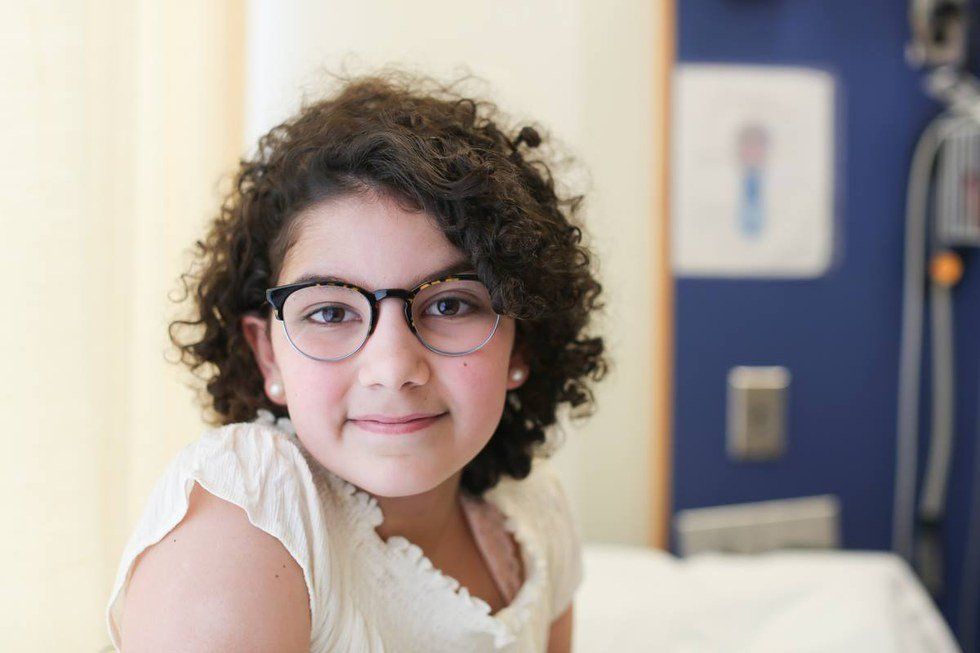
Brandon Stanton, the mind behind Humans of New York, has taken a couple weeks off from shooting in the streets of New York City to take photos and gather stories within the Pediatrics Department of the Memorial Sloan Kettering Center in New York City.
"Obviously, these are not going to be easy stories to read. These are war stories. The treatment of cancer can be nearly as violent as the condition itself, and even the doctors will frame their efforts in terms of warfare. But the fight against pediatric cancer is uniquely tragic because the battlefield is the body of a child. So these are definitely war stories," said Stanton, on a pinned post on the HONY Facebook page's timeline. "But as with every war, there are heroes."
Stanton isn't just doing this on a whim either. Just as Stanton did last year with a series on Syrian refugees, Stanton is using the popularity of Humans of New York to collect donations for a cause. With each HONY post on social media is a link to a Generosity page accepting donations for the pediatrics center. In 14 days, the fundraiser managed to collect over $2 million in donations, doubling the initial $1 million goal initially set on the generosity page. A link to the page can be found here.
Stanton's storytelling over the last two weeks at Memorial Sloan Kettering has followed children, their families, and the doctors. One such story told on Wednesday was the story of one Dr. Souwedaine, a neurosurgeon who has been researching a form of cancer known as DIPG (cancer that develops in the main center of the brain). In a four-part story, Dr. Souwedaine spoke of his innovative research on DIPG.
"From a surgeon’s viewpoint, the tumor is unforgiving. It infiltrates the brain stem. Everything your body feels or experiences passes through that stem. You can’t violate it with a knife. It’s futile to even think about. So I had to figure out how to insert a catheter into the brain and inject chemotherapy directly into the tumor. There is zero room for error," said Souwedaine via one the HONY's Facebook posts. Souwedaine has been researching DIPG since 1990 and has made progress to where one patient has lived 3 years past the diagnosis of DIPG, a significant feat given DIPG's past history of killing 100% of the children diagnosed.
Another story on HONY's Facebook page was a six-part story following a young girl named Grace, who was diagnosed with Stage 4, high-risk neuroblastoma, and her mother. Prior to going to Sloan, Grace's mother spoke of the doctors that were ready to give up:
"They told me: ‘We’re no longer treating her to cure her.’ In the beginning, they were so optimistic. They were telling me about all these options and all this stuff they were going to do. And now they were telling me to give up. And I’m looking at Grace. And she looks OK. She looks strong. She doesn’t look like the girl that I’m reading about in these medical charts. But they’re telling me to give up on her," said Grace's mother.
When they went to Memorial Sloan Kettering, they were given an option, an experimental antibody known was Humanized 3FB. After two rounds of physically rigorous treatment on Grace, they found that Grace's cancer was gone. "It had been everywhere: her pelvis, her skull, her bones, her arms. And now it was gone. All of us started crying.”
Grace has plans to become a pediatric surgeon, herself. "Being a pediatric surgeon will be hard because you never want to hurt kids. You just want to cuddle them and hold them. But saving them is most important so it’s something you have to do," said Grace.
The stories of Grace, Dr. Souwedaine, and many other families and staff at Memorial Sloan Kettering's Cancer Center can be found on HONY's Facebook page, and if you wish to donate to the generosity page, a link to do so may be found here.