
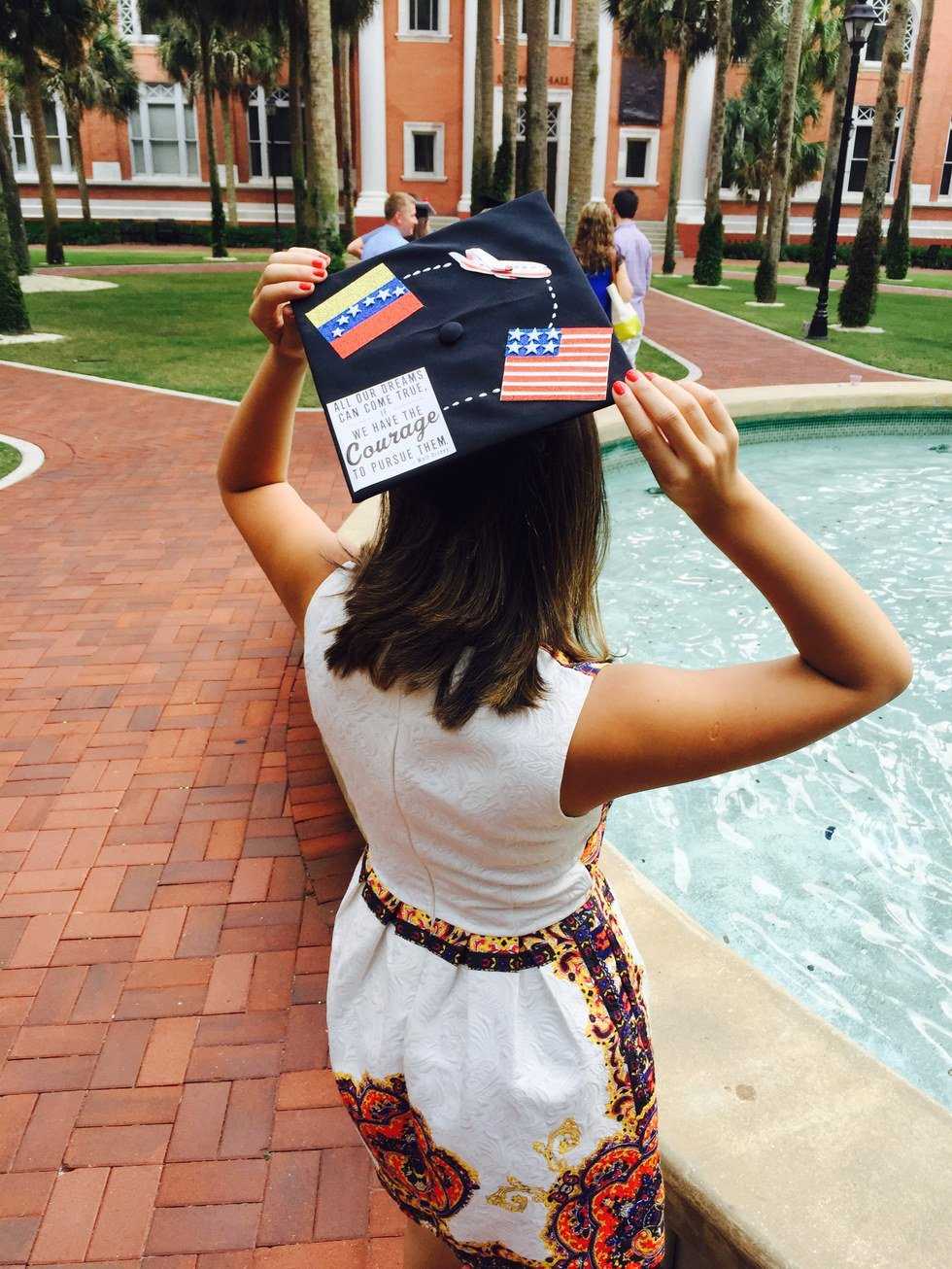
My Senior year at Stetson was the most difficult one because I was bewildered by all the opinions from family members, friends, and professors on what path to follow after graduating. I attended career fairs, had meetings with faculty, spent countless hours searching online. I found that going straight to grad school was a tempting option as it would allow me to continue having the all so familiar student life while deferring "real adult life".
Since I was clueless about what I wanted to do with my life, I also thought grad school would give me a clearer idea on which career path I should choose. My major was Finance and it seemed logical back then to do an MBA (though I wasn't even sure if I wanted an MBA in Finance, Econ, International Business, etc.). I personally went to different schools to learn about their programs, the cost, and the application process. I invested my time heavily in understanding everything I needed in order to start grad school ASAP; being an international student, I couldn't afford to do a sabbatical because my student visa was going to expire 60 days after graduating - my days in the country were counted.
Amidst all the rush, confusion, and stress I attended a conference held at the Lynn Business Center that was a game changer for me. On this conference, Stetson invited several guest speakers from renowned institutions and companies: Peace Corps, Yale University, the FBI, among others. There were sessions on different topics and the one that caught my attention the most, obviously, was titled "Is it OK to take a year off after graduating?" or something along those lines. The speaker was the director of admissions at Yale and I mistakenly assumed he was going to tell us we should have started the application process the beginning of junior year.
Much to my surprise, he actually prompted us to do the total opposite: he told us we should definitely take AT LEAST a year off after graduation to get hands on experience in the field we believe we're interested in. Once our zeal and passion is confirmed through that real life experience, we could pursue a graduate degree in such field. He told us the main reason is that college gives you an idea of what your industry is like only to an extent; you won't know if you'll be fulfilled with your chosen major until you start working at least six months (summer internships will give you a slight idea, but you won't have the mindset of "this is what I'll be doing my entire life" as you know is for a finite period).
The speaker told us another reason to hold off grad school is that, ironically, jumping straight to it may actually deter you from getting into a good school. As an admissions officer himself, he told us he prefers a candidate that doesn't necessarily have the shiny 4.0 but has had previous experience on the field of study over someone who has the best GPA but is straight out of undergrad. He even told us that a year doing community service or any other sort of valuable involvement will be a great resume builder for grad school application.
This session was an eye opener for me. It made me realize I needed to be confident I wanted to make Finance my career choice before rushing into getting an MBA. I switched gears and put all my effort in getting a job instead. Thankfully it paid off as I got hired by a financial firm one week after graduating.
Fast forward a year and a half and I am more confident than ever that waiting was the best choice I made and that doing an MBA right after college would have been a terrible mistake for me. I confirmed through my job what I suspected while I was at Stetson: my heart isn't in Finance. I understand it, I can certainly perform well, but it isn't my passion. I don't see myself doing it for the next 20 years no matter how well it pays off. Even though I would have been way more convenient to find out by working that Finance was the right field for me, I am grateful I have come to the realization it isn't at an early age. I am also grateful, I didn't invest more money and time to be in an industry I don't truly fit.
Grad school is quite a financial and time commitment and you should be as certain as possible (it's almost impossible to be 100% certain of anything in your 20s) your heart is in Finance, or Education, or English, or Psychology, or whichever field you've chosen. I can tell you from my own experience that doing something you are not completely invested in for eight hours a day is overwhelming and can sometimes feel unbearable. Grad school is an investment and you need to make sure the return won't only be a higher paycheck but also a career that gives you bliss. Go out there and explore your options, whether it is getting a job, going abroad, learning another language, anything that will add value to your life. Get to know yourself a little bit more and what you want to dedicate a lifetime- don't rush there's plenty of time!