
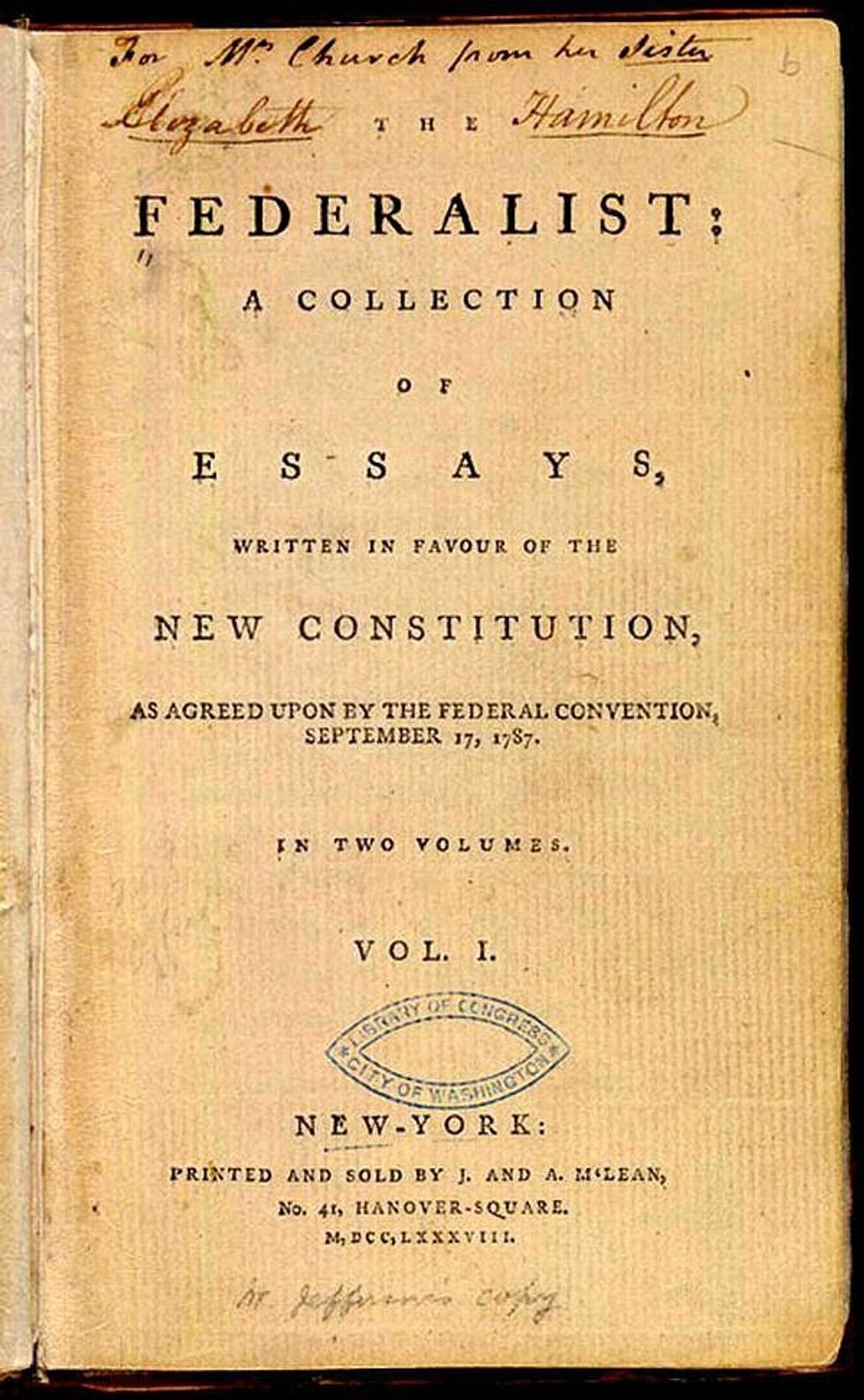
Once upon a time, in 1788, the United States Constitution was ratified. However, this ratification was no simple task. The country was being run by the Articles of Confederation, which ended up being a bit of a mess. In 1787, James Madison, Thomas Jefferson, Alexander Hamilton, John Adams, and a few others got together and wrote something that would hopefully last a bit longer and provide the people with a government that would protect and lead them. Once this document was finalized, the state delegates had to vote whether they were in favor of ratification or not. Nine out of thirteen states needed to vote in favor of the Constitution for it to go into effect nationwide.The Constitution certainly saw it's fair share of critiques, and not many people were in favor of it being the new law of the land. James Madison, Alexander Hamilton, and John Jay (another strong force in the writing of the Constitution,) got together to persuade the people to ratify this new Constitution. They wrote and published essays anonymously in the newspapers under the pen name Publius. These essays were titled The Federalist Papers. There were 85 papers in total, with Jay writing five, Madison writing 29, and Hamilton writing 51. In one of these essays, the largest danger to democracy was discussed.
In Federalist Paper #10, Madison writes about Factions. Factions can be defined as "a small, organized group of people with a common interest, usually within a larger group." Madison argued that factions could very quickly develop into majority factions, which is where the majority of the population is coming together to fight the government on an issue. This could lead to majority tyranny, which tends to be a terrifying concept for the founders. So, in Federalist Paper #10, Madison offers a solution. He states that we as a nation should encourage factions. I know what you're thinking: "This guy was nuts." Well, he actually had some pretty solid logic. Madison said that since factions are being encouraged, more will form, and they will likely be pretty small. The numerous, small factions will then fight with each other for power, instead of fighting the government. The essay that defined this plan ended up being one of the most important single-person written documents in American history.
It is somewhat easy to see how factions have developed over time. An easily recognizable kind of faction is an interest group. I personally have struggled with the difference between factions and interest groups, but in basic terms, an interest group is just a subset of a type of faction that is a group of people with a shared interest that has government recognition. Some examples of interest groups in America are the NRA and the NAACP. A good example of how factions have developed over time is American political parties. A political party is a large group that seeks to group together many smaller factions. This ends up creating what could be considered a majority faction. A party is a loose interpretation of a faction, since it is made up of so many smaller factions, and consists of people who don't necessarily agree with everything that the party represents. However, almost all people in America identify with a certain party with beliefs that they agree with, which is how factions form. Even if someone doesn't identify with any party, they end up being in the "Unaffiliated" faction.
At this point in time, factions are unavoidable, since they've been a huge part of how our government functions since the beginning. In modern times, parties essentially ruin Madison's plan for lots of tiny factions, since the parties strive to group many interest groups together for a common purpose. This ends up with a majority rule, and something that could very quickly turn into majority tyranny. Many political scientists question how Madison didn't foresee the forming of a two-party system. However, many people in America don't really mind having these huge factions. It seems inevitable that factions will form in a democracy. There has never been a democracy without parties, and vice versa. This raises the question of whether or not parties, and by extension, factions, are truly conducive to democracy, or are they a hindrance? There is no real answer to this question, so it becomes up to individual people's own opinions and beliefs.