Aside from humans, who have wrongly poached numerous animals such as the cheetahs, lions, giraffes, elephants, leopards, rhinoceroses and many more animals into endangerment and some cases extinction, hippopotamuses are the most dangerous animals in the continent of Africa.
When asked, most people would refer to a carnivore such as the king of the jungle (lions,) or perhaps a stealthy scavenger who has a bone-crushing bite force (hyenas) as the most dangerous animal in Africa. It is to many’s surprise that a cuddly-looking herbivore takes the crown for Africa’s most dangerous.
Humans study animal behaviors and instincts within the animal kingdom in order to understand and anticipate future actions done by animals. However, sometimes it is not so simple. According to the National Geographic, the extreme unpredictableness of hippopotamuses is one of the main reasons why they are the most dangerous mammals in Africa.
Animals, for the most part, show signs that they will attack, whether it is pointing their ears backwards, hissing, growling, or pouncing, and therefore other animals including humans know when to take cautionary measures in order to protect themselves. Without being able to make an educated prediction on what a hippopotamus might do next, it is never safe to be around one at any time.
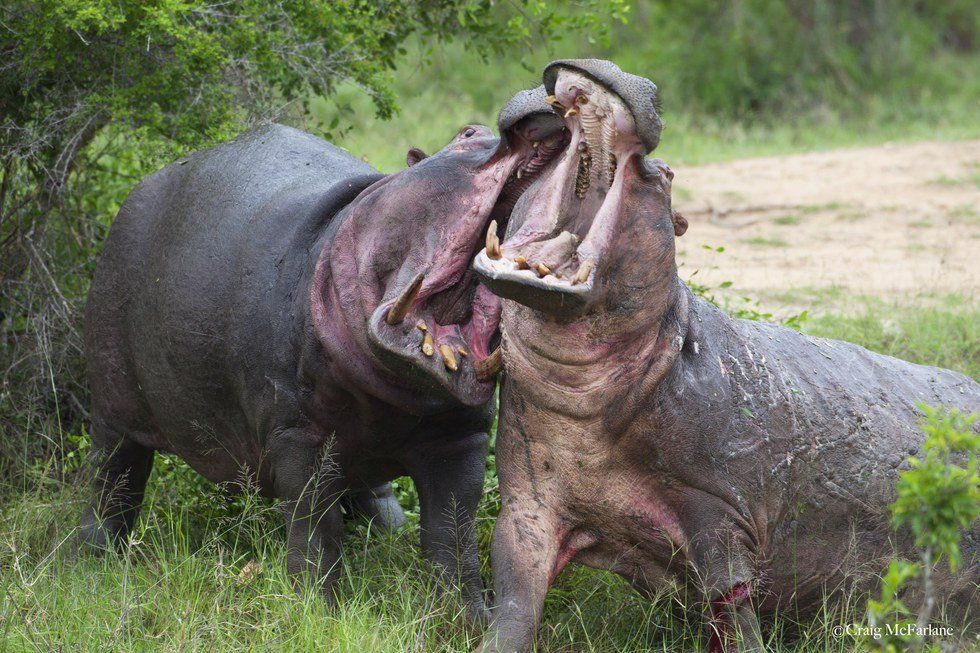
Much like almost any other animal, hippopotamuses are territorial and will attack if they feel threatened, or at any other time because they are so unpredictable. Once attacked, there is a near impossible possibility of surviving, for hippopotamuses can weigh up to more than 3,300 pounds, have impressive agility in or out of water, and bring two 20 inch tusks to the fight. In comparison, a lion only has 2.7 inch canines. With a bite force of about 1800 pounds per square inch, 20 inch tusks, and lethal aggression, the hippopotamus is almost invincible and unescapable.
Aside from their impressive adaptations that allow them to be such powerful and successful fighters, hippopotamuses "sweat blood." The red secretion is neither sweat nor blood, but rather a red mucus-like liquid that acts as a natural antibiotic and sunscreen while allowing their skins to be moisturized and healthy. Not only are hippopotamuses more than well-suited for wars in the wild, they are also equipped with the capability of fighting off the scorching African sun as well as bacterial infections that may result from the river water entering open cuts, or from another animal's mouth.
Considering how dangerous and powerful hippopotamuses are, are they the king of the African rivers? The answer is not so simple; while the hippopotamus will most likely overpower and kill a crocodile, crocodiles are much more evolved and fit for survival. Also, crocodiles are notorious for stealthy yet brutal attacks making them apex predators of the waters. Yes, there have been multiple cases where a baby hippopotamus was killed by a crocodile, but when both animals are mature, the crocodile faces little to no chance against the third largest land mammal.
A hippopotamus will experience little difficulty when killing almost any African animal (except grown elephants and rhinoceroses,) assuming that they are in combat, yet the Nile crocodile will always have their reputation as coldblooded (literally) killers and will be feared by all animals, except adult hippopotamuses.