“The characteristic of great innovators and great companies is they see a space that others do not. They don't just listen to what people tell them; they actually invent something new, something that you didn't know you needed, but the moment you see it, you say, 'I must have it.’” – Eric Schmidt
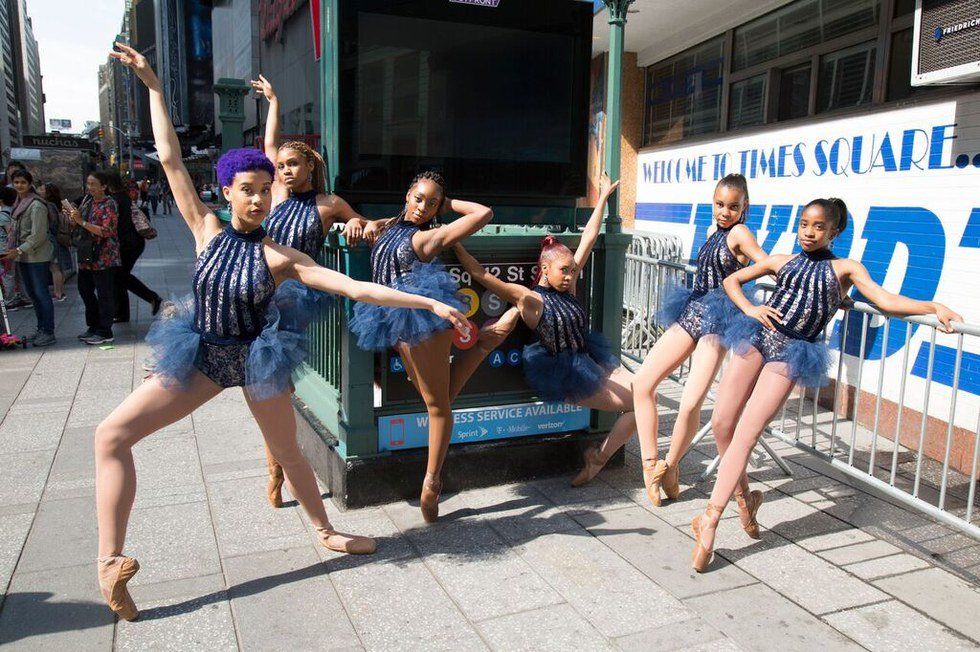
You’ve heard of hip-hop and ballet, but have you heard of Hiplet? Hiplet, created by Homer Bryant, innovative creator and founder of the 1990s Rap Ballet and Founder and Artistic Director of Chicago Multi-Cultural Dance Center (CMDC), combines hip-hop and ballet dance techniques to create a new, innovative style of dance. Hiplet is a trademarked, non-traditional pointe class held once a week at CMDC to supplement the students' classical ballet training. Each student vying to take Hiplet classes must take a minimum of four to five classical ballet classes per week along with pointe technique classes and must audition for acceptance into the Hiplet beginner and advanced classes. Currently, 25 dancers participate in Hiplet classes each week under the direction of Homer Bryant himself using hip-hop and traditional ballet terminology along with Hiplet’s unique terminology.
After over 70,000 views on YouTube, Mr. Bryant and his Hiplet dancers, who are between the ages of 12 and 17, have performed on ABC and additionally will be making more appearances on major TV shows in the near future. “We typically have had four to five interviews per day and receive calls daily from Hollywood producers,” Mr. Bryant stated enthusiastically.

Upon being asked about negative press, Mr. Bryant said, “Here is the thing about haters. You are the first to do what you are doing. They can’t do what you can, they are jealous of what you have and they wish they had it.” He reiterated his view by adding that those who wish to dance, experiment in new styles of dance, or even create new choreography and fuse styles of dance should “Do it for your dreams. Don’t let anyone stop you. Work hard, be hungry and want to do it. If people say you shouldn’t, say 'watch me' internally and just smile at them. Then do it and keep smiling the entire time.”
While some maintain that dancers, dance teachers and choreographers must keep classical ballet alive, others argue that innovative ideas such as Hiplet will keep the art form alive by bringing in new audiences and appealing to people who may not relate to ballet’s art form which substantially reflects its medieval origin. Mr. Bryant noted that as artists and members of society we must open our eyes to new ways and avenues of doing things. He pointed out that we are not living 800 years ago when ballet was created; we need to connect ballet’s old-fashioned technique to the present age, 2016, and to the people living in this era. One way CMDC does this is by allowing students to wear skin tone tights to class. Mr. Bryant explained that allowing his students to feel comfortable in what they wear has improved their self-esteem as well as allows them to work without feeling self-conscious constantly adjusting and looking in the mirror. “Many of the kids come from school and are excited to put on their skin-tone colored tights rather than pink tights because they feel more comfortable in them.”

New York City professional dance teacher and expert pointe shoe fitter, Mary Carpenter, agrees with Mr. Bryant’s claim about the role of innovation in the evolution of ballet and allowing the art form to stay alive and relevant to today’s audiences. “Ballet was created and performed in French and Italian courts with people like Catherine de’ Medici and Louis XIV in the late 17th century. Without new avenues like Hiplet connecting this generation of dancers and audience members, the art form will die. Today’s audiences did not grow up around courts, kings and queens and simply cannot easily relate to classical ballet.” Ms. Carpenter also noted that her students could correct their posture and alignment better if she tells them to “stand up as though you are proud of yourself and own the sky” rather than to “stand up as though you are a king or queen." She noted correcting ballet technique by using modern visuals and descriptions helps dancers to better understand, relate and grasp the corrections given.
Ms. Carpenter additionally commented on several remarks provided by viewers of the most recent Hiplet videos concerning safety. Specifically, these commenters stated that performing hip-hop moves performed on pointe would damage dancers’ ankles, feet and other areas of the body. “If anyone else originated and taught this style, I would be a bit concerned. Knowing Mr. Bryant’s fabulous training, that he is very educated in dance as well as movement, and that he understands the importance of strengthening for dancers especially those who do pointe work, I see no issues with it. As long as Mr. Bryant believes they are strong enough to perform this technique safely, why not?” She later added, “I view pointe shoes not as toys but as instruments much like a violin. The violin has been pushed in a new direction with the introduction of electric violins. If this can be done with violins, pointe shoes can be pushed in a new direction with Hiplet.”

She also noted that one way to look at the new technique is to look at the Hiplet dancers’ use of the pointe shoe as a tool in order for the dancers to perform certain movements and “tricks." Ms. Carpenter went on to explain in tap, dancers do toe stands on their toes or “pointe” if you will, and that additionally in La Fille Mal Gardée’s Clog Dance, the dancers use clogs as a tool to go on pointe to perform various steps. “Mr. Bryant is taking the pointe shoe and pushing it in a new direction, which is interesting to see.”
Ms. Carpenter commented that Hiplet, as well as every other technique, has had its supporters and haters. “Innovators always have a blowback and then afterwards hit the ground running down a new avenue. When Igor Stravinsky’s "Rite of Spring" was released, it created a riot in a Paris theater then became a world renowned ballet.” She noted Hiplet in a similar way is something completely different than what people may expect – it is not classical ballet. It has many haters but also many supporters and has become a style recognized by people around the world.” She additionally noted that Mr. Bryant is not calling Hiplet classical ballet; therefore, viewers of his work should recognize it as a unique form and view his work with an open mind.”

For More Information:
Homer Bryant, Hiplet and Chicago Multi-Cultural Dance Center (CMDC): www.cmdcschool.org
Donate to the new "Hiplet Sensation" by clicking here!
Mary Carpenter:
Ballebrity or Dance with Mary NYC.
For Mary Carpenter's pointe shoe fitting videos please click here.
Special thanks to Homer Bryant, Chicago Multi-Cultural Dance Center, and Mary Carpenter.