Question 5: “So, does God want us?”
For the last few weeks, I’ve discussed the existence of a God. Now, however, comes a bit of a paradigm shift. This week and the next will entail a discussion of how to enter a relationship with God.
I know many nonreligious are wondering, Why would He want a relationship with the likes of us? We’ve established that he exists. We must now see about if he cares—and just the crazy detail with which He crafted the very universe.
To answer this, we must go back to another article in this same series. Earlier, I discussed the teleological argument and its implications. However, there is far more to the story about my experience with the said argument. A few years ago, I once saw a video on YouTube, posted by a Christian organization called Reasonable Faith, in which they talked about the fine-tuning of the universe. this article will be concerned more with the ethical and interpersonal consequences of the ideas in the video. How this specifically pertains to you will be discussed in a more precise manner next week.
The fine-tuning of the universe is a massive process which cannot be underestimated. The video talks about the gravitational constant and the cosmological constant, two numbers which control the expansion of the universe, as well as almost everything that happens on it. It has been empirically discovered that, if these constants were off by a mere 10-60 or 10-120, respectively, the universe would either expand too quickly or too slowly, preventing stars from being able to form, preventing the existence of habitable zones, and, therefore, life. Scientists such as Stephen Hawking remark at the data, expressing nothing short of awe Says Hawking, “The remarkable fact is that the values of these numbers seem to have been very finely adjusted to make possible the development of life.”
The video proceeds to offer three theories for the existence of these values, the first being necessity. The universe, supporters of the theory say, must have been designed for life because there was simply not an option. In other words, this is just the way things are, and there is no other way they could be. This theory is flawed insofar as it assumes that a life-hostile universe is impossible. This could not be further from the truth: there is a very large chance that, in fact, the universe could not support life, and more than 99.9999999999999999999999 percent of our own universe—far more, in fact—is decidedly inhospitable. It didn’t have to be like this.
The second theory is chance. Obviously, the natural chances of this happening are, statistically speaking, zero, so this theory’s proponents believe in the theory of the multiverse. There is essentially a universe factory somewhere, and its job is simple: to create universe after universe after universe. Surely, they say, one must support life. But some essential problems arise: to create life, the factory itself needs fine-tuning, and there’s no empirical evidence that such a machine exists. And even if it did, most universes would not be nearly as large as the one we have—they would be small, large enough to accommodate a single observer (read: any living thing).
So, we are left with the third option: design. The universe was created as it is because someone—or something—wanted it that way. More scientist quotes and Bible verses, and the video ends.
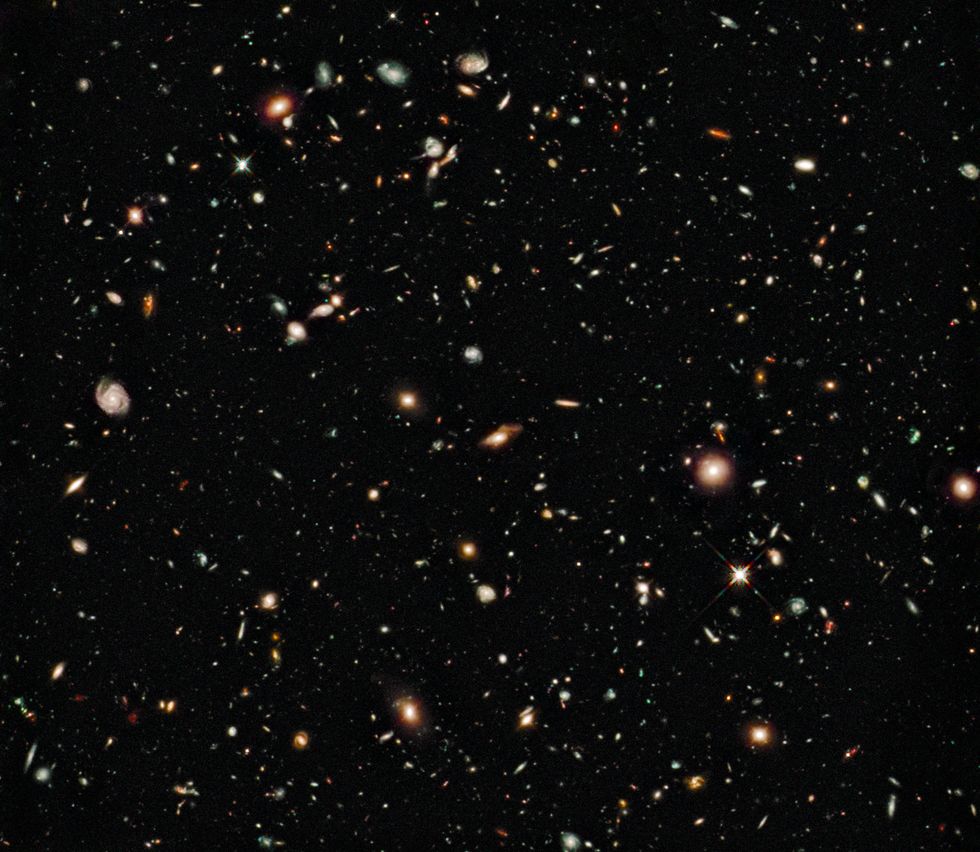
But what does all this have to do with relationships? It’s simple. Remember how I said just how small our Earth really is? What if the universe was created simply for us as a demonstration of God’s glory—to remind us that he cares? The God who cares about the universe surely, at least on a societal level, cares about us. God wants us very badly, so why would you ever pass up the opportunity to get to someone madly in love with you?






 man running in forestPhoto by