Question number two: “If God is really this powerful, where is the evidence?”
This question is central to any argument concerning theism vs. atheism. Many religions, especially Christianity, regard God as a being who created the universe. The creation stories run the gamut from the absurd histories of polytheistic religions to evolutionary biology (some religious people believe it).
Yet, for many, the evidence is just not there in the natural world. But I already talked about that in my last article. How, they ask, can a world so bad exist if there is a good God, as most religions have it? The next article will talk more specifically about that, but for the time being, we’ll discuss some arguments for God’s existence.
This topic alone could merit several articles of its own, but since I only have so long to write, I’ll do that later. At any rate, the argument that God has been an intelligent creator has existed for hundreds of years, with medieval theologian St. Thomas Aquinas positing that “[w]e see things that lack intelligence act for an end….Therefore some intelligent being exists by whom all things are directed to their end, and this being we call God.” Of course, this was before empirical reasoning, but that does not mean that Aquinas was an imbecile by contemporary standards. Quite the contrary. Even in our heavily digitized, post-religion, post-truth era, he would be one of the most influential figures among Catholics, and even non-Catholics like myself. While I personally loathe everything about Catholic theology, I cannot deny that these are truly impressive words coming someone who lived even before the Renaissance. In fact, even the early church Fathers, many of whom, though committed believers, thought largely in terms of Hellenic philosophy, were impressed enough by the order of the world to make similar claims.
Finally, there is also the concept of the Inference of Best Explanation, which reads like so: “If H is the best explanation of the observed facts, then it is rationally obligatory to believe that H is true, even if there are other, reasonably good explanations available.” Essentially, H here is the existence of God, and the observed facts are the evidence for the existence of God.
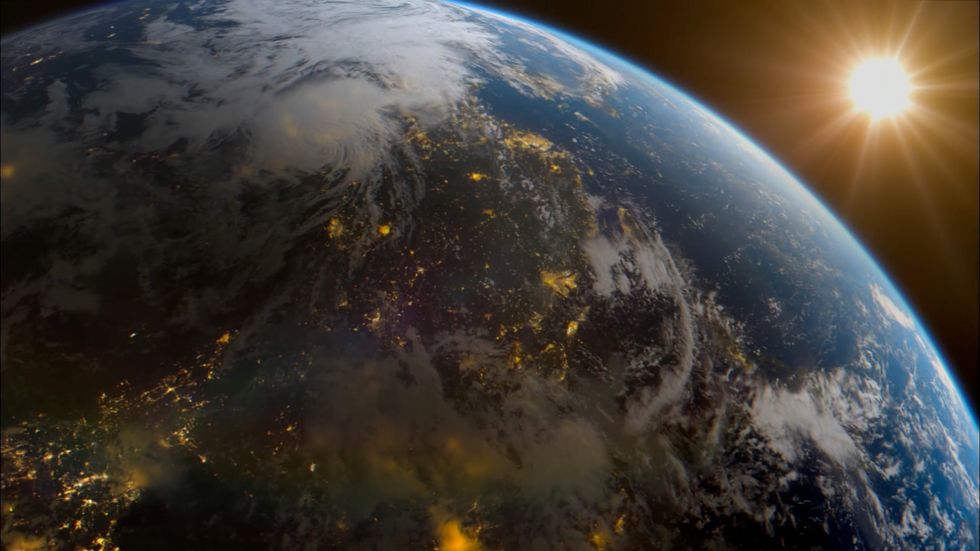
I am going to leave you with this: imagine if your name were perfectly spelled out in a hedge. Do you think that just happened? Or do you think someone made it? That’s the way it is with the universe, our beautiful universe, filled with everything—stars, supernovae, planets, meteors, trees, plants, fungi, crustaceans, protists, archaea, bacteria, continents and much, much more. Not to mention everything we ourselves have created—boats, cinema, computers, X-rays, light bulbs, firearms, sports, robots smartphones, automobiles, empires, cities, dams, arrows, bombs, typesetting and more. There’s just too much around us to have come about randomly, so if we chalk it all up to darkness, what’s the joy in that?