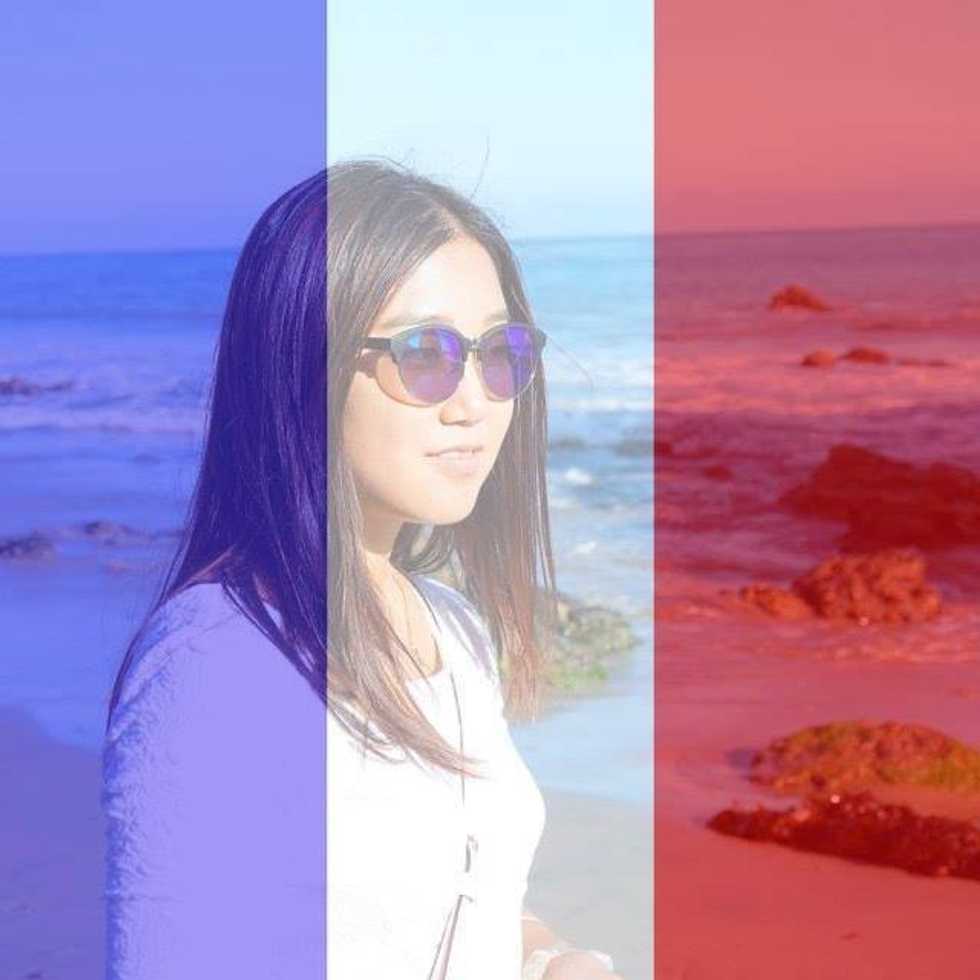
In the past two days, I have seen so much red, white, and blue in the form of the French national flag that it would put 4th of July decorations to shame. Every other post on my Facebook news feed seems to be a new "friend" changing their profile picture to that of a translucent French flag sitting on top of the picture they had. It's not a bad thing to take part in this widespread trend of adding stripes to your picture, but know that there are implications that follow.
Showing support for an event, cause, or distress is always welcomed. That's the beauty of social media. Within minutes of an event, the entire world can know about it; things spread like wildfire. Within hours of the explosions and hostage situations in Paris, France, a Facebook campaign started, to show support and solidarity with France against terrorist attacks. It wasn't just Facebook, but also Spotify and the Sydney Opera House that sported projections of the French flag. It's truly amazing how widely and rapidly solidarity can spread around the world in the 21st century.
However, solidarity isn't the only thing that the flags are signifying. The wildfire that is all of the temporary profile picture changes is also a sign of the profound power of social media. With great power come great responsibilities. One of those responsibilities is to educate ourselves. It's one thing to change your profile picture; it's another thing to actually keep up with the aftermath of the attacks, and to even know that another attack happened a day before Paris, in Beirut.
A double suicide attack Thursday left at least 43 people dead and over 300 injured in what has been the biggest attack in Beirut for years. The attacks took place during a popular shopping district during busy, rush hours. After the first suicide bombing, Adel Tormous, a civilian standing nearby, died tackling the second suicide bomber. And where are the Lebanese flags on Facebook?
"Monuments around the world lit up in the colors of the French flag; presidential speeches touted the need to defend “shared values;” Facebook offered users a one-click option to overlay their profile pictures with the French tricolor, a service not offered for the Lebanese flag. On Friday the social media giant even activated Safety Check, a feature usually reserved for natural disasters that lets people alert loved ones that they are unhurt; they had not activated it the day before for Beirut.
'When my people died, no country bothered to light up its landmarks in the colors of their flag,” Elie Fares, a Lebanese doctor, wrote on his blog. “When my people died, they did not send the world into mourning. Their death was but an irrelevant fleck along the international news cycle, something that happens in those parts of the world.' " (Anne Barnard)
Barnard's article in the New York Times is titled "Beirut, Also the Site of Deadly Attacks, Feels Forgotten." The article goes on to elaborate on the tensions between the Sunni and Shiite groups that had resulted in a series of bombings about a year and a half ago. Barnard concludes the article with a direct quote from Facebook's vice president for growth, Alex Schultz, who explains:
There has to be a first time for trying something new, even in complex and sensitive times, and for us that was Paris,” wrote Alex Schultz, the company’s vice president for growth, adding that Safety Check is less useful in continuing wars and epidemics because, without a clear end point, “it’s impossible to know when someone is truly ‘safe.’”
Showing support for tragedies such as the attacks in Paris and having good, positive intentions is something to be encouraged. Many of the youths on Facebook changing their profile pictures, though, aren't aware of the other tragic attacks occurring in the world, such as in Beirut and in Kenya, where four gunmen of the group Al-Shabab opened fire in Garissa University, killing 147 (mostly students) and when cornered in a dorm room, eventually detonated themselves through suicide vests they had on. In light of the recent shooting threats and evacuations of students of color at Mizzou, the assault at Garissa University resonates with me, as I am a college student.
If, in a day, or in a week, I were able to approach all of those who changed their profile picture with the flag overlay, many of them, perhaps a majority of them, would not be able to answer questions about the aftermath of the Paris attacks, wouldn't know that there was an attack in Beirut just a day earlier, and wouldn't have thought to go beyond only the nations that American institutions and corporations choose to publicly support. Social media may be powerful, but it is also very impressionable. Facebook didn't choose to make SafeMark available until the Paris shootings happened. The temporary profile change feature only offers the Paris flag overlay. It's so easy to get caught up into the bandwagon that we forget the reason why we took part in the first place.
The objective of adding the French flag overlay is to publicly show support and awareness of the event, and the effect of social media is to spread that awareness and increase exposure. If we really want to make ourselves aware of current events, however, we should realize the responsibility to go beyond Paris and actively take a part in reading articles about global news, and maybe stick around to see the consequences of the aftermath. The thing is though, there's no one to blame for the single-mindedness of Facebook and its administrators. Facebook made a socio-political comment when they didn't offer SafeMark for Lebanon or when they only offered the French flag; their actions speak to the political dynamic of developed nations only caring and having sympathy for other developed nations.
As powerful as Facebook and other social media outlets are, there is also a level of superficiality that cannot be ignored just due to the nature of rapid, explosive spread of information. But maybe we can use that to our advantage. One of my good friends on Facebook overlaid their profile picture with the Kenyan flag. It definitely caught my attention and caused me to get on Google, searching "Kenya attacks." We can go beyond just what Facebook offers us, and harness the globalized power of Facebook. We can share information that we actively have sought after, and spread awareness of true depth. We can start more conversations than just those about Paris, which is still important but is only one drop in the ocean.
With each click made toward adding a French overlay onto a profile picture, we lose a click being made to open Google to search for "recent attacks/tragedies." There's more to do than to be swept away by the superficial bandwagon that is temporary profile pictures. Just the fact that Facebook calls the overlays a "temporary" profile picture speaks for its own flippancy. I was curious to see how this "temporary" picture worked, and when you click on the "Try It!" button, Facebook gives a few options for the time duration: one hour, one day, one week, or never. (And of course, because of the societal guilt we'd feel for only showing support for an hour, I imagine that maybe people choose the longer options.) Social media is magical in the sense that the Arab Spring quite literally began because Twitter, Facebook, and YouTube existed. As I mentioned earlier though, big power also comes with big backlash.
I don't condemn or negatively judge anyone that has changed their profile picture; I hope that they will all take active steps to become aware of the equally tragic and terrifying events happening around the world. We are capable of more if we get off the speeding bandwagon, take our time, and walk along with others.
If you are interested in adding an overlay of a national flag of your choice, such as the Japanese flag to show support for the recent 7.0 earthquake, here's a link to the website where you can find (almost) any flag of your choice: LUNAPIC. Shared by the friend that added the Kenya overlay.