
Young girls have been told for years they can be anything they want to be. But the question is: has Mattel gone too far?
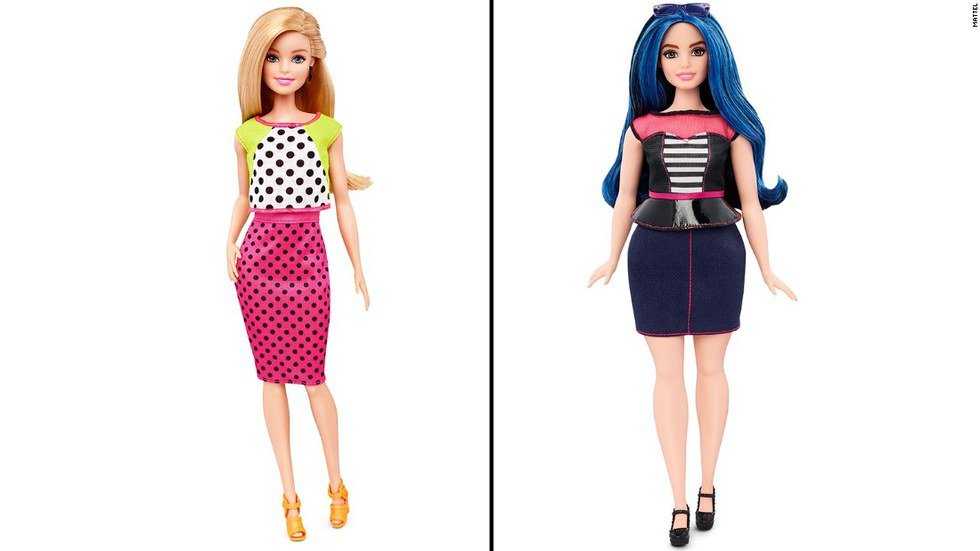
After sixty years of tradition, Mattel changed the iconic body of Barbie. The “Curvy Barbie” debuted January 2016, accompanied with a whirlwind of controversy. Arguments have risen regarding the new Barbie’s abduction of innocence in childhood as well as its emotional effects on young girls. I believe the Curvy Barbie phenomena is simply unnecessary.
Dolls are designed and bought with the intention to be used as an object for imagination and play, rather than for the discrete physical attributes. Parents should not promote companies that focus on the image of their toy more than the ideas they are intended to create in children’s’ minds. Introducing such a heavy adult social issue at too young an age will potentially cause children to start thinking about their body image and may ultimately lead to eating disorders and body insecurities later in life.
Interactions between girls with the new Barbie and those with the traditional version may result to bullying. Imagine a pair of 6-year-olds during a playdate; one with the original Barbie and the other with the newest. They may or may not notice the difference between their dolls right away until they attempt to share clothes, as they would ordinarily do with the traditional Barbie. Due to the aerospace tight design of the plastic clothes and completely different body shapes, sharing outfits is impossible. As the blonde one tries to squeeze her modern doll into the slick purple blouse of her red-headed best friend’s hand-me-down Barbie, she will be questioned why she has such a plus-sized doll. Instantly, a barrier is created between the girls instead of facilitating imaginative and cooperative play. After the playdate, the blonde six-year-old will predictably beg her mother to buy her a new wardrobe for her Curvy Barbie in order to prevent the same situation from reoccurring. Time Magazine conducted a study similar to this playdate and concluded, “These are kids who are barely out of kindergarten, and they already know that the thicker Barbie is the odd one out." In this example, the only party profiting here is Mattel.
Worse, Mattel’s modernization of Barbie promotes childhood obesity. In a study that experimentally tested the effects of playing with thin dolls on body image, “The most important finding was that girls who played with the average sized doll ate significantly more than girls who played with a thin doll." The new campaign wrongly focuses on body image rather than playtime and imagination.
It is disappointing that, during this time of global terrorism, war and political elections, Barbie apparently feels the need to be politically correct. Founded in 1959 for Baby Boomers, Barbie has remained as an icon of youth’s innocence and playtime as the chosen doll for little girls’ imagination around the world. Adding other “Barbies” unnecessarily changes Mattel’s entire company image and tradition for no discernible worthy social purpose.
The decision to actually purchase the Curvy Barbie is as controversial as the doll herself. Parents may try to use the doll as a social learning experience and force their child to play with her. On the other hand, some adolescents could mock the world’s newest Barbie. The later was found to be true in a Time Magazine focus group experiment. When placed into an empty room to play with the Curvy Barbie, the group of girls called the new Barbie “fat" or “a little chubbier," and even “often undressed the curvy dolls and laughed at them."
Barbie’s iconic presence in our society gives Mattel a large voice that can be heard worldwide. Since the addition of the Curvy Barbie in January of 2016, Mattel has lost credibility as a role model for young girls. The Curvy Barbie introduces body image issues to children too early in their lives. She is supposed to be an object for their imaginative play, not a symbol of childhood obesity.