It’s a heartwarming story, I guess: young girl with a messed-up face and years of childhood trauma beats out her evil stepsisters for the hand of an all-powerful, invisible guy. Yet, as I sat on the carpet, examining patterns comprised of the bright, primary colors so often associated with children, I couldn’t help but feel dissatisfied. Why, I wondered, would the girl want to be married to a see-through boy who uses a rainbow as his hunting bow? Shouldn’t that mean he’s a giant made of air or something? They couldn't even kiss!
In my mind, a relationship between an invisible spirit and a young girl made no sense— especially since the only reason they were together was that she saw the invisible man all of one time. I just couldn't understand how the other members of my first grade class could enjoy reading The Rough-Face Girl, when it didn't even make sense. In my opinion, it was more stress than story. But the class didn't just enjoy the book, they loved it, and Mrs. Becker read us The Rough-Face Girl about ten times in the space of a month. It was all anyone seemed to want to hear.
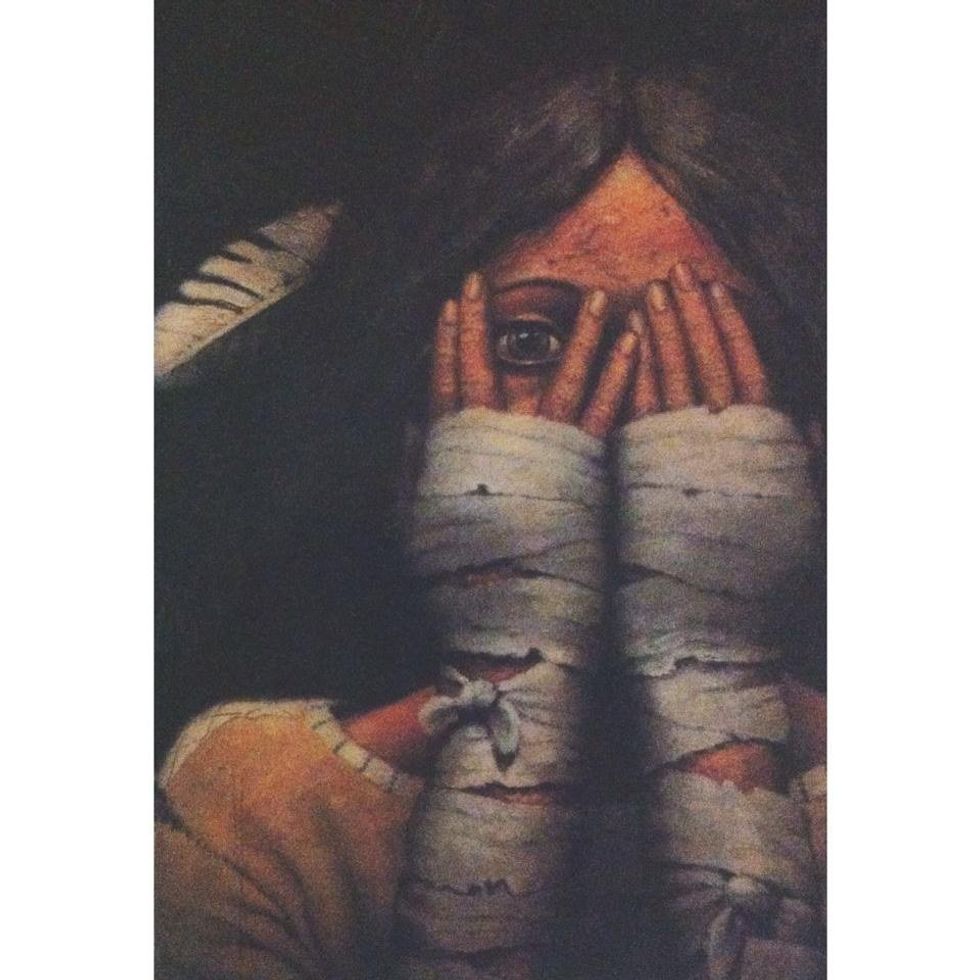
Throughout that month of storytelling, I listened to the story of the Rough-Face Girl more intently than anyone. I found where the book was kept, recognizing it’s cover with the illustration of a Native American girl, bandaged hands covering her face, a single eye peeking out from between her fingers, and I examined the pages every chance I got. It wasn't long before I figured out the book had an author, Rafe Martin, and that the story was not even his own idea, but supposedly based off of Cinderella (which would’ve been fine, if the story had been any good). My teacher, noting my obsession, must have assumed I was even more in love with the story than the rest of my class, but in truth, the more I learned about it, the more upset I became.
Rafe Martin, I thought, is a crackpot (or at least, that’s what I would’ve thought if “crackpot” had been within my vocabulary). My issue with The Rough-Face Girl was that I felt there were holes in the plot— the Rough-Face Girl and the Invisible Being had no real names, no real relationship, and it seemed to me, no real benefits from being together. Readers were supposed to be happy for the characters when they got married, but there just wasn't any point in feeling any way at all. Never in my life had a story caused me to feel this unfulfilled, this completely void of any feelings toward the characters, happy or otherwise. Thus, I blamed the author. This was the first time I ever engaged in any form of literary analysis, but more importantly, this was the first time I realized some writing can be bad.
Who cares about bad writing, though, right? Take any other little girl’s life as an example, and realizing some stories are better than others would’ve been no big deal; in fact, it’s a realization that probably goes unnoticed for just about everyone, blending in with all the other facts of life. For me, however, the discovery was earth-shattering. I will clarify that my discovery did not change my entire perspective on writing, make me strive for excellence or anything else of the kind, but from first grade on, I examined a whole slew of things I had never taken a second glance at in the past. A good story, I realized, was more than just a happy ending.
While teachers were trying only to help us understand the plot of stories, navigating from beginning, through middle, to end, I started to focus on more. I paid special attention to the descriptions and the characters, and most importantly, how to make things “make sense.” I already knew that a story needed conflict and resolution (everyone did, seeing as the teacher told us about a million times), but slowly, I began to figure out the millions of other things that writers need to build stories that “make sense”. While teachers showed us grammar, structure, vocabulary, and spelling, I realized that good writers rarely follow every rule to the letter. When they showed us how to properly use quotation marks, I also wanted to learn how to write realistic dialogue. I didn't just want technical skills because I had seen that good writers more often spend their time crafting strong emotions, vivid scenes, and characters who are somehow more real to me than my own mother. Yet, as I tried harder and harder to crack the code, few others even seemed to notice it was there. Ironically, like the Rough-Face Girl, I began to see what others did not.
Martin’s is not the worst story, I guess: young girl with a messed-up face and years of childhood trauma beats out her evil stepsisters for the hand of an all-powerful, invisible guy. Seems kinda sweet. But it’s not really anything special. Looking back, if that story hadn't bothered me as a kid, I actually don't think I would’ve gotten anything out of it. I wouldn’t have learned any life lesson, that’s for sure (except maybe to marry a stranger). Yet, here I am, analyzing writing, striving to get better, seeking constructive criticism, reading and learning and actually pursuing writing as a career. All of it at least partially due to the fact that I read a fairytale I didn't like when I was eight. When you think about it, it’s comical; for years, I’ve been working towards good writing, striving for my own happy ending, gaining distance from the Rough-Face Girl so I can eventually live my dream— and all along, that book has been guiding me towards my invisible man.