I’ve always been fascinated with mental illness. A desire to learn more about the biological underpinnings of mental illness was one of several factors that drew me to neuroscience. I learned about their mechanisms, like how anxiety and mood disorders can occur when cortisol is not properly regulated, or how schizophrenia may be caused by overstimulation of dopamine receptors in the brain. These explanations were good for rationalizing the characteristics of these disorders, and they were sufficient for scientists to develop therapies for these illnesses. Even so, they leave one major question unanswered: why do mental illnesses occur? If mental illness is caused by chemical imbalances, what causes the chemical imbalances?
As far as biological explanations go, one of the more popular explanations for why mental illnesses occur has been genetics. At the surface, it makes logical sense; if genes are responsible for the machinery that regulates the chemicals in the brain, and if mental illnesses arise due to problems in this machinery, then genes should cause mental illness. I assumed this without question for some time until I came across a book by Harriet Washington, Infectious Madness: The Surprising Science of How We “Catch” Mental Illness. In this book, she presents a compelling counterargument to the once popular genetic theory. When looking at diseases with established genetic causes like Huntington’s disease (caused by inheritance of a dominant allele for the disease) or Down syndrome (caused by having three copies of chromosome 21), the rates of incidence among identical twins is nearly 100%. The rates of coincidence for conditions like bipolar disorder or schizophrenia, however, are significantly lower.
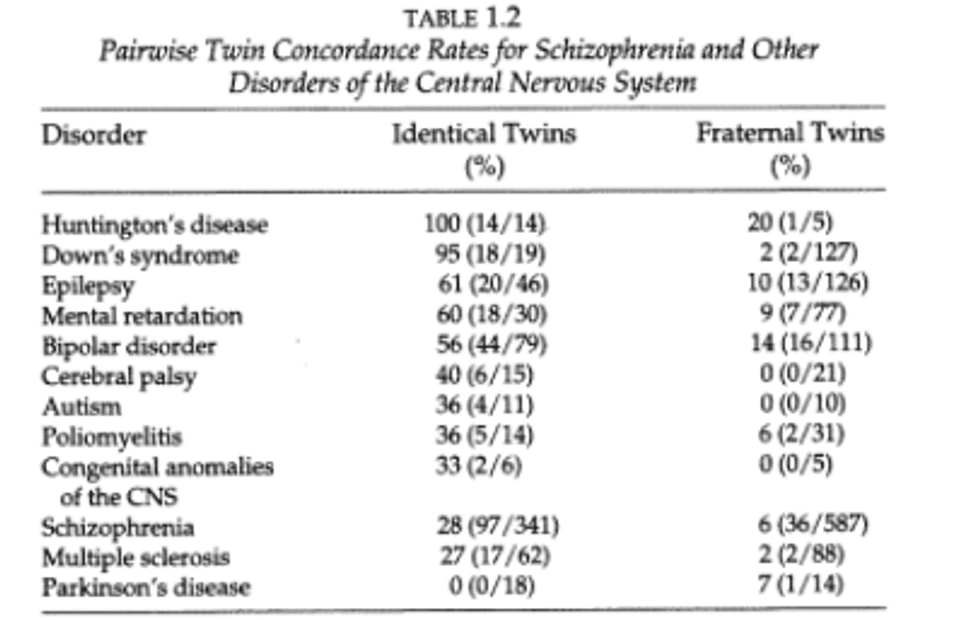
Source: E. Fuller Torrey, Ann E. Bowler, Edward H Taylor, and Irving I. Gottesman. Schizophrenia and Manic-Depressive Disorder. New York: Basic Books, 1994.
This determination aroused the interests of many neuroscientists. If one’s genes are supposed to be the reason for mental illness, why does it only affect just one identical twin and not the other? If the instructions for one’s biology aren’t to blame for the brain’s chemical imbalances, what is?
Well, the hypothesis explored in Washington’s book is that bacteria and other microscopic creatures may be implicated in the development of mental conditions. The idea is that mental illnesses could be caused by a bacterial presence or lack thereof. There are many studies that have examined this link. For example, Schizophrenia could be caused by a T. gondii infection, according to a study published in Emerging Infectious Diseases by Torrey and Yolken. The study explains that schizophrenia may occur when a child is exposed to the pathogen during the perinatal phase of its development, which includes the weeks leading up to and immediately following its birth. This infection can lead to issues later in life by depleting the number of glial cells, which help support and nourish neurons, and causing abnormal concentrations of dopamine and other chemicals in the brain.
Another example touched on in the book was the idea that the bacteria present in one’s gut can play a role in the development of mental illness. As explained by this article in the Scientific American by Jessica Fortner, the brain and gut have a codependent relationship in which the brain helps regulate the immune system’s affairs in the GI tract while the gut’s bacteria synthesize the chemicals used in various neurological processes. This relationship is explored in a plethora of studies, including one by Hoban et al in Neuroscience, which found that rats showed depressive behaviors, reduced spatial memory, and other significant behavioral changes following an antibiotic treatment, which depleted the bacteria in their gut. Without the gut bacteria providing the brain with some of the chemicals it needs to carry out its functions, the rats began exhibiting abnormal behaviors.
Despite the evidence building up in favor of a microbial basis for mental illnesses, it’s difficult to say for sure that we’ve found the answer to the question of why mental illness happens. There are other well-established theories; for example, there is a well-supported theory that epigenetics may be to blame for the development of mental illness. That is, there’s nothing wrong with how the biological “instructions” are printed on the page, but how they’re read and interpreted by the machinery that reads them (think about how an ink blot in the middle of a sentence can change the way you read it). Furthermore, it’s very much possible that the true answer lies somewhere in the middle of these theories, or perhaps in another theory or combination of theories. Additionally, even if this theory explains mental illnesses like anxiety and mood disorders, it might not explain why people develop personality disorders. Nonetheless, the development of these theories provides hope to many people. To patients, these theories could someday bring an end to mental illnesses; to neuroscientists and neuroscience students like myself, these theories take us further in our eternal hunt for an understanding of how our minds work.