
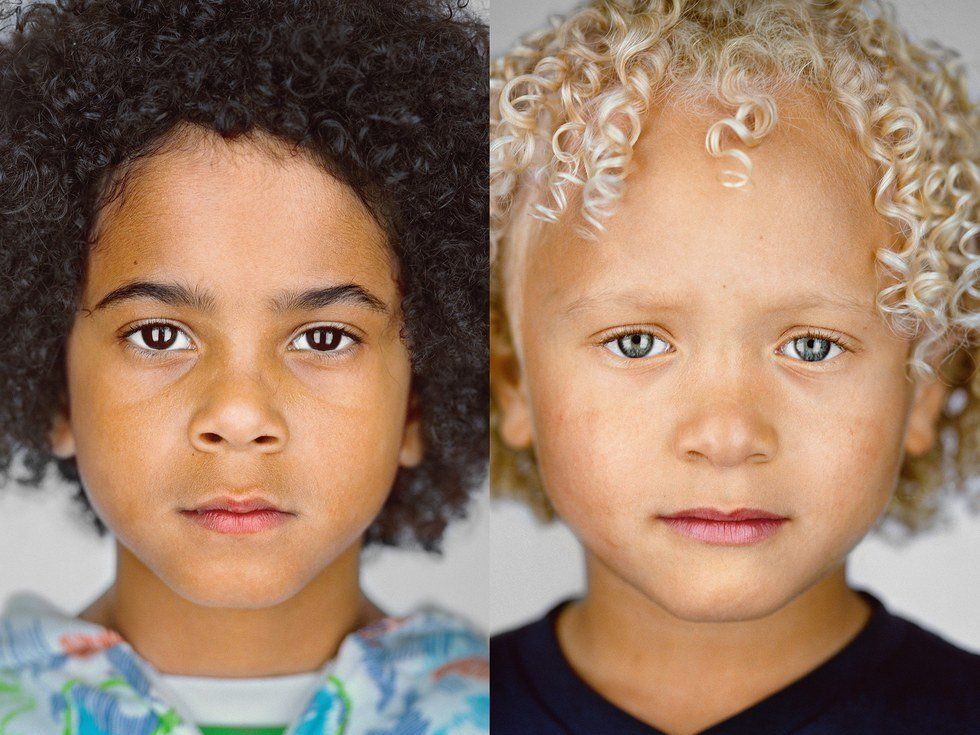
If you've been on any form of social media in the past week, you've probably seen the nostalgic Tweets about #growingupblack that have since sprung into an insane number of different hashtags, all representing people everywhere bonding over their childhood experiences. I first saw screenshots of #growingupblack Tweets on Tumblr and fell in love with the idea. But when I scrolled through the hashtag on twitter, something hit me. #Growingupblack wasn't necessarily something I could relate to despite being black. Well, not completely black. I'm mixed race; my mom is Caucasian and my dad is African American. It was that realization that has made me see just how different my experience as biracial has been. And since my revelation, #growingupmixed has also made its way to Twitter -- but that doesn't mean I'm not going to put my two cents in.
For me, #growingupmixed meant that I was stuck between two races. I was too white for those who were black and too black for those who were white. My whiteness became a characteristic of embarrassment as I was asked at so many family gatherings if I "had any black friends yet." But on the other hand, going out anywhere with my mom's family meant I stuck out like a sore thumb and was assumed to be adopted more times than you'd think. I was called an "Oreo" constantly at school, where telling me that I was "basically just white" was offered like a compliment. #Growingupmixed, I did not come to terms with my own identity. I navigated between the two, too uncomfortable to talk about race.
And even after 20 years of living with this identity, I'm still trying to understand what my race means to me. And as racial tensions throughout our country heighten every day, this journey becomes even more difficult. It has become more and more apparent that, to many, the lives of black people do not matter. Such a cold realization makes you think. Yes, I am biracial -- but to those that surround me, is there only a half of me that holds any worth? Does my blackness make me less desirable as a friend, sister, partner?
If there's one thing I've learned as a student at a liberal arts university, it's that race, biologically, does not exist. It has been constructed over many years, and it is constantly evolving. And while saying that "race doesn't exist" might seem to solve the problem, it doesn't. Race is very real to many people. It was real when, as a second grader, I was told by a classmate that he didn't like me because I was black. It was real when my hall-mate told me I only got into William and Mary because I was black. And, more importantly, it is so incredibly real to the men, women, and children who have been unjustly murdered because of the color of their skin.
Talking about race makes a lot of people uncomfortable, but for a lot of other people it's an expect of themselves that has defined so many important moments in their lives. If you find yourself wondering why something as seemingly trivial as someone's complexion is so important to them, it might be time to consider what their lives may have been like #growingupblack, mixed, Hispanic, or otherwise.