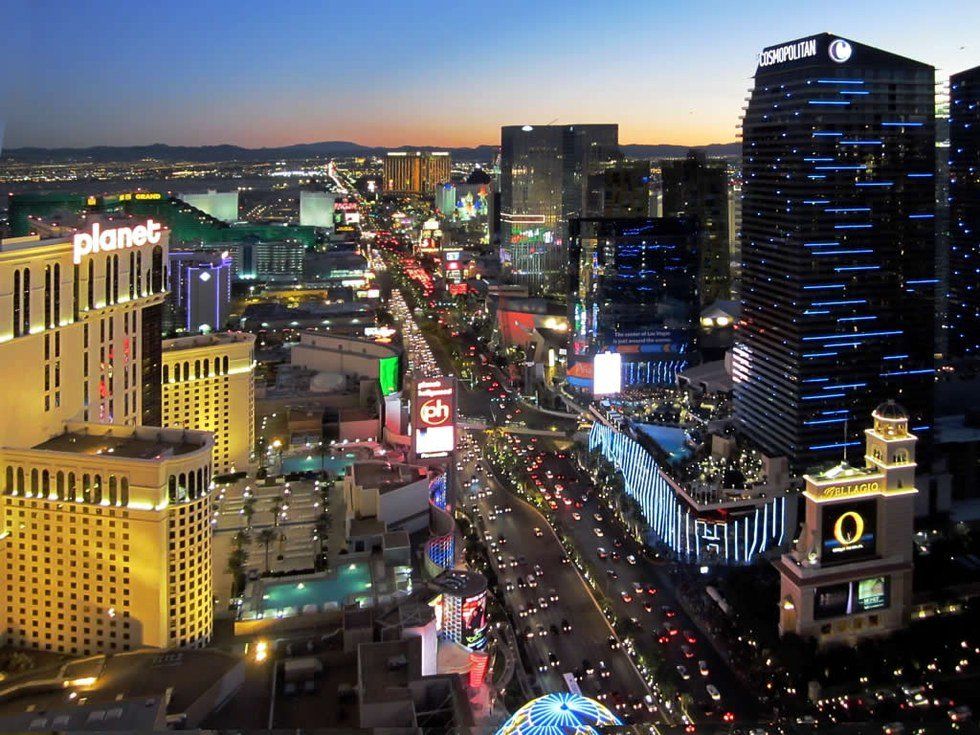
I'm one of those crazy people who actually lives in Las Vegas. I was born there, I grew up there, and oddly, it's my home.
When I see the blinding lights in the darkness, coming in from Arizona, California, or Utah, I always get excited and I know that I'm home. I remember peering out the window at the Strip with my older brother while my mom sped down the freeway in our booger-stained, frumpy green four-door Honda thinking that I'd work in The Castle one day. I would point my stumpy finger at The Castle aka The Excalibur Hotel telling my mom again and again that I'd be a princess there (my brother favored The Pyramid aka The Luxor Hotel). She would just laugh, playing along with my fantasies.
I had no idea what went on in those shiny, oddly shaped buildings for the longest time. I thought every place had Eiffel Towers, Stratospheres, Luxors, Excaliburs, and MGM Grands until I got to the fourth grade. My teacher, Mrs. Dougan, taught me some real Nevada history and the whole idea of a saloon and gambling. I suddenly understood how the city I lived in was unique. I suddenly grasped the concept that I lived in "Sin City."
Come middle school, I wasn't too happy with where I lived. I hated having to go see a movie or eat at my dad's favorite buffet inside smoky casinos. I hated the Thunder Down Under and Playboy billboards, the gigantic neon beer signs from the freeway, and the line of smog that outlined every casino and hotel. I hated being in an "adult playground." I didn't understand why I had to grow up with every social wrong duct taped to my eyebrows and dangling in front of my face 24/7 like the omnipresent neon lights downtown. I didn't understand it as a city or as a home, and I wished to be that innocent girl in that filthy Honda again.
I came to understand it eventually. My dad had a job there. My mom had a job there. That’s what made it my home--their jobs. I wanted more reason though: why this putrid, hot city? Well, I was told, my great grandpa on my dad’s side migrated here from the Phillipines, and my mom’s family had always lived in the Vegas Valley. My family has history tied to the concrete asphalt jungle of Las Vegas. That’s what it means to be and live and call a place your home--a certain history to cement you into some iota of the space you occupy, the sky and trees you see everyday walking down the street. You feel a belonging, an ancient urge to remain.
I grew to appreciate Las Vegas. I’ve been away for nearly six months. It’s the longest I’ve been away from that city, and to be in a different country and to see different neon lights and stoplights has taught me that home, for me, will always be Sin City. And yes, I hate that it stands as a microcosm for the corruption of capitalism, but it’s my home.
One thing I’d like you, reader, to understand about the concept of home is that you don’t have to acknowledge the place you grew up, the house, flat, street, or the suburb that lingers in your mind as a part of you, but you will always be a part of that place. You’ll see glimmers of your childhood peak through your dreams and maybe out of the corner of your eye, you’ll see the sun, so piercing, so familiar, under which your four-year-old self played with your blonde-haired brother. When you go to a new place, when you “make yourself at home” in a place other than your original “home,” they’ll always be that lacking feeling tugging at your pinky finger, like your mom’s hand while crossing the street, the electric spark of something absent but wholly tangible.
That’s the memory of yesterday. The overwhelming sense of belonging that you don’t feel anywhere else but your designated “home.” I’d like to think I’ve found home here in New Zealand. I’d like to think that I could belong somewhere other than Las Vegas even though I was born smack dab in the middle of it at UMC Hospital. Maybe it doesn’t have to be this spiritual essence that invades you and makes you feel like you’re home. Maybe it’s just a bunch of glorified déjà vu.
Smithsonian Magazine writer Verlyn Klinkenborg states, “Home [was] as usual. That [was] the point—home is a place so profoundly familiar you don’t even have to notice it. It’s everywhere else that takes noticing...a place we can never see with a stranger’s eyes for more than a moment.” You can only ever see how deep your concept of home is by leaving it and coming back to it, and I’m scared that the Las Vegas I knew before leaving it for six months has altered in some way, but I’m also scared to go back to the usual, the dull, the familiar. And yet, there’s TED Speaker, Pico Iyer who states, “home, really, has less to do with a piece of soil than with a piece of soul,” which means that perhaps my home isn’t Las Vegas. My homesickness has nothing to do with missing the city I grew up in and all the strings attached to it, but rather the part of me dedicated to it. That’s too metaphysical though.
We all latch onto something in our lives to ground us, and for me, I appear to have latched onto the city I once despised, Las Vegas. Like Iyer, I am mixed race. I don’t belong to my Anglo-Saxon European ancestors and their associated countries on my mom’s side and I don’t belong to my Filipino ancestors and the Philippines on my dad’s side, and now that I’ve lived in a different country, I certainly don’t feel I belong to the United States. I do feel that Las Vegas is a city I’ll always associate with my childhood, with growing up and sweating in the hot sun, but I don’t want to live there forever. I’ve become the person I am living in that city, and saying goodbye to it six months ago was the best decision I could have made. Now I have to return to it, and assume my old lifestyle, but it won’t be the same. My home won’t feel quite as familiar, but it’s important that I keep that feeling in my heart. I have to keep the city and all its lights close so that I never forget my childhood, what I owe to my parents and that city for defining who I am.