


I recently decided that my concentration for my creative writing major (my other major is German) would be poetry. The funny thing is that I have read very little poetry for a self-proclaimed poet. With that being said, the poems that I actually sit down to read carefully tend to stick with me. One of my favorite poems is Rudyard Kipling’s "The Betrothed."
Kipling is most widely known for being a racist asshole. While generalizations are usually wrong, this one is not. Kipling was,in fact, a racist asshole. His most enduring poem, "The White Man’s Burden," is testament to that. I’m not trying to convince anyone that Kipling was not racist. Instead, I’d rather call attention to the few ideas that have endured in the last century. "The Betrothed" is one of a handful of his poems that remains relevant in a modern discussion, not for its capacity as a historical artifact, but for the ideas that are still applicable today.
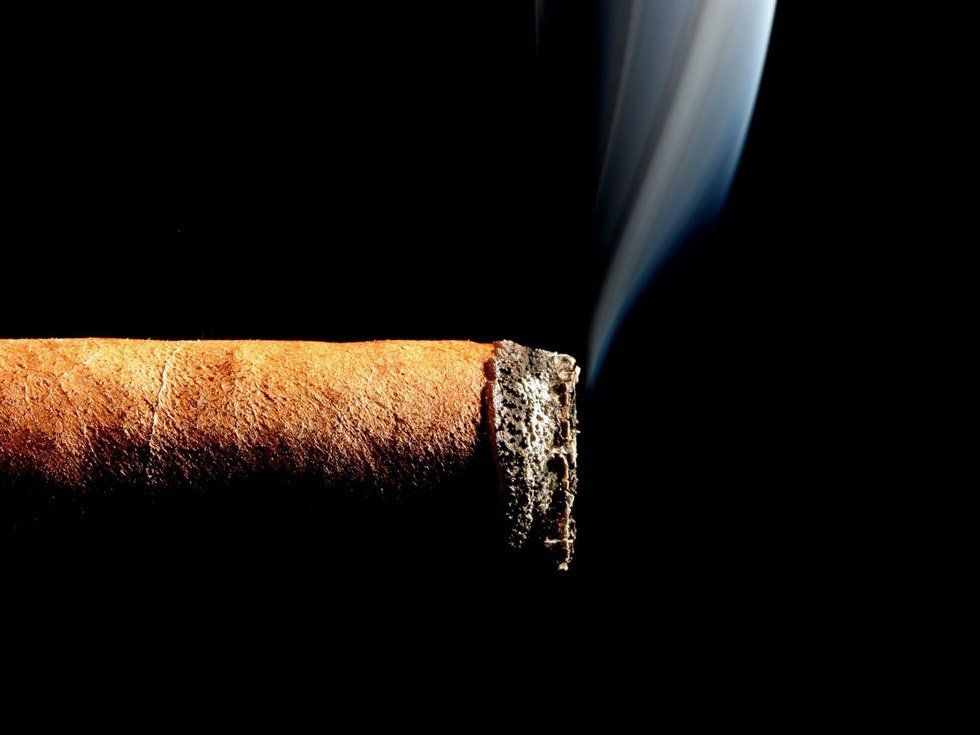
I will admit that the message Kipling attempts to convey in "The Betrothed" is not what drew me to it. The poem contemplates the beauty and ritual surrounding cigars, a subject with which I could not agree more. In short, the narrator of the poem contemplates the ultimatum that his fiancé has presented to him. He must choose between his future wife, whom he loves, and the cigars, which he perhaps loves even more. My brief summary here does little to capture the dilemma the poem presents. It is better just to read the poem.
http://www.poetryloverspage.com/poets/kipling/betr...
Ultimately, the narrator chooses his cigars instead of his future wife which initially reads as cowardly or superficial. Some critics may disagree with me, but I find the conclusion beautiful. Instead of bowing to the pressure of a romantic partner, the narrator decides to stand by the things he loves ,and that make him who he is. Through the poem, Kipling stresses the importance of maintaining one’s individuality even in a relationship. I think this is an important lesson for today’s generation.
As the dating world becomes more warped every day by Tinder and the other by-products of hook-up culture, more individuals seem to be altering their persona on the internet or in person in the name of romance or one-night stands, typically through the omission of a "guilty pleasure". The phrase “guilty-pleasure” seems like a relatively modern concept. This may be speculation, but I doubt that there was such a thing as a “guilty-pleasure” in Kipling’s day. Cigars were simply a source of pleasure, but I digress.
The important distinction in "The Betrothed" is that the narrator is aware that love is always a possibility. Our generation has lost sight of this. Modern dating seems to have polarized into two separate camps. There are those individuals deeply entrenched in hook-up culture for whom love has become an afterthought. In the opposite camp are the individuals fixated on “one-ness”, the people who have succumbed to the Hollywood notion of “the one”. The former group seems to disregard the idea of love. The latter places to much emphasis on it. However, both groups are almost too comfortable with the idea of altering their persona in the name of lust or love.
Kipling’s pivotal line of the poem is “a woman is only a woman, but a good Cigar is a Smoke”, and is the only line I can actually recall off the top of my head. The major pitfall of my generation’s idea of romance is the sheer value we place on romantic entanglements. Casual Daters look to one-night stands for a boost in self-esteem. The “One” Seekers desire relationships because they believe that a partner will give them a sense of purpose. Both romantic camps make the mistake of looking for personal satisfaction in other people which is why "The Betrothed" is an important work for our generation to study. It stresses the importance of individuality in a way that modern works do not.
Romantic comedies and sit-coms have over-sold the idea of love, partly because it is easier to write a scene with two people rather than one. Modern media is too concerned with the idea of love. If a scenario like the one seen in "The Betrothed" were to occur in a sitcom, the beauty of the conclusion would be lost. The protagonist would be faced with the same dilemma, but would ultimately choose their significant other over their hobby or vice. The couple would happily embrace each other, and the studio audience would respond with a cheesy “aww.” This scenario has doubtlessly been used on a number of sit-coms in the last thirty years, and has, in-turn, contributed to many toxic notions about love.
The issue with the generic outline above is the normalizing of romantic manipulation. The last thirty years of television has created a climate that accepts the concept of guilting one’s significant other into giving up something they enjoy. If partners are supposed to be equal in a relationship, this idea should not be acceptable. Not to belabor the point, but this is why "The Betrothed" is especially applicable to our generation. It casts love in a slightly more realistic light.
Essentially what this whole article comes down to is the unrealistic expectations we have about love. Somehow in the last century, it became acceptable to manipulate one’s partner. We are both content to settle for less, and to demand the ridiculous. We have been taught that romantic love is more about the other person than one’s own self. This is why the poem has stuck with me for the last few years. It served as a reminder of what a relationship should be. One should never lose sight of what makes them an individual for the sake of a relationship.

















