
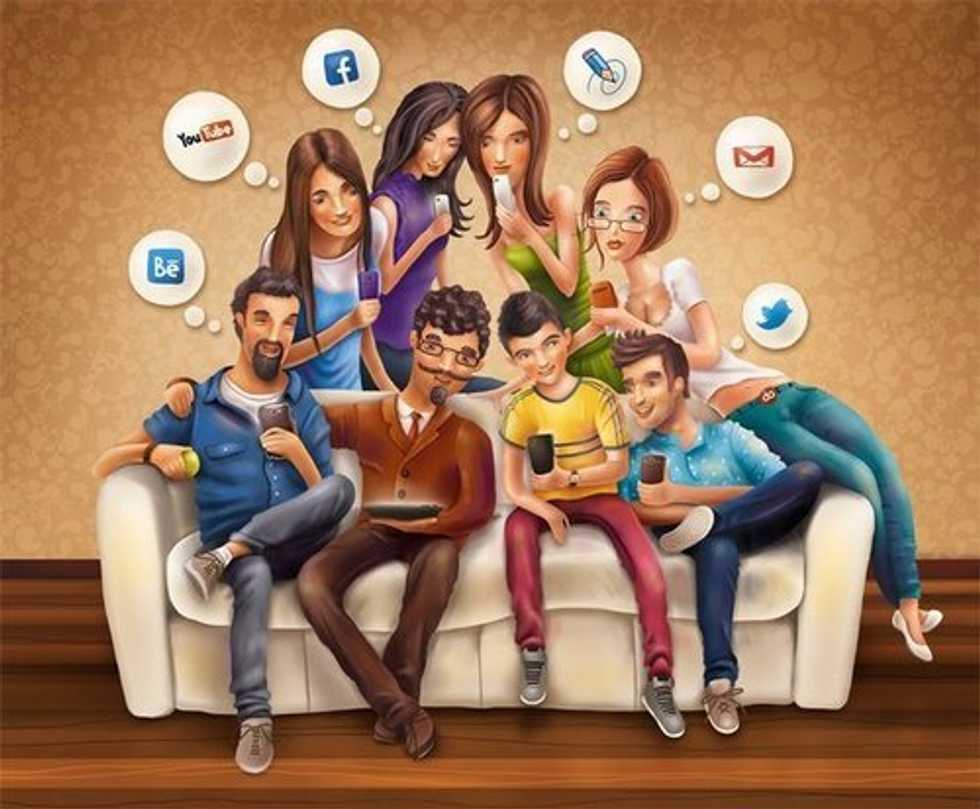
Social Media: what is it?
I really mean that.
How exactly do we define the term “social media” in an age where platforms are edited and remade weekly, and new, popular platforms are popping up every month? With continual innovations, expansions and adjustments being made in order to fit the needs of an increasingly inattentive client base, is there any way we can truly trap down a definite definition of “social media”? More importantly, where are we headed as a species, as a result of this continuum?
To begin, I should say that I do not hate social media: rather, much the opposite. Upon thinking of the possibilities, I get a warm feeling in the chest: there seems to be a great hope somewhere in the far away future, that the numerous contradictory ideologies, which have now infested every country the world over, could perhaps one day come to reconcile their differences thanks to these better systems of communication. The internet, in my opinion, is exactly the sort of powerful communication system which the oppressed and underprivileged masses have been waiting for: I just hope we can learn how to use it freely, and correctly.
Social media sites tend to center around text, image, video, apps, sales, and a variety of other personal and private interactions. Generally, these sites earn revenue by allowing companies to post targeted, consumer-specific ads on the sides of their webpages, or even within the main “timeline” of the site. In simplest terms, the main objective of social media for a user is the sharing of information between different people, all over the world: which (considering our 7,400,000,000 worldwide population) adds up to some serious storage space.
Like, an incalculable amount of storage space.
Literally. The amount of stuff we have on social media alone is, at this stage of our technology, far, far, farfarfarfar beyond the realm of any sort of precise calculation. Considering the huge amount of information which is being processed, uploaded, and downloaded every second over social media, as well as the extremely private nature of most social media sites’ storage facilities, it truly is impossible to know how much information we as ordinary social media users are putting out into the ether of the internet every second, of every day.
But what is it exactly we are putting out there? Well, a whole bunch of stuff: from resumes, to our opinions, to our snazzy shots of foodstuffs (and of course, a myriad of other stuff): the common denominator seems to be that the content’s nature is usually presented public forum style, but with much more personally inspired information. This can be for both good and bad: both for humanity and for vanity.
Though I do not hate social media, I do find it rather easy to criticize its shortcomings. And I could give you the same dull speech you have heard again and again, from skeptics and luddites alike, that social media is nothing but poison in the veins of our once great society. I could go on and on about how social media is nothing but a mirror reflecting our own vanities: how, as Bo Burnham observed in his recent, brilliant stand-up show, Make Happy:
“Social media, it’s just the market’s answer to a generation that demanded to perform. So the market said, ‘Here, perform everything to each other, all the time, for no reason.’ It’s prison. It’s horrific. It is performer and audience melded together.”
The reason one could conclude any of this with even a hint of certainty is because it is happening everyday: constantly, both consciously and unconsciously, right in front of our scanning eyeballs. People post for lots of reasons: to provoke, to tease, to sympathize, and to mourn. Two common traits between all of the posts are that they represent an attempt, whatever the intention, at connecting with other people: whether through inclusion, or alienation. At the same time, because of the short format of most social media sites, posts end up being, at best, nothing more than abstractions of reality; and, at worst, become recycled dogmas which play off our lust for individuality in a way so total, that the person posting is unable to see their own bias.
For many years, I saw myself as relatively well-aware of my surroundings, a solid eye for my own wrongdoings, and the will to correct them if need be. Recently, though, I have begun to realize that social media has made me acutely aware of my own extensive ignorance and vanity; my own hypocrisy. I have shared the same posts as millions, in what were at the time valid attempts to show solidarity, but which came at the cost of isolating others: other people I had probably never met. I have reposted posts, crafted by other people with other motives, which I thought would represent me in exactly the right way. What I'm trying to say is that I think we post in order to impress others; to antagonize others; to get people to try and see us a certain way. And while this is not necessarily good or bad in and of itself, it does pose problems when we ask the question, 'How can we pursue egalitarian ideals if we cannot even refute one another's points without using insults?'
This is something I feel we have been using social media more and more for: the art of attempting to destroy another group’s solidarity in pursuit of our own group’s solidarity. I have had very strong words with both friends and strangers over social media: people I would not have spoken to so strongly if the conversation were in person. And all of this (at least I thought) in an attempt to better the world!
And I think that’s because social media is easy like that: it is easy to pick apart a 250 character Tweet or a 10 line Facebook status: it would even be easy to pick this very article apart, for it is nothing more than a page of letters and punctuation marks. It is easy to believe you are bettering the world by posting about how bad something or someone is: it is easy to believe that someone is a worthless pile of garbage because of a few Facebook posts they made. It is easy to believe anything if you mistake social media for reality, because it is not reality. It is something illusory.
People are not happy all the time, as all of their pictures may suggest. Just because you see someone repost a quote from a famous person doesn’t mean they have actually heard of said person. And just because a person is posting that they believe the vanity of social media is poisonous, doesn’t mean they won’t go right off and share this article with their friends on their very own social media page (Yeah, you; Monsieur hypocritical author. I’m looking at you).
Okay, so you’ll be glad to know, we made it through the depressing part. Now on to the more hopeful stuff, and then to end somewhere in between.
I think that the benefit to social media, as I have discussed with friends, and mentioned earlier in this article, is its innate ability to connect distant social groups, across any distance, instantly.
After about 150 years of innovation, what one person now says in Beijing at 10:01am can be heard by an American at exactly the same time (10:01pm) in their home country. Seriously, I don’t care if you grew up, and have lived all your days alongside the internet: that feat is absolutely deserving of the term, incredible.
Though I see less of these exciting aspects of social media’s potential being put to use, I definitely do see it in places. I believe that the group organization abilities of sites such as Facebook and Gofundme allow us (in the distant future) a serious possibility of advanced international movements of solidarity. There are human rights sites which are doing great work: news has the ability to be delivered much quicker, as well as mail and other important information. We have the ability to use onion browsers to hide our online identity, and to avoid targeted advertising and the tricky “filter bubble”. And, perhaps most exciting of all, we are bearing witness to the birth of internationally accessible sites for free education, such as Khan Academy, DuoLingo, et. al., which have the potential to bring about a serious change in international literacy rates and general consciousness.
This massive potential for social media, its potential to revolutionize the plight of those less fortunate, to spread information, to tear down misconceptions, has hardly been exercised. From what I see on Twitter, Facebook, and from what I myself generally do with this magical gift known as the internet (aka, generally Netflix, FB and chill), tells me that, at present, we are beginning to misuse something potentially species-saving, at a very vital time in our history.