
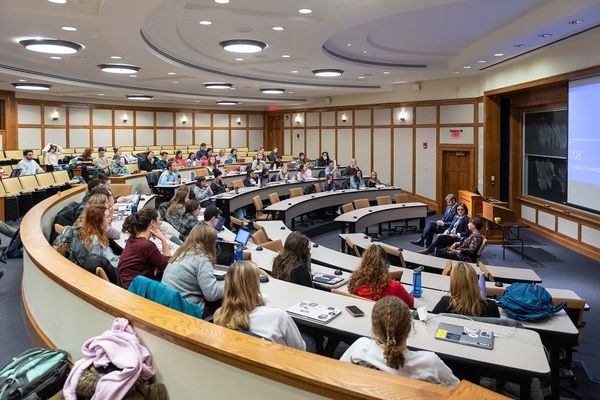

After graduating from high school, many students choose to further their education by attending college or university. At these institutions, people will (hopefully) specialize in a skill that credits them with the assets necessary to get a job within their desired field. For example, I am studying Public Relations in order to increase my public speaking skills, among other things. I have friends who are studying to get into nursing school; they are taking courses such as anatomy, chemistry, and biology to prepare them for the work they will one day do.
My point is that all college students, upon entering, have completed twelve years of secondary education. These twelve years of learning equip us with the foundation necessary to build upon our knowledge. I, for instance, would not be able to budget my monthly grocery bill without the prior math knowledge I learned in elementary school. Were it not for my high school English courses, I would not have learned to write. The ability to write coherently helped me land a job on campus and get accepted into the school of my choice.
The required, general courses of secondary education, though painful at times, are necessary. The sweet relief many college students feel when they throw their cap in the air is, Finally, I can study what I WANT to study! Not so fast, you poor unfortunate soul. Degree plans are heavily littered with more general studies courses. Most of us feel that these classes are irrelevant and unnecessary to our higher education, and I don't think we are completely mistaken in saying so.
Some would argue that further general studies are required because students enter college needing more math or English or science than they learned in high school. Is this not the fault of the high school education plan? Secondary education is meant to prepare students for college. Therefore, if we are required by our university to take say, more writing classes even if we are studying dentistry, is that not the fault of our high school for not equipping us fully for college as it supposed to do? It is advertised to us that we get into college because we are equipped. Why, then, does higher education feel a need to equip us with more general classes that aren't directly related to our field of study? We come to college, and spend a ridiculous amount of money doing so, in order to specialize. We have already been forced for twelve years to learn the general stuff. Was twelve years not enough time to teach us the necessary basics? This poses several flaws.
One, the material covered in one's freshmen year of college if they did not already complete the courses in dual credit, heavily resemble the material from their senior year of high school. Because of this, nearly anybody can get into college. This may sound like a positive, but it isn't.
If everyone easily completes high school and gets accepted into college, the value of a bachelor's degree decreases. It is now conjectured that in order for college students to have an advantage over others in society, they, at minimum, should obtain a master's degree to prove their credibility. A basic college degree does not offer the same head start that it used to. Why?
This system is contradictory.
High school "prepares" us for college. But, we still have to take general studies courses because "we weren't taught all that we needed to know in high school to succeed in college." In the words of that bald teacher from "The Incredibles", "Coincidence? I think NOT!"
If high school is too easy, then most everyone will get their diploma. If most everyone easily gets their diploma, then they will easily enter a university of some sort. If a whole half of the course load at university is of the same difficulty and generality as high school courses, then a bachelor's degree will be easily obtained.
So, one of the two is not doing their job. Is it the fault of universities for imposing repetitive courses upon us and thereby increasing the cost? Or, are high schools merely not equipping students as well as they should?