

Have you ever asked yourselves… when were all the atoms in the universe born? If you haven’t yet, then you ought to find out.
For the good of science and humanity itself as we know it, the most widely accepted theory states that long ago, a shell formed over a period of about a hundred thousand years. That shell was made of escaping photons that were not deflected by electrons. Meanwhile, electrons joined the nucleus to form atoms. This solid phenomenon was called “The Surface of Last Scatter," marking the epoch when nearly all of our cosmic atoms were born.

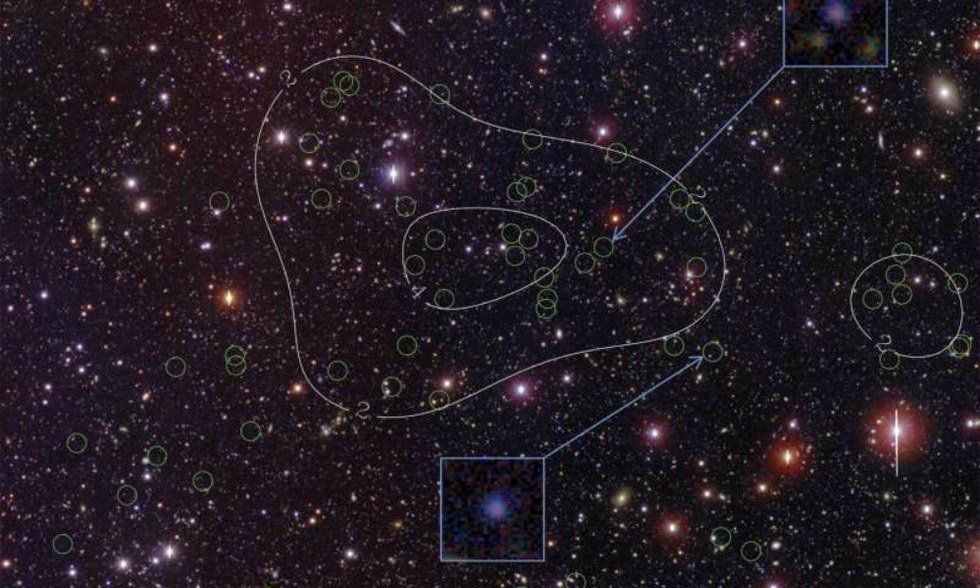
All of those matter-rich regions seeded the formation of galaxy superclusters while other set regions of our Interstellar Coast remained empty. In the intermedium of this gravity field, some photons scattered electrons within the coalescing regions.

These last ones developed a different and cooler spectrum while they were climbing out of the massively strong gravitational field, which then gathered from them a part of energy.
For this, the Cosmic Background Radiation (CBR) shows places that are hotter or somewhat cooler than average. Normally, the difference is of one one hundredth thousandth of a degree. These different temperature spots signal the origins and early structures of the cosmos — the initial gathering of matter.
Nowadays, we are able to see matter because we observe galaxies, galaxy clusters and galactic superclusters. Because of this, scientists probe the CBR(Cosmic Background Radiation), which allows us to see a relic part of existence from the past that still fills our universe completely.

The information that we can gather from the CBR detector is outstanding. The patterns vary between bumps in the early moments of our baby universe and show the behaviors of a long lost and expanding universe (to what our perspectives can interpret).

With the knowledge of existing CBR, we can thank Arno Penzias and Robert Wilson for accidentally discovering the Cosmic Background Radiation and publishing a paper in 1965 in “The Astrophysical Journal” referring to inexplicable excess antenna temperature from the Holdem Horn Antenna, which was perhaps the most important astrophysical discovery of the century! At the same time, scientists Robert H. Dicke and colleagues heard about Penzias and Wilson’s results, and immediately knew that they had been scooped. The Princeton team knew exactly what that excess antenna temperature was, and everything fit their theory:
- The temperature
- The signal coming from everywhere -all directions in equal amounts-
- Not linked in time with Earth’s rotation or Earth’s position in orbit around the Sun.

Reference:
- Chapter 3 “Let there be Light” from Origins: Fourteen Billion years of Cosmic Evolution by Neil Degrasse Tyson and Donald Goldsmith.
- Image Credit: NASA, ESA, Internet sources under: “CBR – Cosmic Background Radiation”.
-AstrophysicsAngie (10/1/2016)






 man running in forestPhoto by