

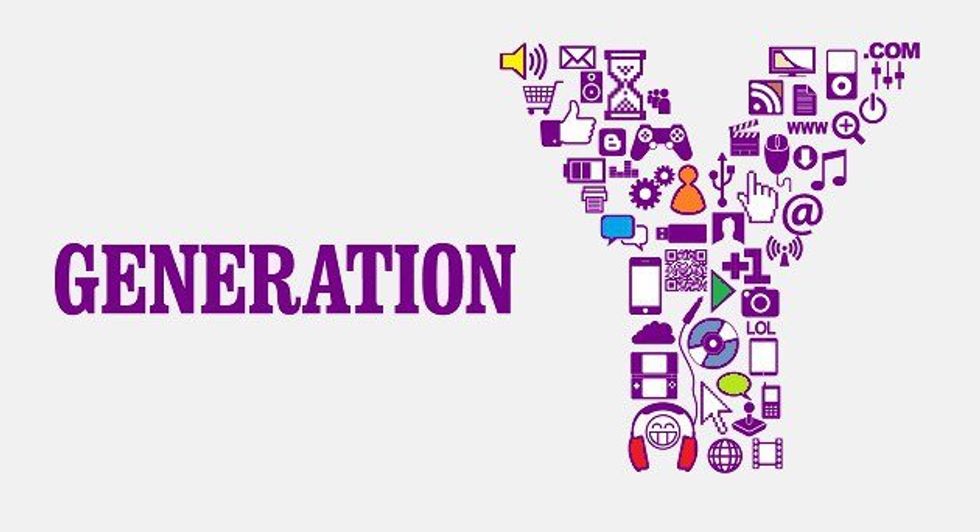
When it comes to criticism of the new generation, Millennials are quick to point their fingers right back at the Baby-Boomers who raised us. Simply put, we do not take criticism well. However, as a fellow Millennial, I feel as if it is my inalienable right to censure both myself and the rest of Generation Y. As a member of this generation, I know through first-hand experience the eternal trance that social media has bestowed upon us. We are a generation driven not by morals or traditions of our ancestors, but rather by digitized forms of communication.
Social media can be defined as computer-generated sites which allow users to quickly and efficiently share information—whether it be in the form of text, photos, videos, etc.—with other users from all over the world. How does Generation Y define social media? To be frank, it’s our lives. While we may have vast and distant memories of life as a toddler in the early 90s, we did not get the chance to experience life to the fullest extent of that time period. Despite our respectable efforts to convince ourselves that we are 90s children, we truly aren’t. The bulk of our childhood took place in the 2000s, however, we were just too busy being consumed with technology to realize it. In our defense, technology and social media was only just getting started and we could have in no way predicted the effect it would eventually have on our lives. Nonetheless, it did. Technology grew, social media expanded, and our lives slowly fell into what we now call the App Generation.
Whether it be on Twitter, Facebook, Instagram, or Snapchat, we all want to have that perfect post. It is this mindset that causes us to lose out on experiences right in front of our faces because we are too busy trying to capture them for social media. Life has become less about living for the moment and more about living for the perfect picture. We have fallen victim to the mentality that if we didn’t capture the experience, it must not have happened. We watch concerts through our iPhone cameras and neglect the friend standing beside us to communicate with another through our phone. We fail to realize the beauty of a moment as well as the importance of the people we are sharing it with. How could an experience truly be special if it’s shared with the world, rather than just a few meaningful people? It’s a simple calculation—as our Snapchat stories rise in seconds, the gains in our experiences flatline.
Social media bares an eerie resemblance to rose-colored glasses, and when viewing our profiles, the lives of those around us always seem to be better than our own. We can all attest to this feeling of missing out—so much that it has been characterized into a disorder known as FOMO. What we fail to realize, however, is that social media is only offering us a glimpse into someone else's life. We see as much as they are willing to show, and it is no secret that people choose to only show the best parts of their life. This idea goes hand-in-hand with that of the “perfect post.” We take 100 selfies before we finally hit the share button and we wake up at the crack of dawn to capture the sun rising for our Snapchat story. However, looks can be deceiving and we shouldn’t ignore the fact that we are only seeing end results. We don’t make it public knowledge that we slept through 10 alarms before finally waking up to view the sunrise, and we certainly don’t advertise that our “natural look” actually comes in a bottle and can be purchased for 50 dollars at the local MAC counter. We are the generation that compares our behind-the-scenes moments to our friends focal points, and our failure to bridge that gap is destroying us.
Social media presents us with the perfect opportunity to recreate our lives and not be our true selves. We hide behind our laptop screens to tweet about a life we wish we could live, rather than actually living the life we have. We spend hours writing clever tweets and Instagram captions all so we can alter the image that we appear to have. We have become so fixated on our followers’ (I use the term followers instead of friends because we’d be lying if we said we personally knew all 500 of our Instagram followers) perception of us that we neglect the fact that if we met face to face, the person we are trying to sell ourselves as would be unrecognizable. We write things we wouldn’t even fathom saying in person and we post pictures that don’t even look like us in our truest forms. We filter out all of the negative aspects of our lives and mask our profiles with a false positive.
While we may not all possess the picturesque qualities that our social media accounts attribute to, Generation Y does all share one trait—we are all passive aggressive and it is yet again another effect of social media. Nobody enjoys confrontation and social media makes it easier than ever to escape this uncomfortable situation. Unfortunately, it also seems to escalate the issue and causes more problems to arise. Millennials are the creators of the subtweet—an offensive tweet that refers to another user without specifically tagging them. To us, subtweets solve everything. Got a problem with a friend? Subtweet them. Your crush didn’t text you back? Subtweet him AND the girl he most recently mentioned on Twitter. We no longer take the time to confront people when a problem arises but instead view our social media accounts as an alternative solution to the problem. A close second to the subtweet is the passive aggressive "like"—whether it be on a status, a picture, or a tweet. It lets the owner of the account know that you saw their post, and you’re definitely not happy about it. This new form of confrontation is causing an epidemic across Generation Y that causes us to become even more social media obsessed. Now not only are we trying to capture every second of our lives, but we are absorbing every second of the life of every person we have ever known just to ensure we don’t overlook a passive aggressive post about ourselves.
The scariest part of social media's impact is that many people fail to realize it’s true control. We are so far in denial of these issues to the point where we are too busy tweeting about how much social media has NOT impacted us, that we ourselves are unaware of our hypocritical ways. Our go-to tactic is to deny, deny, deny—and we can deny it all we want but the proof is in our profiles. While generations before us are remembered for life-changing discoveries such as gravity, evolution, electricity, etc., us Millennials are known for our discovery of all technology driven aspects of life. While I am in no way saying that these technology-based discoveries are irrelevant and not respectable, I am saying that it is impossible to ignore the stigma that comes along with them. When used correctly, social media is extremely beneficial—offering us quick and efficient communication, as well as a way to reach an enormous audience with the click of a button. However, the powers of these sites have become both abused and overused and that is the greatest downfall of Generation Y.