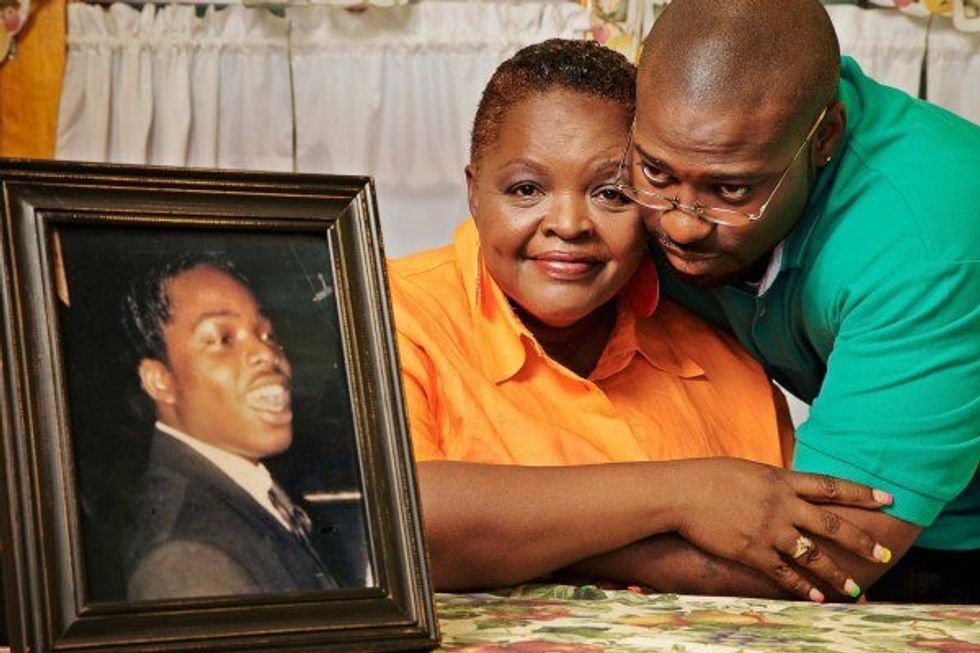
“Seriously, that lady is crazy!" "It wouldn’t be me, that man murdered her son!" "Mary Johnson must have psychological problems, there's not that much forgiveness in the world.” Those were just a few comments that I heard from people after we listened to Mary Johnson and Oshea Israel’s story. I immediately mourned Ms. Johnson’s loss, but I appreciated her ability to forgive the man that shot and killed her son. I instantly became irate at the people who were passing judgement.
I take a course at Bryant University called Professional Writing as a Story. My professor introduced us to the website, Story Corps, where people can tell their stories through podcasting. He played a podcast entitled “I Just Hugged The Man Who Killed My Son,” I was immediately intrigued.
On February 12, 1993 Mary Johnson’s only son, 20-year old Laramiun Byrd, was murdered. The perpetrator was 16-year old Oshea Israel, who received a 25-year sentence for second-degree murder. Many years later, Mary visited Oshea in prison, and since his release in 2010, they have lived as neighbors in the Northside community of Minneapolis. Mary now dedicates her time to From Death to Life, an organization she founded that uses healing and reconciliation to end violence between families of victims and those who have caused harm.
It's my thought that forgiveness definitely makes the offender who has wronged a victim feel better, but someone who has personally suffered the loss of life, and who has suffered depression as a result, truly forgives to obtain his or her own personal peace.
Genuine forgiveness is a voluntary act, and if Ms. Johnson found it in her heart to release the hurt and anger that was bestowed upon her by Mr. Israel, it is then the responsibility of others to essentially mind their own business and respect her decision. People should refrain from making comments that are meant to shame her for deciding that peace and serenity were more important to her than hatred and condemnation.
If your boyfriend or girlfriend cheats on you, or if someone steals from you, those are both acts that are hard to get over. Let’s keep it real, betrayal by someone you love hurts like a stab in the chest, and being violated by someone who has taken personal items or money that belongs to you is considered an unforgivable act by some. Admittedly, some will forgive and others will not, regardless of the offense. What's my point? Forgiveness is subjective to the person willing to release anger, pain, resentment and ill-will. Without walking in Ms. Johnson’s personal shoes, it is shameful for anyone to judge her.
Ms. Johnson will never ever see her son walk across the stage after graduation from college, nor will she get to see him get married, but because she has forgiven Oshea, she looks forward to his accomplishments. Out of forgiveness came friendship, happiness, and a new organization called From Death to Life. The organization supports mothers who have lost children to homicide. The mission of From Death to Life is to show people who are grieving how to forgive people who are responsible for their loss.
I'm not saying Oshea's crime was right or light-hearted, but in life, we all make mistakes. Oshea still has trouble forgiving himself because he knows the pain and hurt he caused Ms. Johnson and her family. He will forever remember the night that he ended a young man's life.
Whatever people think about him is truly their own business, but in the spirit of doing what's right, it's my hope that people will let him live and make this second chance he has been given a productive one. While he gained a friend and a mother-like figure in Ms. Johnson, she has gained a son in him, and even if that doesn't make sense to others, it makes sense to them, and that's the only thing that really matters.
Ms. Johnson, I commend you, because you have chosen to keep on living and breathing. I commend you because your forgiveness of Oshea has allowed you to open your heart to the very man who can’t even forgive himself. May your peace and your happiness be with you, even when people who don’t know your story condemn you for choosing to forgive, to love, and to live. I leave everyone with this thought: “An eye for an eye leaves a blind world.”