It’s the 21st Century, and we are finally realizing that mixed couples are the reason for not only the cutest but also the most interesting babies. I am one hundred percent Indian,but for those of you that don’t know, there are over 25 different Indian languages—and no, they aren’t all just dialects of Hindi. My parents are originally from complete opposite sides of India: my mother is from Gujrat and speaks Gujarati, and my father is from Kerala, and speaks Malayalam.
When I was little, I wasn’t taught both languages, just Gujarati, so I grew up considering myself a Gujarati with a Malayali last name. I was embarrassed of not knowing my dad’s culture or language, so why even address that part of me? I went to every Gujarati cultural event, for those of you that know what Garba is, along with fluently speaking to all my relatives in the language which showed off that I am an American, but I still can go back and communicate in India. But really, communicate to only half of my family.
I had visited Gujarat many times, and even though we go to the “New York” of India on the regular, Bombay (where every different language speaking Indian can be found), I went there ready to flaunt my inner Gujju. This time, however, was different. This time, I visited my dad’s original state, Kerala, where my ancestors from his side lived, and the culture of his family remains.
I was nervous; how was I going to communicate with anyone? My dad tried comforting me by saying the second language in the state is English, but I also knew that it was a village there. Literally a forest with locals who live their lives so peacefully with not even a single telephone. I was going to tour one day and visit relatives the next. Touring was just beyond my excitement; Kerala is known as the paradise of India, but relatives? What was I going to do? Awkwardly sip tea and nod? Well, turns out, that was almost accurate.
The first day, we got on a house boat. We were to spend the night there. It was absolutely peaceful; the surroundings completely green, and the villagers wrapped in their vibrant colored saris. The fisherman on a boat next to ours were so used to the scene, while I didn’t even want to blink just so I could capture it all in. The air felt different: cleaner and more pure. I have yet to fully figure out how to describe the flawless moments on that boat in words.
We stopped on the shore of an island for 10 minutes to pick out the fish we were going to eat for dinner. Kerala is known to be one of the meat-eating states in the predominantly vegetarian India, while Gujarat is almost vegan. I guess I realized my food preferences always swayed more to my Malayali side. We finished picking the fish and had a man open coconuts from a tree for us to drink the water from, then made our way back onto the boat.
We continued on and saw a boat with locals going to work—almost like a ferry. It was four rupees to get on, and sometimes the only transportation to their work. My dad told me stories about how he had to canoe to get to his house, and how his dad took a canoe almost every day.
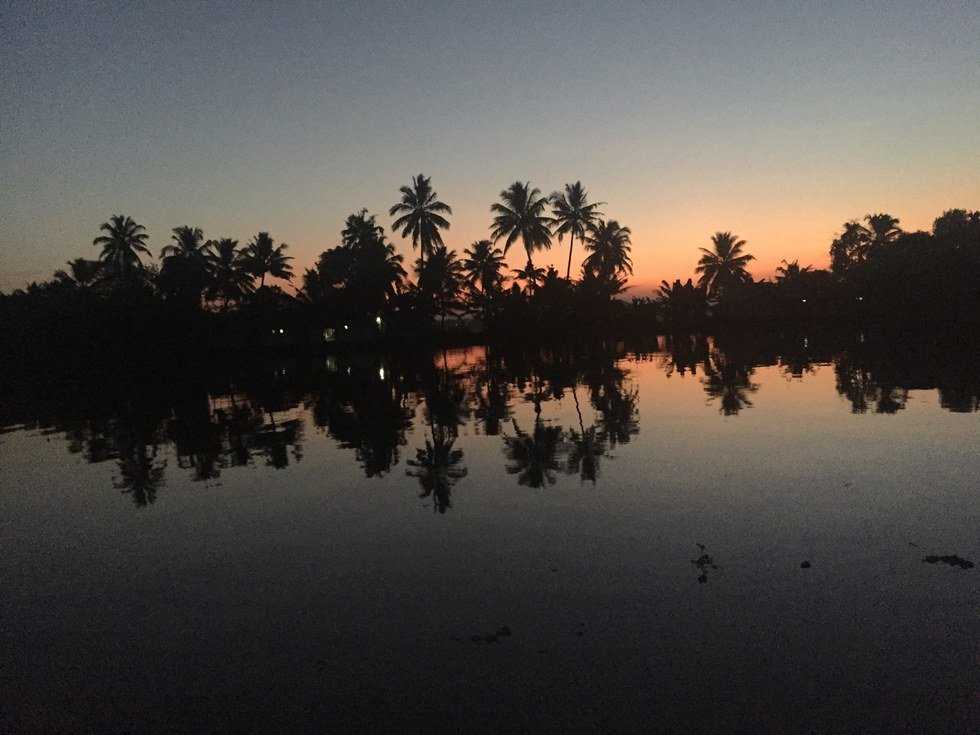
We reached our stopping point, and the boat parked in the perfect position. We walked around the village onshore and came back to the enrapturing smell of our dinner: fried fish, rice, roti, chicken curry, mixed cabbage, and okra. We ate until we could no longer move and took in the sunset’s beauty until it was dark. The bed was more comfortable than you could imagine for a houseboat, another one of the billion things right on our adventure.
We woke up the next morning, dazed with disbelief at the perfection of the reflection of the trees in the sunrise. We didn’t want to leave—the past 16 hours were one big, flawless moment.
It was time to leave, but fortunately, we had one more night to spend in this paradise. We got into the car, sharing our adventures with our driver, my late uncle’s driver and friend. He was so familiar with the routes to our family’s houses that I felt like he was a part of the family himself. He, Christian like a large population of Kerala’s locals, took us to two churches. They, too, were gorgeous beyond belief. I felt as if I had been missing a part of me all my life that I had finally found, one also so beautiful I felt ashamed to ignore all these past years.
The touring part of Kerala was over, and now was my biggest fear: visiting relatives that I already knew I couldn’t communicate with. We started off in the first house, my sister and I sitting in silence, trying to figure out what was going on through body language. Then the next, then the third. The third house technically was the same situation, but different for one reason: it was my grandfather’s sister’s house. I had never met my grandfather, but heard stories from multiple people about how great of a man he was.
There was so much I wanted to ask his sister, but I couldn’t. I was upset at the beginning, but by the end of it, I was OK. There was a look in her eyes, so genuine and happy she even got to see us. She looked just like my grandfather (thank god for pictures), and I felt almost this weird connection with him.
The visits were a bit much to take in, but the emotion I saw in each one’s eyes, a desire for them to want to talk to us even though we couldn’t, was so much more meaningful than I had ever thought. I felt at home by the time we reached the airport to depart. Some words and phrases even became more familiar to me. I had come in foreign, but left my land a local.
I still have work to do on balancing my two differing cultures inherited from my parents, but this trip gave me the chance to realize how much I’ve missed out on, and how much more I need to make up those years lost and find the Malayali in me.
So, in conclusion, if you're a mixed child or intend to have one, balance out both cultures. And find the things that help you connect with both sides. Because from what I've learned, both are pretty damn great.