
MAJOR SPOILERS AHEAD
Trigger Warnings: POC, LGBTQ+, abuse of power
As your everyday Netflix-binger, I was totally ready for the new season of “Orange Is The New Black” to arrive. I watched the entire season without almost any breaks, and by the end of it, I was numb — but beneath that numbness was an outrage and pain. I longed for the funnier moments from season one where Piper is offended for being called Taylor Swift as opposed to the tears sticking to my cheeks in the last two episodes due to a sense of rage and loss.
This season truly is action-packed: from Nichols’ vicious drug cycle, maxi pads seen as “inessential” in medical, Lolly’s trip to psych and Healy’s subsequent mental institution, a collection of new backstories (Lolly, Maritza, Flores, more on Suzanne and Healy), Alex’s murder of friend/hitman Ayden — and for some reason, the audience is continually hit over the head over and over by rising white supremacy within Litchfield's walls.
Here are my Top Five “WTF” Moments from Season Four of Orange is the New Black, and an attempt to understand them for the overall benefit of the show:
1. Piper’s power trip
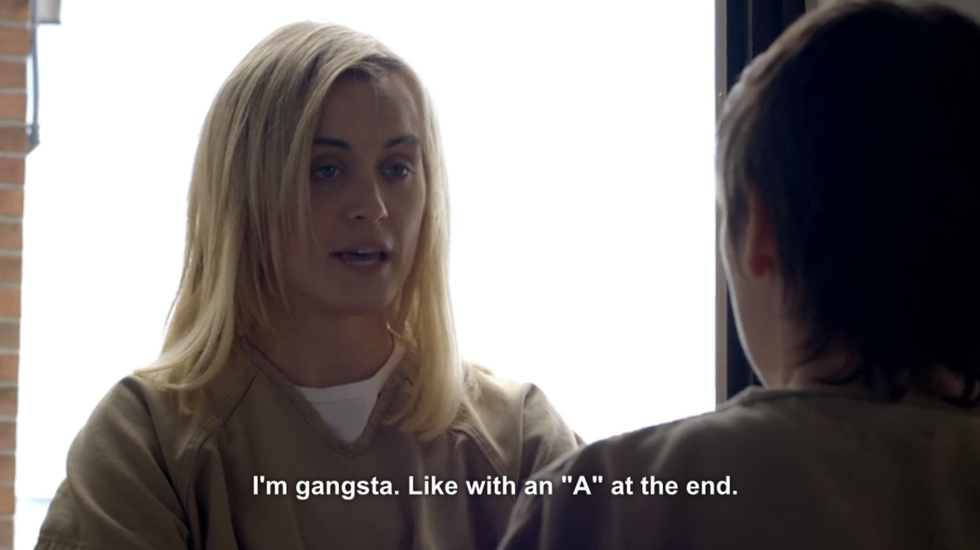
Starting out as a fun panty business, Felonious Panties becomes endangered when Maria Ruiz decides to "jack Piper's business." In retaliation, Piper accidentally starts a white supremacist gang (something that Morello says “shouldn’t be a group activity”) and “protects her people” by planting dirty panties into Ruiz’s bunk – adding three to five years to Ruiz' sentence, which according to the horrific bear and Guard Captain Piscatella, is to “make an example” of gang activity. The situation snowballs to an abandoned Piper and a horrific scene in which Ruiz and her girls brand a swastika on Piper’s arm. Her return to her prison family by telling a very high Nikki and Alex about the experience and Red and Norma’s assistance to turn the swastika into a window led to a poignant line about taking matters into your own hands:
“When God gives you a swastika, he gives you a window. And then you remember – there is no God.” – Red
While it is all too common to hear white voices shouting in an attempt to cover the voices of others – as one character says in the show, “People keep going on about black lives matter. What about white lives? White lives matter!” My response? Well, yes, they do, but perhaps the writers were merely attempting to emphasize the lives of those who are suffering from the color of their skin, and how to change institutionalized racism. And everyone would like to see less of Piper and more of anyone else.
2. Inmate/Celebrity Judy King
And speaking of institutionalized racism, we have newcomer Judy King (Blair Brown) coming to Litchfield as a celebrity white Southern chef – who immediately is given a private dorm with a single other roommate (Yoga Jones, triggering Jones' internal conflicts left and right). She’s treated as a queen amongst prisoners, but her words carry heavy weight, as does her understanding of the business side of the world, something we are much more familiar with as Litchfield has been bought out by the Feds. She is able to abuse her powers that “Litchfield keep her happy” with extra soft sheets and making Luschek her lover, but is reminded of her prison status when forced to teach a culinary arts class by everyone’s favorite Mr. Healy. She seems to have (mostly) good intentions, but when word gets out that she had a racist puppet show in the 80’s, she does her best to squash racist rumors – by surprise-kissing Black Cindy for a photo-op to be sold, essentially using Black Cindy (even if it was her crew’s initial idea). Seeming perfectly at ease until the heartbreaking end of episode 12, she also delivered one of my favorite lines of the season:
“You are a straight white man. You don’t get to be the victim.”
Judy King meets prison is an interesting social experiment; as Yoga Jones points out, she controls both her and Luschek, despite the fact that she is a prisoner. Sure, she wasn’t the most moral of characters, but questioning morality is one of the big parts of the show.
3. Guard Brutality
“You’re criminals. And you deserve nothing.” – Piscatella
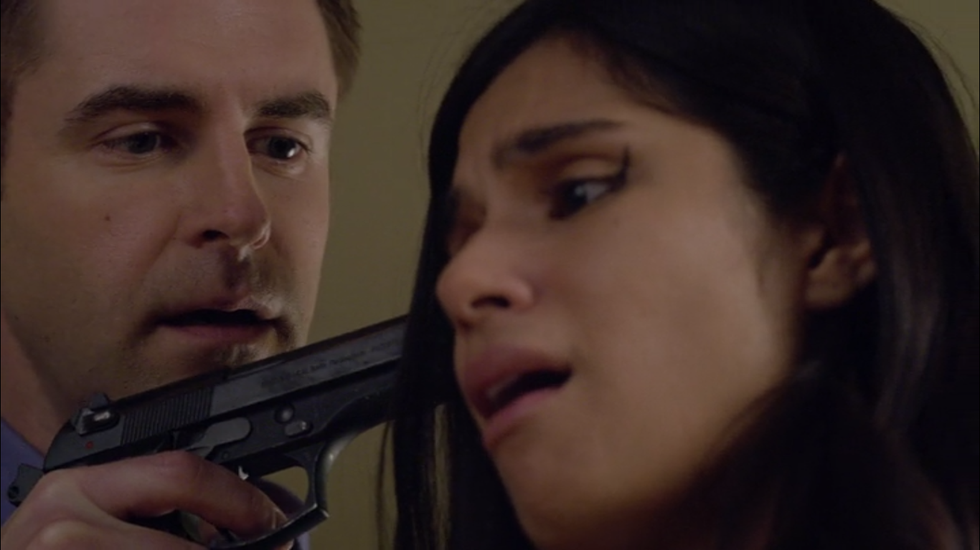
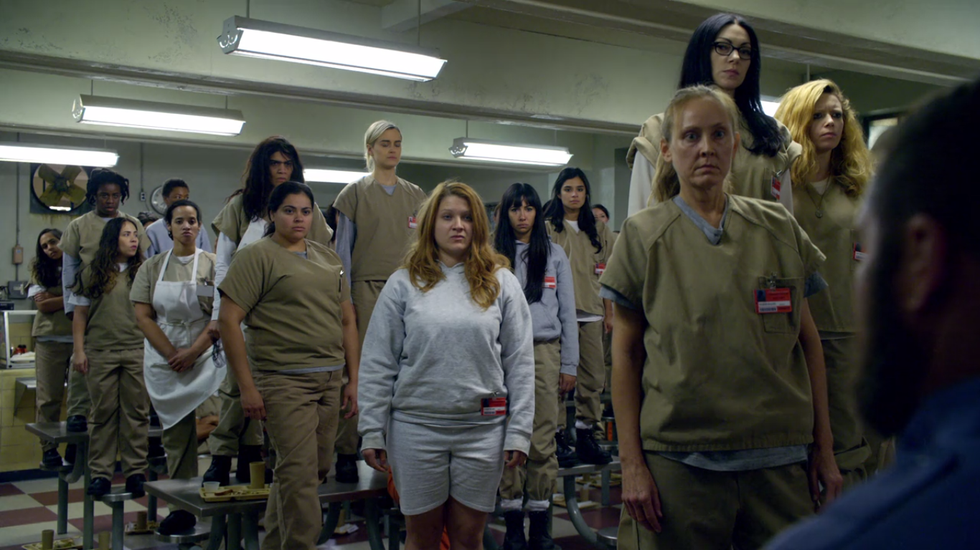
The guard system of retired veterans brought a hydra into Litchfield, with Piscatella at the head. After Piper hints that there may be gang activity with the Latinas (as Ruiz was paying her panty girls in red slipper socks) stop and frisks become a regular occurrence – targeted at all POC, with an “ahola” satirically said to the new Hawaiian inmate Hapakuka (Jolene Purdy). This ragtag group of new guards all have their faults – CO Humphrey’s monstrous “gun to your head” game, CO Stratman’s pleasure during the frisks and his command that Blanca stand on the table until she respected him. This stemmed from the civil disobedience Blanca started by not showering or otherwise smelling disgusting for the frisks – and leads to the climactic peaceful protest in episode 12.
Our older guards don’t seem to be doing much better – Coates doesn’t realize until Pennsatucky tells him that she was raped by him, and Luschek’s normal habits of guilt for turning Nichols in and sending her to SHU over a drug deal they had planned together. Judy is able to get Nikki back to Litchfield (for a sexual favor from Luschek) and when he addresses Nikki, he tangles the web even more:
Luschek: You could say thank you.
Nikki: For what, ruining my life and then un-ruining it? Why do you think I’m still on this shit?
But Judy doesn’t always make the prison a better place – when a guard is sent to protect her in the bathroom, he openly objectifies the women. Bayley is as useless as ever as a guard, but still manages to do the unthinkable – but we’ll get to that later. Red is unable to sleep due to Piscatella forcing her to work, a guard destroys Taystee’s watch for asking how long interrogations will take. After finding Ayden’s chopped and decomposing corpse, common actions such as going to the bathroom are considered special privileges; and once again Humprey leads the helm by encouraging inmates to fight – and bet on the outcome.
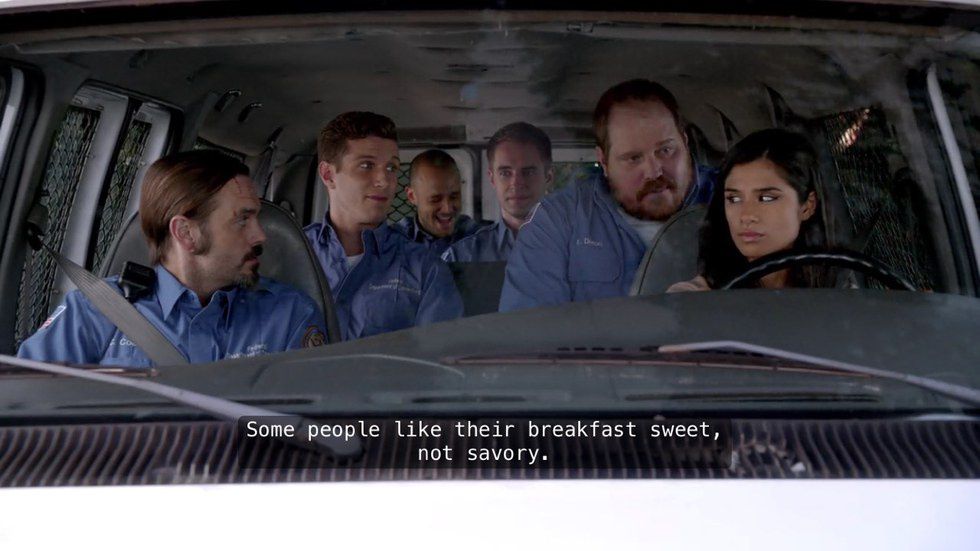 The real problem with all of the guards is the in-group mentality. When Caputo commands CO Humprey will be suspended for two weeks without pay for forcing inmates to fight, Piscatella steps up and completely undermines this frazzled (and big-business dazzled) warden, saying that he and his men will all walk out. When two COs notice Maritza’s nausea after her visit in Humphrey’s house (in which she was forced to either eat ten dead flies or one live baby mouse), one guard says they can't do anything about it because “this is a brotherhood. It’s like a frat house – it’s everybody’s fault.” And it is – but no one one is willing to step up and stop it, and Piscatella’s contempt of the criminals is apparent in how he speaks to them and treats them, how he leads his guard, defending them at all costs – and ultimately allowing Humphrey’s mistake to bring a gun into the prison. This also allows the guards to sympathize and try to rationalize his horrific mistake in “The Animals…” but trying to rationalize murder isn’t easy.
The decision to bring in veterans was made by the Management & Correction Corporation, the powerhouse that sees the prisoners as stock as opposed to people, something seen in each episode, reiterating the problems that prisons who take this approach will face.
4. Sophia Burset’s time in SHU
I knew that Sophia would be going to SHU on MCC’s orders “for her own protection”, and we had seen the effects of the isolation on other characters in the past, but no one had a stay quite like Sophia. Assuming she was cut off from her transitional medications, not only was she experiencing a form of mental torture, but physical one as well. When she attempts to speak to Caputo (albeit by flooding her room) her belongings such as a bed and blanket are taken away; when slipped a magazine by an empathetic Nikki, the room is next found smeared with blood – a sign of Sophia going to medical. The ghost of her presence on the show was certainly felt, particularly when Ruiz took over the salon as a means of drug trade.
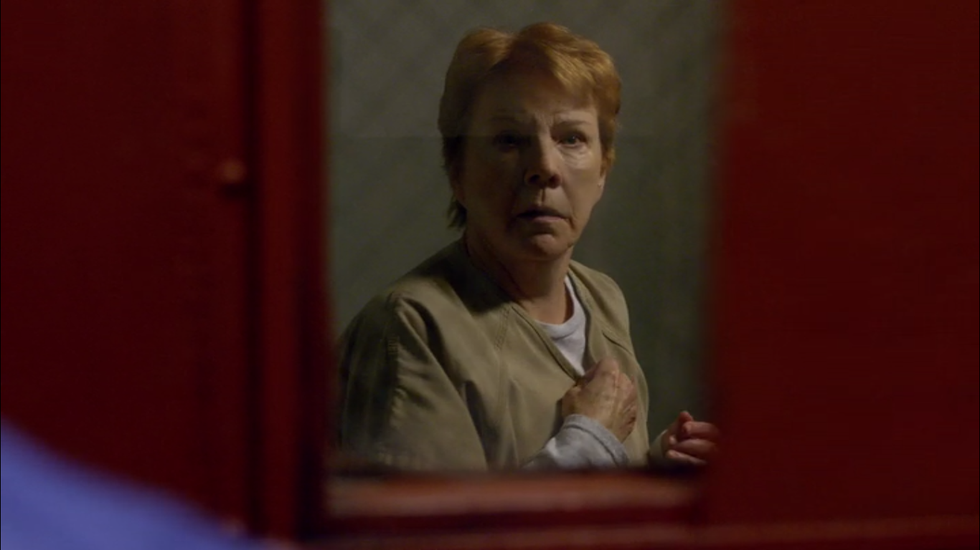
What’s even worse is that her wife Crystal Burset is being blocked by MCC and is not given a single shred of evidence that she is alright in the SHU - she even has a gun pointed at her by Caputo's new girlfriend, Linda from Purchasing (and Satan, as Danny warns Caputo). There is no news on the outside until Sister Ingalls willingly is thrown into SHU and arrives with a cell phone in the one place a woman can hide such an object – her angelic hoo-ha. After Caputo secretly gives a photo of Sophia in SHU to Danny, who uses it against MCC, Sophia returns to Litchfield in the penultimate episode “The Animals,” not looking for pity and certainly not for the peaceful protest turned tragedy to unfold at dinner.
Sophia’s purpose for her time is explained, once again, by the MCC. This mega corporation will do whatever it takes to cover their tracks and protect the company, not the people - and they continue to do so in what is probably the greatest outrage in the season’s history.
5. Poussey Washington’s Death
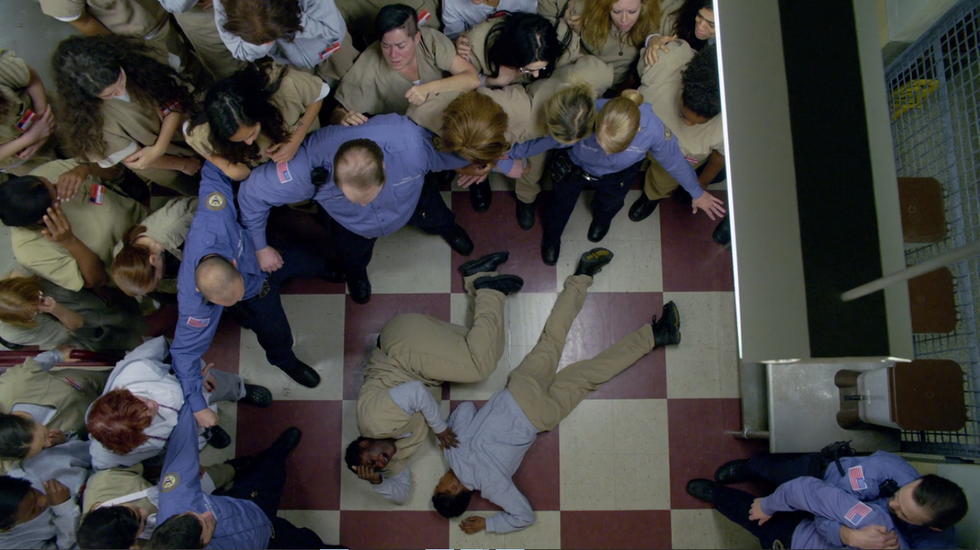
The heartbreak of the season, the hopeful and goofy Poussey was accidentally murdered by Bayley at the end of “The Animals,” by trying to help Bayley restrain Suzanne during the protest among the noise and confusion. Even though Poussey had told Soso that she didn’t believe anything would change because of a protest, Poussey still stood with her fellow inmates and her love in an attempt to change things at the prison.
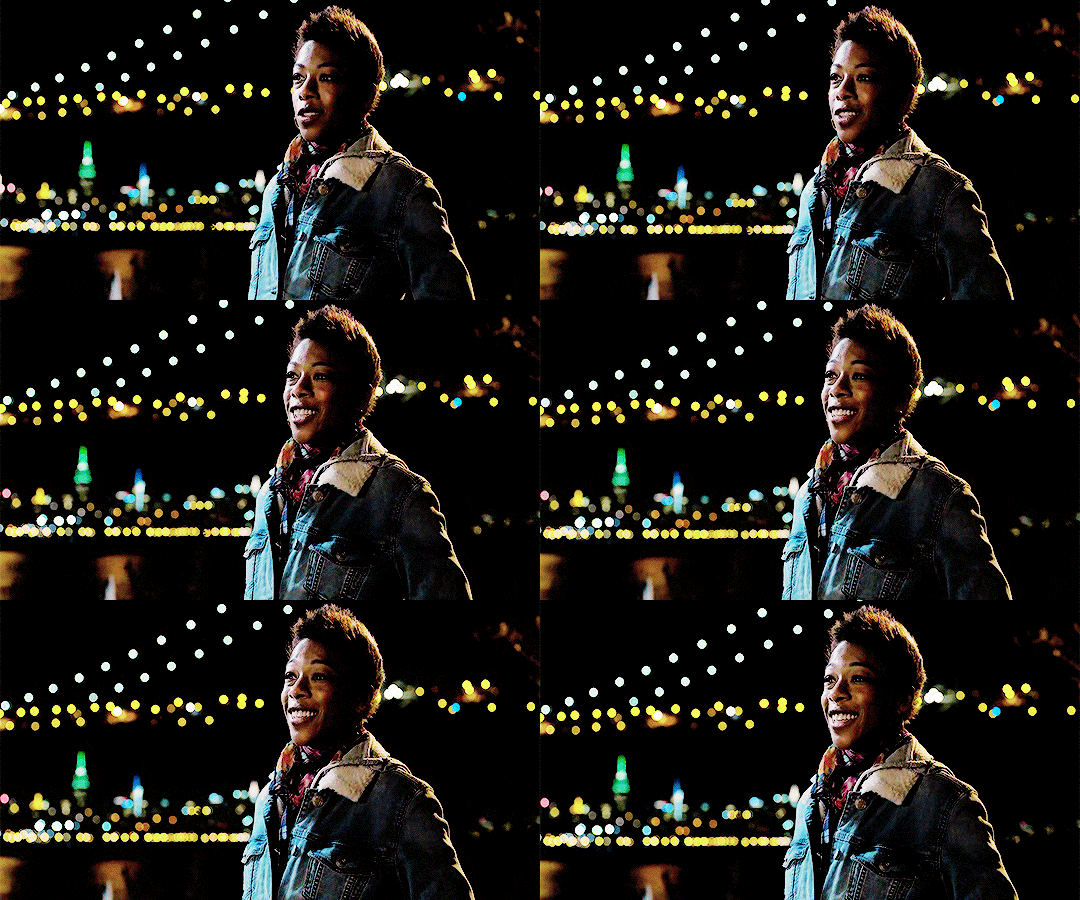
Fans are outraged – Poussey was a favorite character, and her flashbacks in New York City as a free citizen in the final episode further twisted the knife in the wound. Poussey had a promise from Judy King for a job when she got out; she was in an adorable interracial relationship with Soso, dreaming of Fiji and happiness. She was small, unarmed, and murdered.
But Piscatella tells Caputo, “She was an extremely violent inmate. This was not about race. We can’t have an inmate attacking our COs.”
Piscatella’s first instinct was to say she was an armed and violent criminal, which the guards confirm in one way or another under Caputo’s questioning – more of that “brotherhood” mentality, an interesting choice of words considering the many sexual assaults that take place in fraternities. Caputo tells Piscatella to go home for even considering twisting the story like that, only to realize that is exactly what MCC wants – someone to blame. They find their “villain” in Bayley, pinned up as an undertrained CO who was loose cannon (despite the numerous attempts he makes throughout the show to help the inmates). However, Caputo goes off MCC script during a press conference and calls Bayley a victim of circumstance, who is filled with remorse and horror at his actions while also receiving sympathetic flashbacks in the last episode “Toast Can’t Never Be Bread Again.” He is as heavily humanized as Poussey, and realizing that Bayley was briefly arrested and Poussey was charged for the same activity (trespassing and intent to sell) - and yet, their two lives go in very different directions, with one ending much before it's time.
Her death hits some of the inmates harder than others – Taystee, Black Cindy, Suzanne, Watson, and Alison Abdullah (Amanda Stephen) are in deep mourning the next morning – unsurprising, especially because the body was not moved from the cafeteria overnight because MCC ordered the police and coroner would not be called until they had an angle. Suzanne tries multiple times to suffocate herself, blaming herself for Poussey’s death and saying “I want to know how it feels to not breathe.”
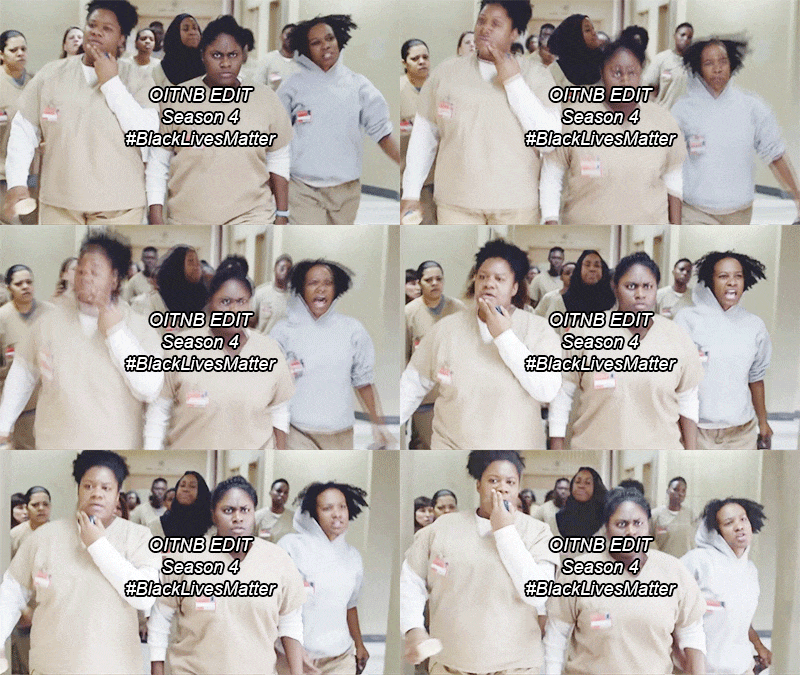
Fights almost break out, and the only silver lining of Poussey’s death is that it causes the inmates to rise up together against a common enemy – the COs who had mistreated them for the entirely of the season. After the press announcement that Taystee secretly overhears, her fury at Caputo’s claim of Bayley being a victim of circumstance and the fact that Bayley will be rehired in two weeks – as well as the fact that Poussey Washington’s name was never stated – causes a volcanic uprising, during which Humprey trips and his gun falls from his ankle, to be picked up by Daya, who aims it at his face admits screams for blood. Fade out season four.
Upon first watching, my horror and disgust vaguely reminded me of something … of the stories I’ve heard in the past few years – Trayvon Martin (2012), Michael Brown (2014), Eric Garner (2014), Tanisha Anderson (2014), and Tamir Rice (2014). The writers have been very forthcoming in their address of Poussey’s death – it was a message, a message that things need to be fixed, both in and outside prison. The day after Poussey’s murder, Gloria says, “Things will change now. That’s what so fucked up. It takes someone dying for them to do something.” Sophia flatly replies, “They ain’t gonna do shit.”
Perhaps all of this is because we, as a society, need to do something. People may be unhappy with the state of the nation as far as prejudice and homophobia, but without actually effecting change nothing is going to happen. The prisoners were the ones with the choice at the end of the episode, not the COs. Perhaps Season Four forces harsh realities towards us, painful ones, in hopes to effect change. “You could say something out there,” Yoga Jones urges Judy as she loads her box to “get the fuck out of [that] place.” Silence is just as dangerous as a knee to a 92-pound woman’s back and hand to her throat.