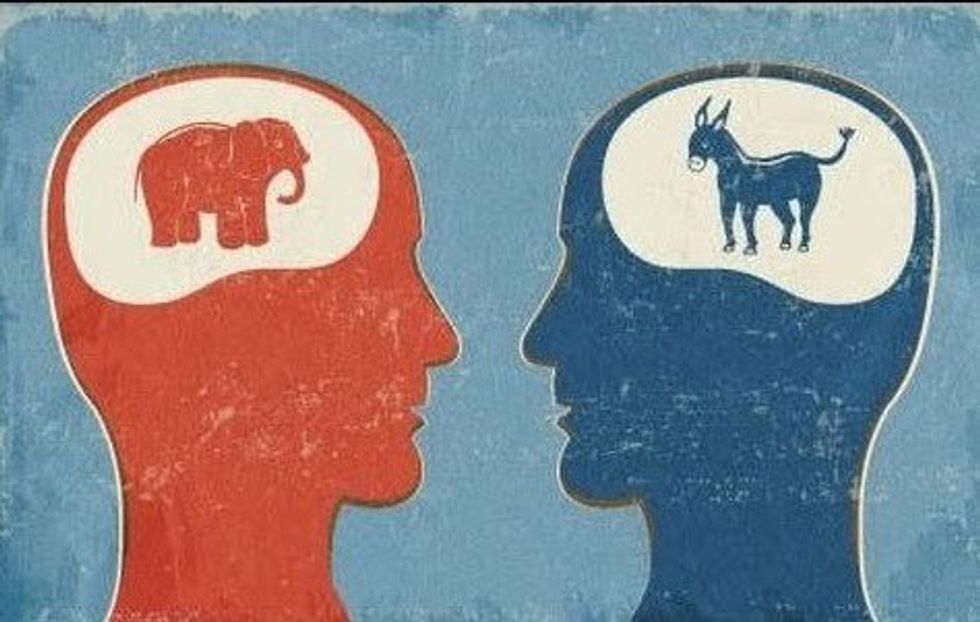
Politics are always a recipe for disaster when it comes to conversation topics. It’s a pretty safe bet that somebody in the conversation is going to be offended when views are shared, or if the views line up, talk will lead to how the country is heading in a downward spiral if the right person doesn’t get into office.
I try to steer clear of most political talk for a couple of reasons.
1. Politics make me sad and usually agitated.
2. Today, it seems like you have to lean one way, right or left, and agree completely with every policy that side believes in. I don’t.
I agree with some things on the Democratic side and agree with others on the Republican side. I can see strengths and weaknesses in both parties, and this often leaves me confused on where I stand.
For a few years now, I have struggled with my thoughts on where I fall on the political spectrum, and the upcoming election is not helping matters. Some of my most important values fall on the Democratic side, but issues that I feel may affect the country’s future line up more with Republicans. It’s constantly back and forth, my mind always having to navigate the candidates’ campaigns. It’s a tricky line to walk because there is no side I feel completely drawn to, and I have to do so much more research about candidates and their stances. I need to see how each candidate feels about the issues that I feel most passionate about. It doesn’t matter to me what political party a candidate belongs to, it matters to me what their opinions are. I don’t want to feel obligated to belong to a specific party due to my age, location, or whatever else, and I don’t feel like a political party should define who a person is or who they vote for. Personally, I want to vote for somebody whose policies line up the most with mine, no matter what political party they belong to.
With candidates offering hypothetical promises and grand schemes on how to fix the country, it’s almost easier to know who not to vote for. This video -- courtesy of Prager University with host, comedian, actor, and director Adam Carolla -- offers insight on how to know whom not to vote for in the upcoming election. He recommends steering clear of candidates who say, “I’ll fight for you!” and, “I want to level the playing field.” These candidates don’t know who you are, so how are they supposed to fight for you? Answer: They can’t. Carolla comedically yet logically lays out reasons why the tag lines that talk about how a candidate or the government will help YOU out feeds into the laziness that seems to have become a big part of society and that realistically, no person of government can personally help YOU out. His insight provides helpful ideas on how to deal with all of the big talk coming out of every candidate’s mouth. For somebody who doesn’t feel like they wholeheartedly belong to one party, I found this video very important.
There are very few things I know for sure about where my beliefs fall on the political spectrum. I believe a woman should have the right to choose what to do with her body (score one for the Democrats) and I don’t believe that the minimum wage should be bumped up to $15 an hour (go ahead, say whatever you want about my opinion, but score one for the Republicans). I believe that there should be equal rights no matter what somebody’s sexuality may be (score another for the Democrats), and I don’t believe college should be free (cheaper, yes, but not free -- who’s going to pay for that? -- score another for the Republicans). I believe in helping people out (make that three for Democrats), but I don’t believe in so many handouts (and three for Republicans). A hand-up is nice, but a hand-out is not. See? It’s a constant back and forth on my opinions and views, and I have yet to see a candidate who shares my opinions that there sometimes needs to be a compromise or a candidate who pulls from both parties’ policies.
A Democratic “think tank” called Third Way decided to commission a poll of 1,500 registered American voters to figure out where moderates stood on political issues and what made moderates a distinct group. What they found was that moderates “aren’t tuned-out or ill-informed, but they tend to see both sides of complex issues,” and that moderates “recognize that both sides have a piece of truth and see flaws in the standard liberal and conservative perspectives.” Moderates have to go above and beyond standard Democrats and Republicans because they have to really research all the different stances candidates are taking and see which ones line up the most with their own viewpoints.
In today’s day and age, I urge my fellow young voters not to just choose a side that has a “hip and with it” candidate, or choose a party without looking at all the policies that party aligns with. I recommend looking at as many issues as possible and thinking about how those issues will affect you, your family, your friends, and the future of this country. Look at both sides with an open mind before checking a box in a voting booth. It's a lot more work, but it's worth it.