I found happiness in a place where people do not look; in a place where old memories are thrown away and become forgotten, forever. I found happiness in the dumps of Managua, Nicaragua in a little girl whose big brown eyes showed me how to look through mine differently. Before coming to Nicaragua to embark on a mission trip with my faith based dance group I suffered a great amount of sadness. For any girl, life can be pretty hard. However, the world convinced me to paint on a new face and hide all of my full potential.
The transformation between elementary school to middle school seemed to be the pinnacle for everyone, but for me, my flared jeans that were noticeably worn, a t-shirt that I got from a summer camp, and a regular pair of tennis shoes never changed. However, this trend I presented wasn’t cutting it for all the other expensive, up marketed kids. As a middle schooler this was comfortable to me, but really I just didn’t care about dressing to impress. I wanted to go run around during recess and get my jeans dirty. During art class I was sure to get paint all over my shirt and by the time school was over, I walked out not being happy with myself… the opposite of how I thought it would be.
I was bullied. Bullied for as long as I can remember for how I looked and dressed. Because I did not wear what the other girls were wearing; miniskirts, tank tops, push up bras, and thongs. Often times I found myself giving into the lingering echoes of their judgmental voices. There was one day in particular that I hate to recall, where I got asked by a peer in middle school if I was poor. With a puzzled face I asked, “Why would you ask that?” The trendy, Hollister dressed girl replied back that my clothes made me look like I belonged on the streets. Later that day I was swayed in believing that I was never going to fit in. Immediately, I begged my mom to take me to the store to buy prettier clothing.
I figured it out. The only way to be accepted as a girl was to not be yourself— so I thought, and with time I converted over to the army of plastic dolls. Instead of uniforms we wore make up as a mask and dyed our hair to mistake the enemy: push up bras for defense and miniskirts to maneuver easily. Even though I knew deep down I was not happy with not being myself, I realized as soon as I looked different, people started treating me better.
As time passed by, I’ve accomplished survival in the materialistic world of middle school, I knew that high school wouldn’t be as hard to adapt to, but before I was ready to take on a “mean girl” lifestyle, I found myself anxiously sitting on the plane, ready for takeoff.
Arrival time, 10:30 p.m. As I looked out the window of the plane I knew by the massive Christmas tree in the middle of June, that I was far from home. The ride to our hotel seemed like it was never going to end. It was dark outside so looking out the window wasn’t all that necessary. We were all exhausted and somewhat moody due to the fact that my teammates and I were sticking to each other like gum on the bottom of a shoe. Much to my surprise, we didn’t drive up to a five star hotel with people waiting for our every demand, it was more like a home. This is how the people here made a living: to make their home someone else’s. Everything had already been a complete culture shock for me though there were a few things that still reminded me of back home. Shower… check. Bed… check.
Our week full of touristy destinations; a Nicaraguan menu that engulfed our appetite, and of course dancing with Nicaraguan dancers through the light of our faith we shared was coming to an end. However, there was one last thing to do before this mission was complete— visit the dumps. I envisioned piles of trash built up over the years, the smell I could imagine would stay with me for a while, but why were we going to visit a place where people put their trash, was the only lingering question in my head. I decided not to ask and just go with it and so we went. The ride was long, I mean very long. We passed through a couple of cities as each city downgraded from pretty stable houses to shacks to practically nothing at all. No one was really talking, the mood was settled and quiet. No one knew what to expect. As we arrived, massive walls bordered the perimeter of the dump. A local walked up to our shuttle and welcomed us while our hosts and group leaders did some more talking, but I’m not really sure what they said exactly.
My group and I hesitated our walk up to entrance of the gates to the dump, almost as if we approaching a long dreadful time in prison. Artificially-made mountains rose high meeting at the horizon of the sky. I looked down at my feet, as if the shock hadn’t hit me yet, and stepped over an old Cheetos bag that had already been morphed into the ground. We walked pass a few small ponds before reaching our last stop. A thick green furry layer floated atop the surface of the water as a shaggy dog drank from the pond water, as if it were his only hope of survival. We then walked pass a few cows that didn’t even look like cows. Their skin draped over their bones and their knees looked like they were ready to break.
“These are a unique set of cows,” one of our hosts explained, “they survive off of trash and nothing but trash.”
As we began to make our way into more of the filth. All I could think about was how much I wanted to take a shower. The group and I made our way up a hill to what looked like the only building around. Another person approached our group, one of the few “hygienic” persons I’ve seen since entering the dumps.
“Welcome. We are very happy to have you here today. Let me tell you a little bit about this place and what we do.”
This program leader began to explain that the people who live in the dumps are the poorest of poor people that live in Nicaragua. They have no food source, they have no water source, and they have no shelter and rarely have clothes on their backs. These people apparently make their living with the weekly trash that comes in.
“My job here is to take care of the children. Their parents don’t take care of them. They are usually scrummaging through the trash to find anything to get high off of. This is why we created this building so that the children can come here to play and stay away from all the bad influences in their life.”
As soon as the program leader finished her spiel, little murky faces began to get curious and pop up. I wondered how these children could live in such horrible conditions. They started to make their way in and sit down wherever. I noticed that the dirt and the trash became them. Soul 2 Sole and I made our way to the opening in the room and we began to put on a little show by dancing for everyone’s entertainment. There wasn’t much room to dance and I wasn’t really ‘feeling’ it, but when the children grew smiles on their faces and began to dance along, that changed my mood right away. After we were done everybody applauded our performance. I stood in the back observing everything from afar when a little girl who clearly hadn’t showered and was only dressed in undergarments, came up to me and tugged on my shirt. She reached her arms up and looked at me with a seldom grin. I was hesitant, thinking of only my health and my hygiene, I turned to one of my friends with confusion on my face hoping she would read, “What do I do?” She nodded her head at me so I reached back down to the little girl and picked her up. I held her in my arms and looked at her right back. She instantly hugged me with all her might, almost as if she hadn’t been hugged in years. After this exchange of a meaningful gesture, she had an even bigger smile on her face than before. It was contagious and suddenly those dirty hands weren’t so bad after all.
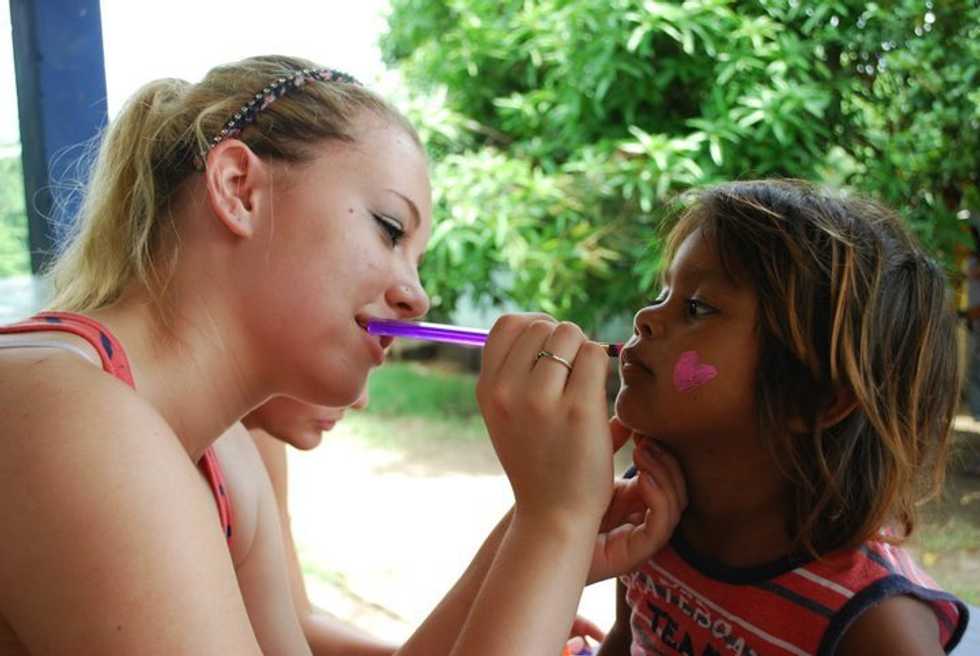
The day I journey to the dumps was by far the best part of the mission. All of us, including the children, sang a danced all day. We even painted each other’s faces ending in a colorful paint-war. I believe that I left the dumps as a different person all because of that little girl. I began to think about all the people in my life that made me think I was never good enough based on how I dressed or how I looked. I reminisced the times I loved playing in the dirt, digging up “treasures” and making little houses for the worms and rolly-pollies. This little girl, who didn’t have nice clothing, pretty hair, or a clean face enjoyed her time with me. She laughed and smiled and was continuously filled with joy. That day, she taught me that nothing is ever too bad to not be happy, and we should not take anything in our life for granted because we might end up without it one day. Though sadness reflected off of the eyes of the children, their smiles told me not to be sad. Their smiles reassured me that there is hope in the world. They know how to smile and so should I.