


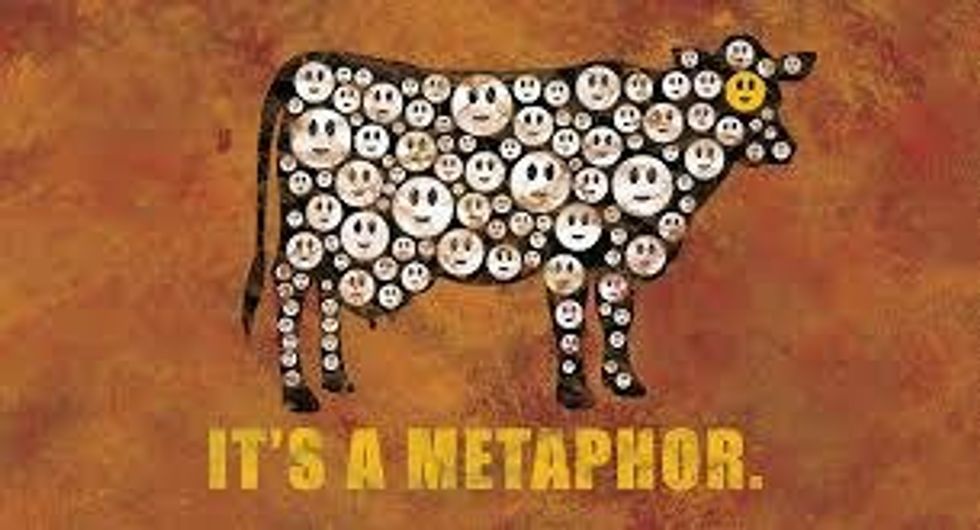
Regardless of whether or not you’ve read the "Bard" or seen "Dead Poet’s Society" you’ve spoken in a literarily creative way or understood and agreed with someone else's “Life is a highway,” “Negative exponents are my Achilles’ heels,” Their smile is literally a philosopher's stone,” etc.
Metaphors and similes help us both to communicate the weight and intensity of our feelings to others and also to ourselves (having already said that last summer's '20s themed party was “epic” and needing some greater comparison now to describe our anticipation of skydiving or something else and needing some more specific adjective for the matter). They (metaphors and similes) help make clearer the abstract motions of our psyche by marrying them to tangible and tactile objects around us.
Generally speaking, poetry relies on this figure of speech greatly as do powerful novels. Our lives are textbook individual phenomena though arguably the best works of literature gain such footing by allowing us to relate to the subject matter, how can we pull this off [If being understood by others and ourselves is indeed one of our goals or aim (which I’d defend is citing the social media platforms that sprout from coders hands like bunnies i.e. Facebook, Instagram, LinkedIn, Reddit, 4Chan, etc.)]?
Infinite Jest (I’ll try to avoid any big spoilers here if you’ve also managed to not read the novel celebrating its 20th year of publication this year, don’t fret), by David Foster Wallace, is among my summer reads and I’m on page 121 now. It's apparent already that the characters are intensively involved with their lifestyles in the sense that they understand the significance of the minutiae surrounding them and have become aware, either conscious or unconsciously, of their various machinations and parts. One such focus of a few characters is the game of tennis that is described as the marriage between boxing and chess. Granted, perhaps the characters don’t describe it being an extended metaphor to life, but the words they use to describe the game and the effort that they exert, both mentally and physically to play it well, leads me (the reader) to see it (tennis) as one big extended metaphor.
So here’s the real perk. An extended metaphor can serve as a mirror.
Perhaps you can feel a pimple on the upper left-hand corner of your forehead but until you gaze at the monster into the mirror the extent of its dominion can’t be fully appreciated. The same goes for our passions. I’ll use an example from my freshman year.
I was playing chess a lot with a friend who was really good. I was playing some games in the morning and several more after class for about three weeks before I started walking around with a ghostly translucent chess-board hovering in my vision. It started getting weird when I developed a crush on this girl who’d take the bus back with me after Monday and Wednesday classes and the people around her resembled knights with their weird L-shaped conversational intrusions, pawns being the people in the rows between her and I on that bus that I’d have to knock over, rooks and bishop being tricky abstract social norms I’d have to circumvent to approach her, the Queen, to checkmate her King, and get a smile.
I won’t argue against considering everything as a war-game is slightly deranged but I’ll state for the record that she smiled, though the next-level games that ensued thereafter aren’t done justice by a two-dimensional chess board and deserve another article (or probably a chapbook of sad confessional poetry).
The point is that the mental plane is like the ocean or space, there’s so much that we don’t have a name for yet but these gestures and motivations that others and we know ourselves by are merely the superficial waves or stars of those gargantuan atmospheres, and that naming and scrutinizing can illuminate the more subtle machinations with the end of helping us be more coherent.
When we connect some commonly understood thing, like chess, to some vague conception, like personality, the unknowns of the latter subconsciously take up roles in the former. While I was considering the ways to get that girl to smile the necessary pieces in the chessboard casted more unknown obstacles around that my heated spear (not a reference to something else) of desire and narrow-minded focus hadn’t had the foresight of.
And this is a successful feedback loop. Centuries ago, the same consciousness that evolved from an ignorant universe it was blind to carved those pieces and made those rules considering the real-life challenges of war as a metaphor that contemporarily a freshman would repurpose to understand the dynamics of getting to ask someone out on a date with, so the metaphor turned back on itself, with all the contents intact.
Einstein said that life is like riding a bicycle, one has to keep peddling to keep one’s balance. Life is also like writing an article, one has to keep giving words to the misunderstood.
So whatever it is: tennis, chess, bicycling, find your extended metaphor and elucidate the dynamics of your life (if you want to.)















