Killing Them Softly is a 2012 crime thriller penned and directed by Andrew Dominik, based on the novel “Cogan’s Trade”, written by George V. Higgins. This film is primarily about a mob protected card game that gets robbed, and the consequences that this has on the whole underworld community. Deciding it to be a fool-proof, fast-cash idea, two low-class criminals rob a big mafia card game. In order to restore the criminal economy and the mob’s “political” image (the street image, so to speak), Jackie Cogan, a hit-man, is hired to clean up the mess. I, for one, am a fan of these neo-noir crime movies coming out, maintaining themselves not with over-saturated violence but with slick dialogue and cool/unconventional characters.
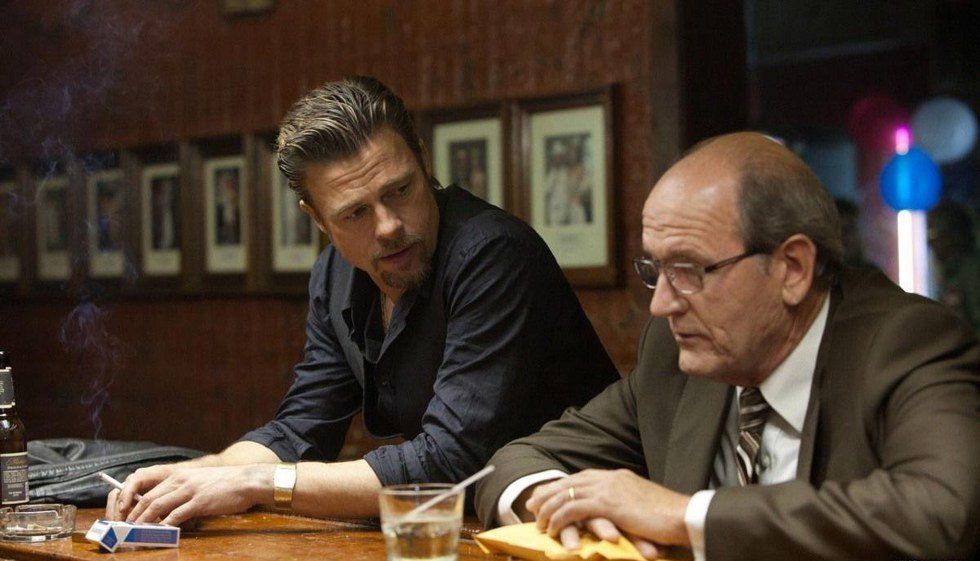
The film stars Brad Pitt as Jackie Cogan, a nonchalant and calculated mob enforcer, who has an authenticity to him that makes you think maybe this is how actual hit-men are, instead of the blood hungry guys we see in a lot of movies. Richard Jenkins plays the middle man between the mob and Cogan, Ray Liotta takes yet another organized crime friendly role as a card game holder, and James Gandolfini is a burned-out hired gun called in from out of town to help on a job. Scoot McNairy and Ben Mendolsohn also give fantastic turns as desperate hoodlums with comedic capacity.
Killing Them Softly was produced by Pitt’s Plan B Productions and Anchor Bay Productions, and distributed in the U.S. by The Weinstein Company. Although not having nearly enough money to support Pitt’s usual salary demands, Brad signed on to do it anyway for just one million U.S. dollars. He would later cite his fondness of the story and eagerness to work with director Dominik again, whom he starred under in 2007’s widely acclaimed The Assassination of Jesse James By The Coward Robert Ford.
I selected this film, besides the fact that it has been one of my favorites recently, because of its interesting Marxist undertones dealing with who has power, why, and in exposing parallels between a nation’s economic crisis like ours and that of a criminal enterprise; because the downfall of a system is a product of its upstart, its soul. The audience intended for this film is geared toward young, adult males largely but also to an extent toward adults of any age or sex. The violence, characters and dialogue are typically more testosterone friendly, but the overall effect the film intends to provoke among its viewers can appeal to a wider audience. Although I will say, I was oblivious before the analysis of this film of just how little female presence there is in the picture. One female character is scripted, and she has about a minute or two of unimportant screen time. Interesting, but that’s another article for another day.
The definition of a Marxist perspective is one that focuses on the premise that material conditions and economic practices form the prevailing ideology, dictating who ought to be and ought not to be empowered. The goal of a Marxist critic is to uncover how popular culture texts reinforce the existing state of affairs of power structures as customary and common sense.
In this analysis I will focus on concepts of materialism, economic metaphors, economic conditions and hegemony. Materialism consists of physical and economic conditions, including all ideas, norms, laws, customs, etc., that have an economic base (that is, who owns what and who controls what). An economic metaphor can include practically any image, event, or practice that suggests something about the culture and its norms and principles. Materialism and economic metaphors go hand in hand, each representing the other to a certain extent. Hegemony is the favoring of a dominant groups ideology over that of other populates. How does that maintain? Typically, those who own the means of production can and do shape what is being produced by those means of production, leading to the ideas becoming widely established.
This film itself is flooded with economic metaphors and reeks of materialism, so I’ll just pick out a few examples. Another Marxist idea is that an individual is only worth what they are able to produce. The only thing the working class can really own is their labor, in comparison to the capitalist class which own the means of production. Thus, in a sense, the capitalist class owns the working class because they own the means of which the working class is able to produce. This idea is prevalent in Killing Them Softly.
Mark Trappmann is a guy everyone loves, cool and friendly as he hosts the mob-protected poker games. But as soon as one of his games gets knocked over for the second time, after he himself knocked over the first one (because he couldn’t resist all the money he saw flying around), Markie’s future is decided. Or, at least that’s how enforcer Jackie Cogan figures it. “I thought you believed him?” says the middle man sent by the head honchos to configure their next move with Pitt’s character, referring to Trappmann’s innocence in the second robbery. “I do believe him…,” Cogan replies, “but the games are closed right? People are losing money…guys on the street, they think nothing but Trappmann…I say we start off with Trappmann, get things started up again.” So why is Cogan so eager to take out an innocent and likeable guy, and his superiors likely to go through with it? Because of the financial implications if they don’t, for one; easy examples of materialism and economic metaphor.
Getting the games up and going again means a return to business as usual for the mob leaders and a halt of losses, and a hit for Cogan means, hey, more money. That is his job, how he makes a living. By convincing the people above him to sanction Mark’s hit, he’s making himself ten to fifteen grand that otherwise would not be coming to him. He embodies the working class, trying to get himself some more money, or, some more labor. The proletariat can’t get his labor without the Bourgeois providing it.
So the assassinations have been authorized, totaling in three hits for Cogan, only he needs old friend Mickey from out of town to help him out with one. “Mickey’s expensive,” Jenkins’ character protests, rebuffed quickly by Cogan, “Not at the moment.” “You got him for ten?”To which Cogan replies, “Fifteen. I think a quick fifteen for two days work would sound pretty good to Mickey in this economy.” Again, economic metaphors for materialism. Mickey’s expensive; the leaders don’t want to spend so much. But he’s not that expensive right now because in the current flailing economy, he’ll take what he can get. Everything in this film, all the decisions made about anything, is directly tied to financial implications. Not only materialism is in play now, but also certain hegemonic values being executed and preserved steadily.
Back to the Marxist idea of an individual only being worth what they are able to produce. Mickey arrives in town for the job, only he isn’t what Cogan was expecting. Instead of a guy ready to do a job, the viewer can immediately see that he’s in a state of drunk emotional distress, going on and on about his unfaithful wife and other personal fiascos as he downs drinks by the minute. Despite giving him a few days to get his head straight Mickey’s condition only worsens, and Cogan reaches his limit of understanding. Later that day Cogan meets with the mob middle man again and explains to him that the situation with Mickey isn’t working out. How do they get rid of him without paying him? “Well, the way I figure it,” Jackie starts, “Mickey’s gunna get into a fight with a whore at a hotel that don’t like whore fights. Police will come, see he’s violating his parole and back in he goes.” Set old Mickey up, send him back to the can.
That’s a pretty tough situation to put a friend in, isn’t it? Maybe not to these guys, especially when the individual in question is undoubtedly more trouble than he’s worth. If an individual is only worth what they are able to produce, and they can’t produce, then they have no more value, according to the Marxist awareness. That’s exactly the situation we’re seeing here. Mickey was brought in to do a job, wasn’t in a capable condition to do the job, so they got rid of him because his value was gone.
The final scene in the film pretty much sums up the whole conversation we’re having here, and the lines speak for themselves. All the jobs are done, and Cogan meets with the middle man for the final time to collect his paycheck at a local bar. An Obama speech is playing on a TV in the bar (radio and TV speeches by Obama and George Bush can be heard throughout the film) and when he says something about everyone being a collective people and society, Jenkins’ mentions that the line is for Cogan. “This guy wants to tell me (pointing to Obama) were living in a community?” Brad Pitt starts, “Don’t make me laugh. We’re living in America, and in America you’re on your own. America is not a country, it’s just a business. Now fucking pay me.”
This film continually suggests to the audience an imbalanced and imperfect economic system in America, and how who has power and why they have it is directly tied to economic conditions. The film also portrays the events that happen as being necessary reactions to a situation, being necessary because the mob leaders, the people with the most economic clout and thus who control the environment they are in, decide they are necessary. The audience can then conclude that the proceedings ordered out in this film come directly from a hegemonic value that has withstood not only in the mob community, but that mirrors general civil communities as well. The hegemony being that the population in power and that make decisions as to what is custom or acceptable are being maintained not only through their own financial dominance, but also through the oppressed agreeing with and maintaining the hegemonic values themselves.