


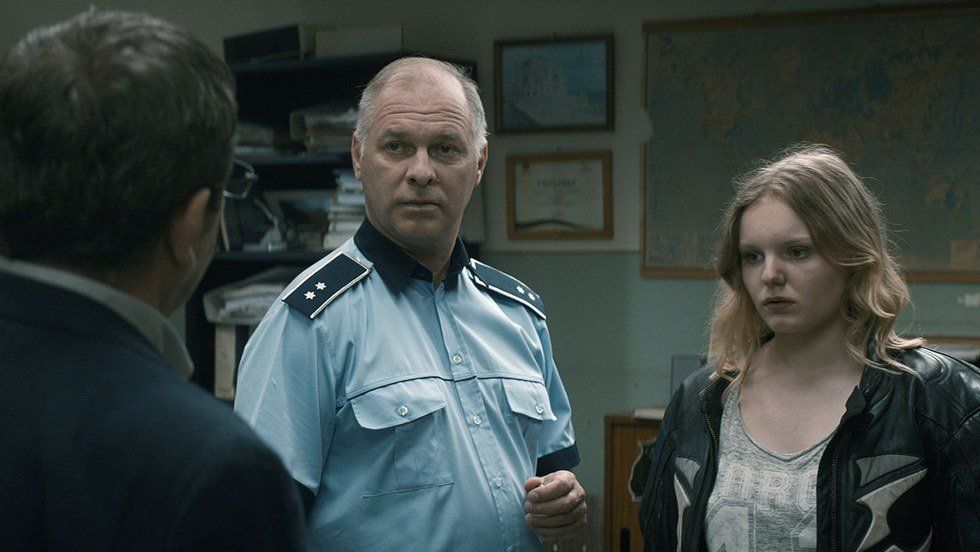
Cristian Mungiu's "Graduation" comes at a time in cinema, and for that matter society, when we ask ourselves not only why bad things happen to good people but what can be done about it. Romeo (Adrian Titieni) is a good doctor in a small town in rural Romania. The mother's side of my family is Romanian, from Bucharest, and the images of the film of post-Communist buildings and a crumbling infrastructure sadly make it all the more clear that this is a film firmly taking place in the present. Romeo drops off his daughter, Eliza (Maria-Victoria Dragus), at a spot close to her school that she likes to walk from to get air in the mornings. The day before what is essentially the Romanian SATs — which Eliza needs to score basically perfect in order to maintain a scholarship she is getting from Cambridge — Eliza is attacked and raped at the spot her father normally drops her off at. Unsurprisingly, the Romanian education system is so clogged with bureaucrats and faceless decision-makers, there is little that can be done in the face of such a tragedy and with such high stakes involved. Romeo decides he will do whatever he can to fight the system.
Now, typically, in American cinema, any person fighting against The Man is strong-willed and it's generally assumed that The Man will lose because that's the only way we progress as a society. Films about civil rights and labor laws show that their enactments were almost inevitable due to the inherent weaknesses of corruption and evil. Think of "Norma Rae", "Selma", and "Milk". Even if there's an asterisk about the results of these changes, the sheer triumph of the human spirit is astonishing on its own terms. How "Graduation" flips this is by asking what if the guy fighting against the system is weak. What if the guy fighting against the corrupt and inefficient system has no strong set of principles himself? What if Job tried to stop the ailments and his own suffering without believing in God?
Which is not to say that Romeo is a bad guy. He's just trying to protect his daughter and seek justice for what's happened to her. But emotion clouds our judgment. He turns to cheating on the exams, to bribery and even the help of gangsters and dirty cops. Certainly the sin of cheating on an exam is not an equal to being raped and traumatized. Why should his daughter suffer because of something that wasn't her fault? It's enough to make anyone justifiably angry, and the audience, for the most part, wants Romeo to succeed in helping his daughter cheat on the exam. But the genius of the film is in making us question the ethics of the matter on an absolutist level. Is this not how the Romanian government ended up in the first place? Is not the road to Hell paved with good intentions?
The movie is a lot to take in. It may be the best film I've seen this year, but I still need to mull it over. There's plenty of symbolism that I'm still trying to understand: a recurrent motif of stray dogs, the son of Romeo's girlfriend (mistress?) always wearing a wolf mask, and a sub-plot involving someone throwing rocks into Adrian's house and through the windows of his car. Maybe the vandal is representative of evil in the world. We can try to chase him down and stop it. It's the only way to have a civilized society. But we can't be all "Death Wish" about it.

















