The nighttime is beautiful, especially in the mid-Autumn with temperatures just cool enough to bed the need of some cozy piece of clothing, but warm enough to make nighttime walking pleasurable. Before college, I used to love slipping out onto my porch after everyone had gone to bed and watch cars pass along the road in front of my house. There was an old barn in front of my driveway, almost falling down, rotted out. At night, it was more foreboding than "vintage." I always thought I'd look up to the top window and see the face of a pale woman looking at me. That was the scariest thing about living in my old town, Owego, which was much like New Paltz only smaller, campus-less. When everyone had gone to bed, I could let myself and curl into a comfortable chair. I could bring a light to read with or just watch the stars and enjoy the quiet
I have always wished I could make a habit of taking night walks. Especially on the New Paltz campus, a walk around the lake in the dead silence of the night, say midnight or close to one a.m., to watch the moonlight shift on the water would be lovely. I like quiet things. I like the dark. I like the water. I wish I could experience it with the freedom that half the population is entitled to.
Ever since I was a young girl, women like me and girls that will become like me were and are given rules to follow. These rules are to help us stay safe. It's not simply things like "don't grab the knife at the sharp end" or "don't run down the stairs." We're told the night is dangerous because everywhere we go, there could be multiple people in the shadows fantasizing about hurting us. We're told that when someone whistles, you keep walking. You don't look behind. There are other things, implicit things that we don't have to be told. For instance: if you look at a man too long, he might mistake that for interest. If you're very unlucky, he'll get the courage to harass you about it. He'll say you wanted it, that you led him on, that you're being -insert a slew of bad words-. We're taught that we need to police ourselves to keep safe.
Just the other day, I went out in town to spend a nice day by myself. I went book shopping; I sat at a cafe for a few hours. All in all, it was a peaceful day. When I started back to campus, I found myself having to pass three drunk men clustered on the outside of the sidewalk. What prompted these men to be drunk by six o'clock, when it was still light out, I don't know, but to get by them I had to slip between their bodies and the wall of a building. Out of no where, one of them opened his arms wide and cornered me there, between the building, himself, and his friends. He asked me for a hug. That sounds harmless, yes? Only I freaked out. I panicked. Here I was, backed into a corner, with a man who was clearly intoxicated, asking to touch me. I snapped "no" at him and rushed past, slipped into Starbucks and sat with a beverage having a quiet panic attack in the corner of the cafe. I called a cab to go back home.
Everyone you go, you hear statistics on how many college women are raped in a given period of time, how many men believe that coercing women into sex isn't rape and eventually it gets ingrained in you. The terror becomes part of you.
I'll say it: I am afraid. When my class gets out at 9:20 p.m. on Mondays and I have to cross campus to get back to my room, I am terrified. At every rustle, I'm checking behind me to make sure that at least the person there is a woman or, if a man, at least there's a woman with him. If there's just a man alone, I keep looking behind me, making sure he doesn't close the distance between us. There's always the chance that at any moment I could be grabbed, hurt beyond repair and traumatized for the rest of my life. This is what we learn as young girls. When we're supposed to be outside playing and discovering the world, we're learning fear and all the ways it will eventually control us.
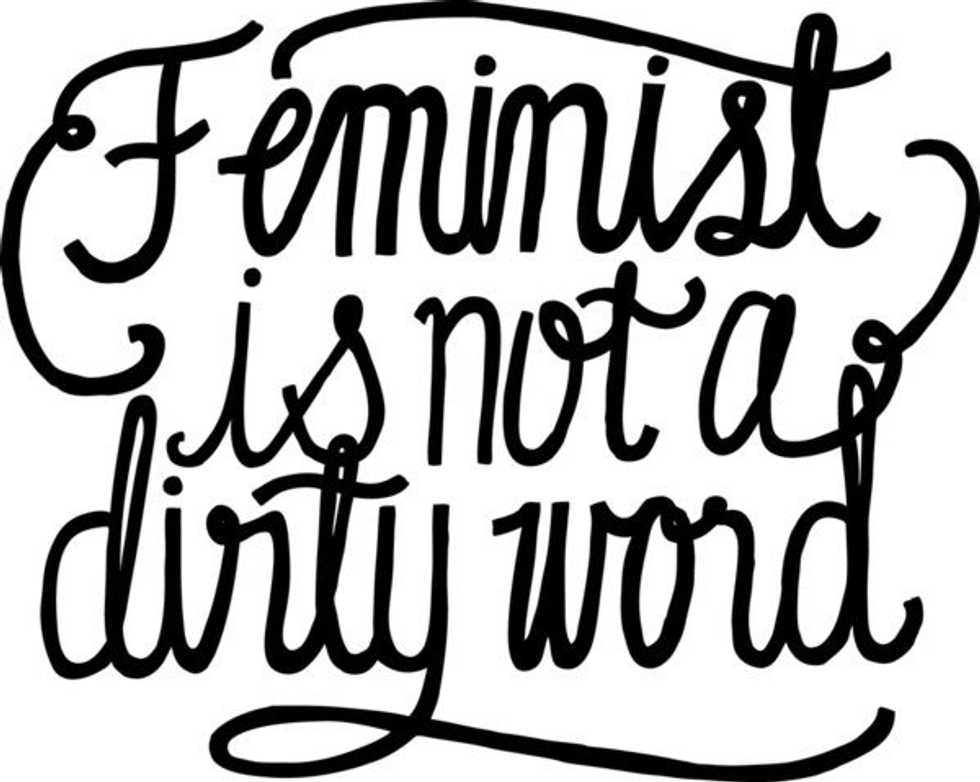
In a lot of "political debates" that I've either witnessed or been a part in, either through media or in face-to-face interactions, feminism has taken on a connotation that seems to be only strictly political. It's something that immature boys use to narrow down the dating pool (as in: "you're not a feminist, are you?"). I think what some of us are forgetting is the humanity behind it. Feminism didn't become "a thing" for any other reason than the fact that people, women, decided that some of their every-day suffering was unjustified.
We're connected to a lot of information now and something I've been thinking about recently is the idea of desensitization. What does suffering mean? What has it come to me? Has it come to mean nothing, unless we're the ones experiencing it? And honestly, where is the compassion? I'm sick of seeing feminists dragged for being too political, not political enough or what have you. Certainly, critiques are necessary, but only critiques founded on something real and solid, only critiques that make sense. The rest of them are just words that distract from the real pain that women feel every day.