Clichés are, well, obnoxious. And yet, phrases don't become cliché unless they ring truthfully enough to be repeated over and over again: actions speak louder than words; better safe than sorry; history repeats itself. The truth behind the latter phrase is highly unfortunate, and we have no one to blame but ourselves. We like to think that when mistakes are made or injustices committed we learn from them and resolve to do better, to be better in the future. And yet we continue to repeatedly make the same mistakes, individually and corporately.
The racial tension as of late (as of always?) is a prime example of this. African Americans fought for equality and an end to segregation in the 1950s and 60s; segregation is now illegal and yet here we are in 2016 and, once again, the political battle for equal treatment, equal protection, equal opportunity is back on and our nation is divided.
I watched a movie this week that reminded me that this public racial tension has happened before. Based on a true story, Remember the Titans (released in 2000; directed by Boaz Yakin and starring Denzel Washington and Will Patton) is a film about a high school football team in Alexandria, VA. In 1971, the school board forced the integration of the town's high schools and chaos ensued. The movie follows as the members of T. C. Williams High School's football team navigate the ensuing tension.This movie also reminded me to be hopeful. Filled with quotable one-liners, I find this movie to be filled with important lessons. (Warning: the following paragraphs contain spoilers.)

At one point during the team's football camp, Lewis Lastik (played by Ethan Suplee) sits down to eat his lunch at a table with some of his black teammates. He faces criticism from Julius Campbell (Wood Harris) who asks why he doesn't sit with his "own people", and he responds, "Man, I don't have any people. I'm with everybody, Julius." Lewis is perhaps the only character in the movie that doesn't struggle to accept people of the other race; instead, he acts a catalyst for harmony among his teammates. Lesson: be with everybody. We don't have to be colorblind to accomplish this. Race is an important, valuable part of who we all are, but it should be embraced and celebrated rather than serve as a cause for divide.
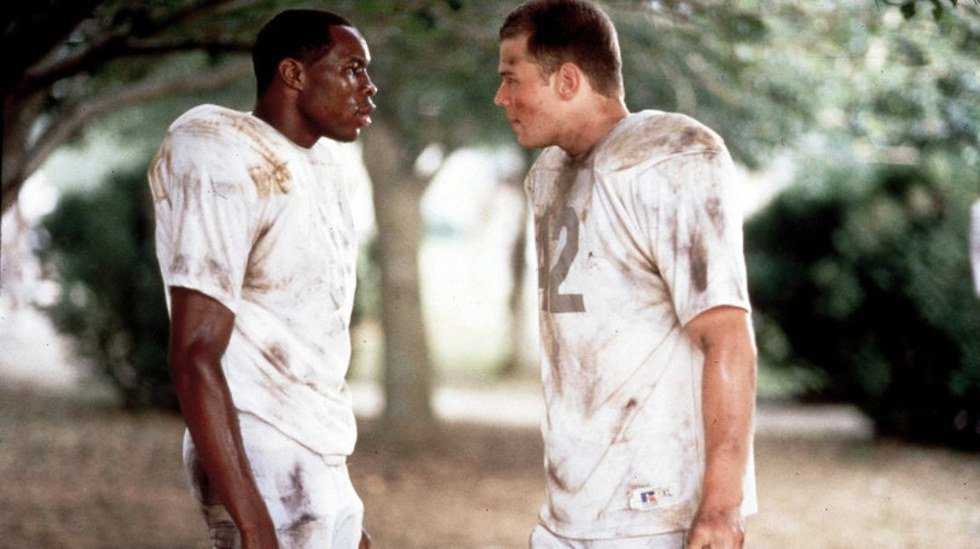
A fight breaks out in line for water after a grueling practice when a black player steps in front of a white teammate. Sheryl (Hayden Panettiere), the 9-year-old daughter of Coach Yoast (Patton), yells, "Quit it, jerks! Come on, you're all actin' like a bunch of sissies!" Even at her young age, Sheryl realizes that the hatred between the black team members and the white team members over petty things is distracting them from what's important: football. She calls out their hatred as ridiculous, childish, weak. Lesson: don't be distracted by petty arguments. If we're going to be angry, we should focus our anger on what's important.
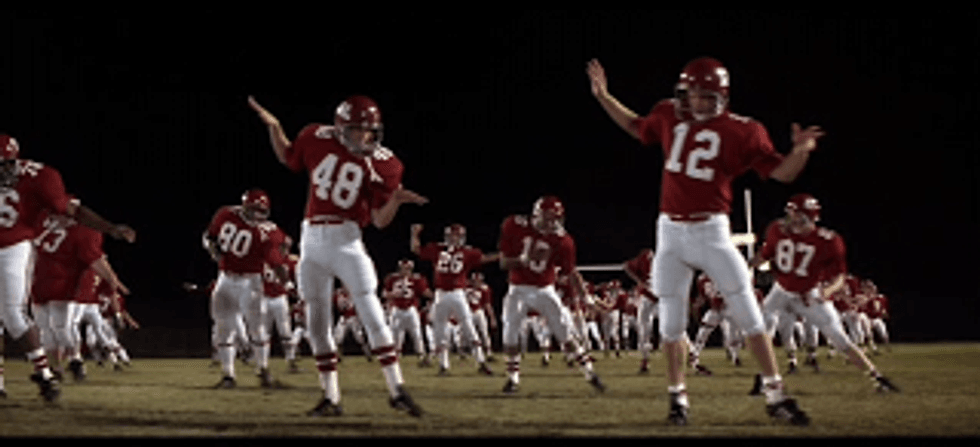
Eventually, the Titans learn to overcome their differences. They learn to work with, respect and befriend one another. At one point, this leads to the Titans dancing and singing their way onto the field for a game, much to the surprise and irritation of the opposing team. The other team's coach scowls and, to one of his nearby players, says, "Shut 'em up. Hard." Lesson: the enemy wants to shut you up. They don't like the appearance of harmony and togetherness. Don't let them get to you. Speak out for justice anyway.

Near the end, white teammate Gerry Bertier (Ryan Hurst) finds himself in the hospital after a car accident. Julius, who has become one of Bertier's closest friends, comes to his hospital room to visit. When the nurse sees him, she politely mentions that only family is allowed in to visit. Bertier looks at her and says, "Alice, are you blind? Don't you see the family resemblance? That's my brother." Alice allows Julius to stay. Lesson: brotherhood is not defined by skin color. Rather, it is defined by kindness, compassion and love. We don't get to choose who we're related to by blood, but we do get to choose with whom we find brotherhood.
Don't give up. News reels highlight the war, the violence and the anger in the world, but love still exists, and there's always hope. At the beginning of the film, Coach Yoast almost quits his job and abandons his team because he didn't want to work under Coach Boone (Washington). But after some thought, he tells Sheryl, "This is a heck of a time to be abandoning 'em to look out for themselves, ain't it?" And he stays. Coach Yoast was a leader in his community; his willingness to remain with the team accomplished much in the way of racial reconciliation in his town. Lesson: use your influence to advocate for what's right. Don't abandon your team. Don't fail to speak out for justice, even though it may be uncomfortable.
The Titans found victory on the field, but more importantly, they found victory in being reconciled to one another. May we follow their example and learn to do the same.