
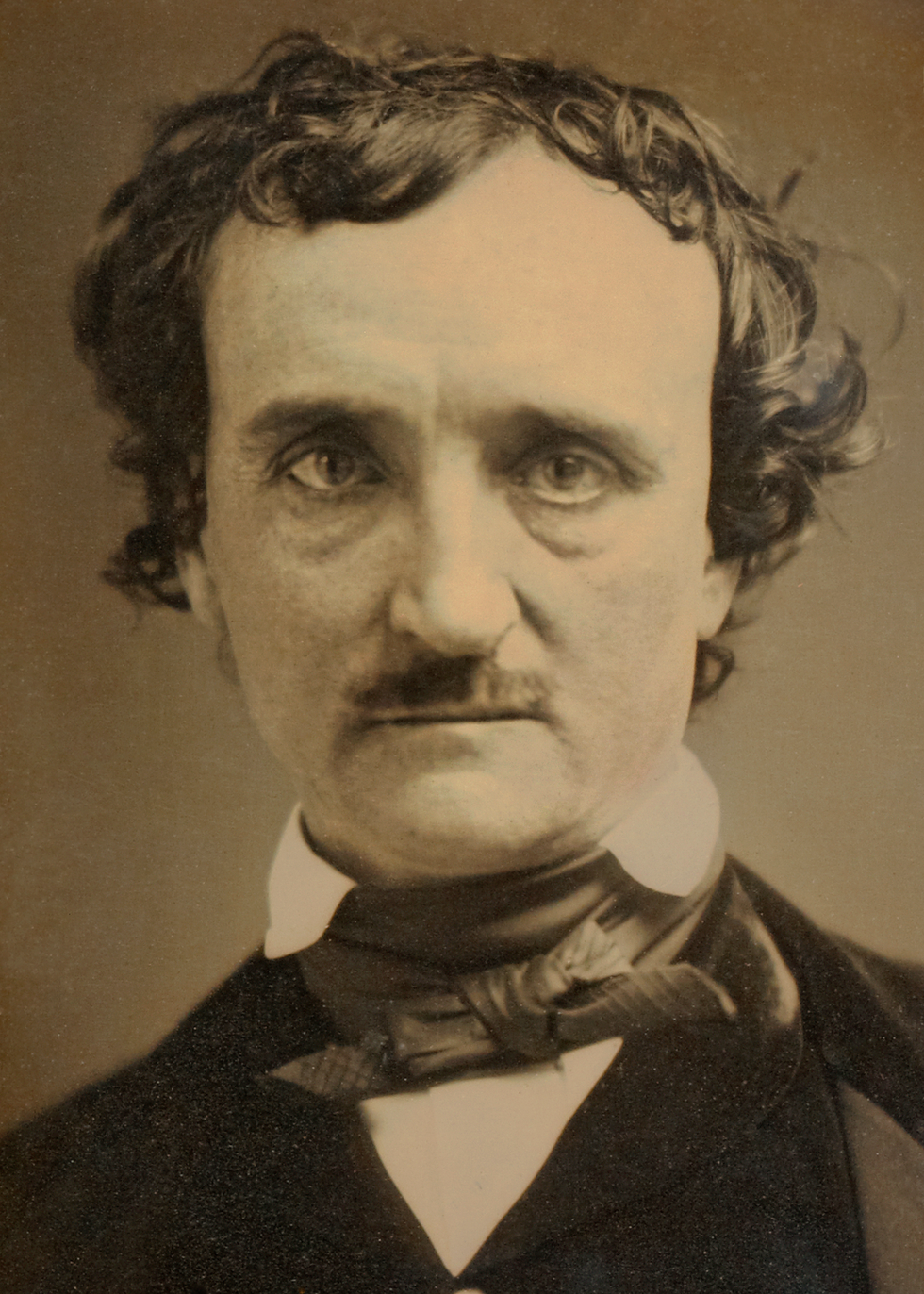
On February 14th, 1826, Thomas Jefferson’s one-year-old University of Virginia enrolled a class of 177 students. Among them was a seventeen-year-old orphan and aspiring writer named Edgar Allan Poe.
Although his residence at room 13, West Range would prove to be of a saddening short duration, he would leave behind both a legacy and a legend at the first and only university that would be his home.
Edgar Allan Poe was born on January 19, 1809, the child of two traveling actors. The early deaths of his parents left him in the care of a prominent Virginia merchant, John Allan, with whom he had a difficult relationship. The Allans stayed for some time in Great Britain, and it was here that Poe was possibly first exposed to the currents of literary romanticism then sweeping the western world. He excelled in Latin and Greek, and with the help of special tutoring, he was admitted to the fledgling University of Virginia.
Mr. Jefferson’s University was, at the time, a small and struggling institution. Lack of funds and a high dropout rate had plagued the University’s early days, as did a culture of drinking and gambling among the University’s predominantly aristocratic student body. For Poe, who hoped to study ancient languages, the entering the University meant exploring a new and uncertain world.
Perhaps the brooding, melancholy ideal of the romantic genius had already begun to affect the young writer. He soon gained a reputation as a bright but solitary student who spent much of his time in the company of books. Although he disliked formal study – he only took classes from 7 to 9:30 in the morning and frequently showed up unprepared – his advanced knowledge of linguistics and remarkably retentive memory allowed him to prosper nevertheless. Easily reciting memorized passages of the classics, Poe took high honors in his examinations, particularly in Latin and French.
Meanwhile, Poe had already involved himself with one of the oldest and most prestigious societies at UVA – the Jefferson. Elected to the society on June 17, 1826, Poe presented at least one essay to its members and even served as secretary pro tem. In the meantime, he had already embarked on the prolific writing of essays and short fiction, gathering a circle of friends in his lawn room to listen to his latest compositions. Poe’s fondness for cryptology, suspense, and twist endings – the elements that would go on to characterize his invention of the modern detective story – were already apparent in his early efforts at fiction.
Perhaps his status as the child of actors influenced Poe’s early efforts, for he soon became known for the theatrical quality of his dramatic readings. Sweeping gestures, a wide intonation of voice, and a lively passion for surprise could describe Poe’s enthusiastic recitations. Yet though generally well-liked, he could at times show flashes of the depressive and unpredictable nature that characterized his later years.
Once, when reciting a story, a member of the audience remarked that the hero’s name, “Gaffy,” was repeated too many times; Poe, enraged, responded by hurling the manuscript into the fire. It was an ill-considered action, for the nickname “Gaffy” thereafter stuck, and still followed the young writer in his days at West Point some years hence.
As a man of letter’s Poe’s perspective on the University’s evolution is of particular interest to contemporary historians. In a long letter to John Allen, Poe describes the ongoing construction of the Rotunda and the beginnings of other University buildings; UVA was transformed from a small, struggling college into a larger and more expansive university. Poe’s letter does not perhaps seem so far from today’s University; like many contemporary students, he noted with apprehension the approach of finals, lamenting the many hours spent cramming for his exams.
Poe might have had a long and successful tenure at the University had it not been for his fondness for cards, an affection which sadly was not accompanied by skill. Within a short time, he had run up over $2,000 in gambling debts, an enormous sum in the currency of 1820’s America. When John Allan refused to pay, Poe reluctantly agreed to depart the University, leaving in December 1826 to return to work at his guardian’s business in Richmond.
Poe, of course, would soon rise on to better things. Within the next few years, he would go on to publish his first poems and involve himself in the emerging world of literary magazines, where he spent most of his short but productive career. By the time “The Raven” was published, Poe had become a household name, though his financial difficulties and erratic personality continued to mar his literary success.
Poe’s tragic life, mysterious death, and enduring legacy in literature continue to preserve his name within the pantheon of American writers. But the University of Virginia retains a particular importance with Poe’s fascinating career. His poem “To Helen” may well reference the University’s iconic Lawn; “ A Tale of the Ragged Mountains” recounts his youthful experiences in Charlottesville. And most prominently, “Tamerlane” – Poe’s first completed book – was mostly written during his months as a student.
Today, Poe’s Lawn room may be seen a short distance away from Jefferson Hall, where the poet once participated in the literary life of the University. Though Edgar Allan Poe remained only a short time at the University of Virginia, his enduring legacy is still preserved on the Grounds of Mr. Jefferson’s University.














