


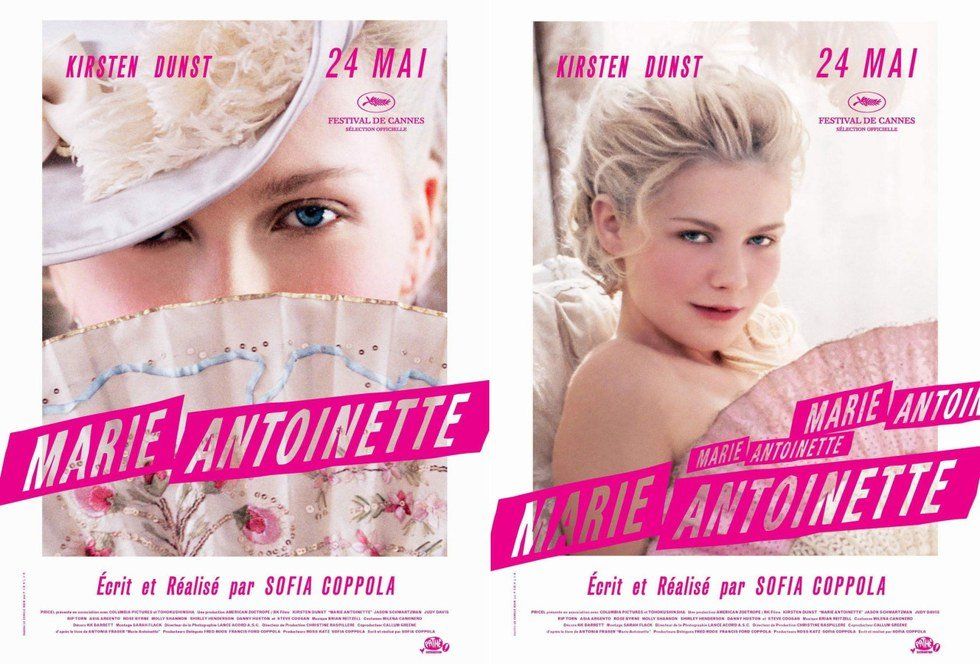
Any film student knows Sofia Coppola's name; in many circles, her status as a budding film auteur is highly debated. Some argue that it is too early to tell, that auteurs earn this title later in life, after having directed numerous films. Such a title should reflect a lifetime of work, not someone who may still be at or not yet have reached their peak as a movie director. Regardless of one's stance, however, Coppola's accolades are undeniable. As a screenwriter, director, producer and actress, she has won numerous awards for numerous films. It is no surprise, then, that her film "Marie Antoinette" (starring Kirsten Dunst in the lead) is as electrifying as it is eye-opening.
The film may have a simple, straightforward title; but that is the only time that such adjectives can be used to describe it. Coppola tells the story of Marie Antoinette, France's infamous queen who ruled with her husband Louis XVI through the eve of the French Revolution. Starting with her marriage to the then-dauphin, at age 14, we follow Marie Antoinette through her life at court as a queen, teenager, wife and young mother. The film opens with her departure from Austria, her homeland. Then still Maria Antonia Josephina Johanna Habsburg, she is told she must relinquish all ties to her homeland. None of her old confidantes may accompany her on her new journey; she may not cross into France wearing clothes from Austria, and she must even give up her favorite pup. Although this is at first shocking and sad for the young teen, she truly adopts the French identity in the film.
What is masterful about Coppola's re-telling about this fascinating historical figure is her ability to blend modernity with history to truly convey the emotions of a teenager thrown into the infamous royal French court. The dialogue is entirely modern; close your eyes, and Kirsten Dunst sounds like any naive, slightly spoiled, yet utterly charming teenager. Additionally, all of the non-diegetic music is modern as well, full of punk-rock-y bands such as The Cure, New Order, the Strokes, etc. One infamous scene includes Marie Antoinette and her new confidantes admiring the latest fashions in hairstyles, makeup, clothes and shoes with an "I Want Candy" remix playing over the scene. While it may be assumed that this takes away from the historical aspect, it actually makes the plight of Marie Antoinette even more relatable.
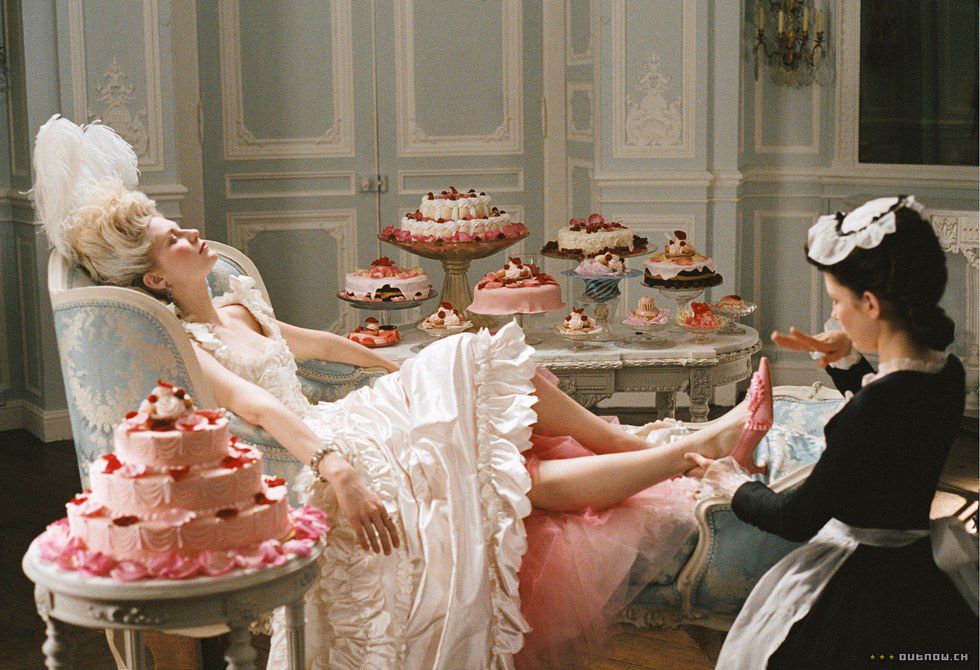
The other two strengths lie in the cinematography and mise-en-scène of the film. Coppola shot the movie on scene at Versailles, so the opulence on set is very much real. The costumes, though perhaps a tad exaggerated, go hand in hand with the decadence that is very much associated with Marie Antoinette's life. Coppola expertly explores issues of identity and culture, particularly for a young foreigner marrying into a court known for its high cultural and nationalistic standards. Scenes such as the redressing of Maria Antonia in French dresses is emblematic and symbolic of the literal and figurative transformation she must make in order to be accepted in her new kingdom. She explores sexuality in a remarkably subtle way. Kirsten Dunst expertly depicts the pressure that Marie Antoinette feels about consummating her marriage and conceiving an heir in order to seal her position at court.
It is true that French reviews were mixed. When it premiered at the Cannes Film Festival, it was met with a mix of applause and boos. Some French critics were miffed at the loose historical accuracy, and the lack of criticism towards Marie Antoinette's decadence. It should be noted, however, that Coppola herself stated her film was an interpretation, not a history lesson. She sought to explore the human being behind the sensationalized story of Marie Antoinette, and this should be kept in mind when watching it.

















