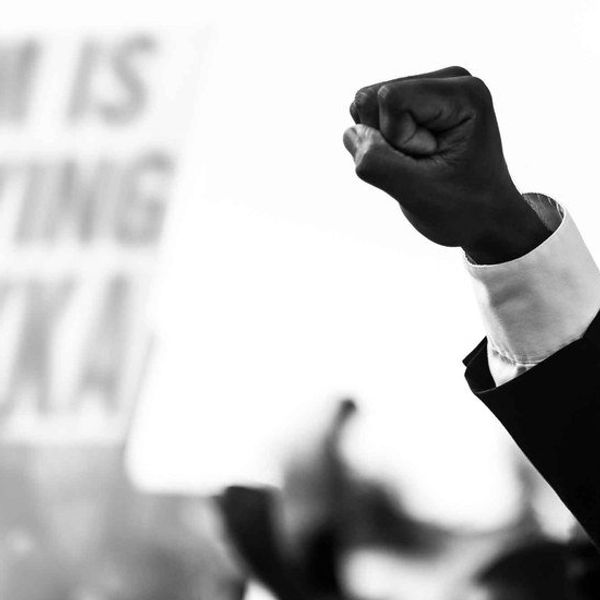
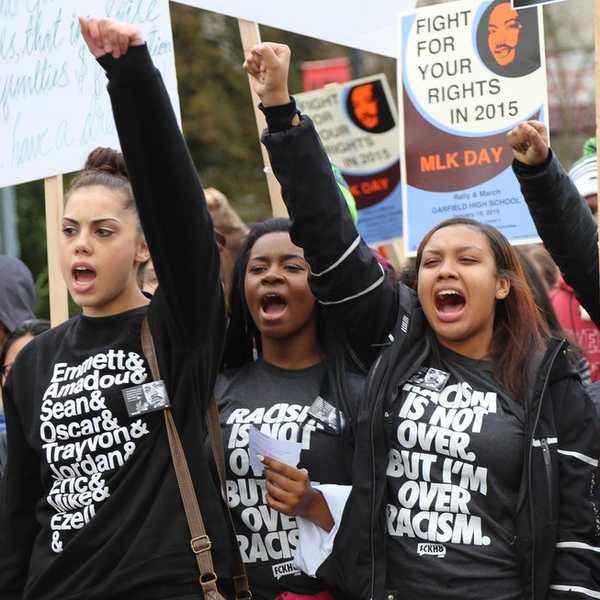
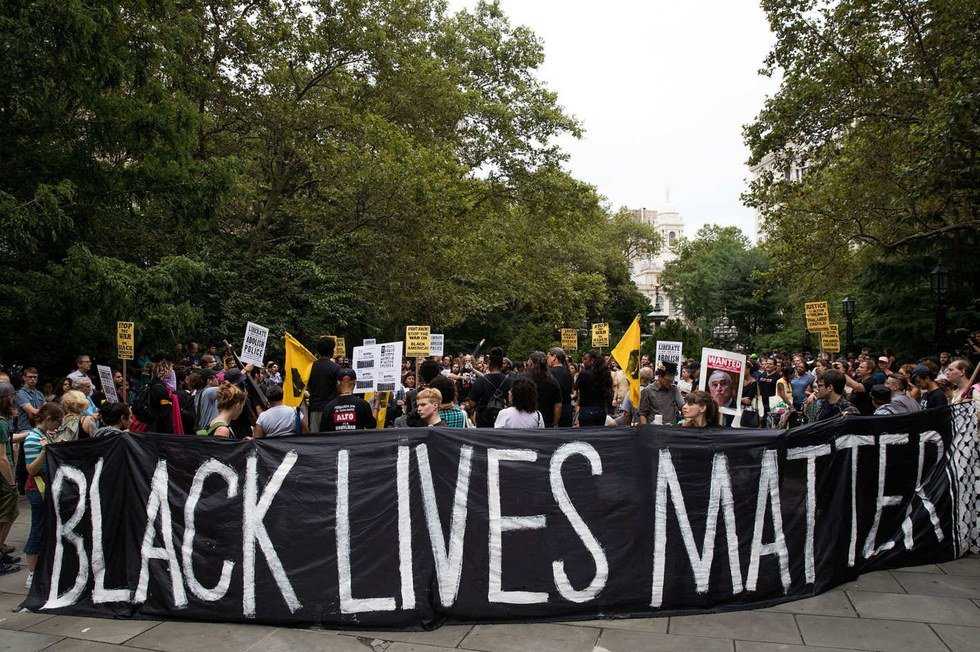
Two years ago today, August 9th, unarmed teenager Michael Brown was shot and killed by a police officer in Ferguson, Missouri. From that incident came the comeback of the Twitter hashtag #BlackLivesMatter, originally just a social media outcry for justice that morphed into a political movement that will likely be celebrated in history textbooks.
As it is now, BLM really all began with Brown's murder. It was the boiling point that sparked a revolution. Originally, the Twitter hashtag surfaced in 2013 after the acquittal of George Zimmerman in the shooting of Trayvon Martin. By the next summer, the hashtag had mostly died down, until news of Michael Brown's death and images of his body lying in the street went viral over the internet, and elicited media attention and protests nationwide. Now, #BLM is almost an umbrella term regarding the now nationwide conversation addressing police brutality, among other complicated social and cultural issues in America, many having to do with systematic racism. Some even argue that without the viral statement sweeping the nation, the Black Lives Matter movement would have never gained as much traction as it has today.
But why did something like a trending Twitter hashtag transcend into a political movement while other top news stories tend to fizzle out relatively quickly? The answer is quite simple.
Firstly, the ever dominating social media presence in our world largely dictates what's important to us in this day in age. For the most part, people only take a quick glance at an article or television headlines and base their opinions and priorities on what they first see and how they first react. There's generally not much research done by viewers searching through the news for particular types of events.
Secondly, BLM is perhaps the most important political movement to exist in the last three to four decades, probably since the anti-war movement during the Vietnam War.
However, even without the death of Michael Brown going viral, the BLM movement would have still likely taken off at lightning speeds. Something like this was inevitable. Think of all of the deaths caused by police brutality which have made major news headlines ever since. There are dozens. Several victims within the past two years include Eric Garner, Tamir Rice, Freddie Gray, Alton Sterling -- the list goes on and on. Just recently, in the process of my writing this article, another young black man was shot and killed by a white man "on neighborhood watch".
However, we can't also forget the lives of police. Just like racial stereotyping, it's unfair to paint them with a broad brush purely as murderers or "psychopaths." Police also put their lives on the line every day just to do their job, and there are still good cops. About one month ago to the day, five police officers were killed and 11 officers were confirmed to be shot in Dallas, Texas, during a peace rally for the deaths of Alton Sterling and Philando Castile, who were killed in nearby states by excessive deadly force via law enforcement. Although the police shootings were only done by one perpetrator, it was made clear by the shooter and his actions that it was a calculated attack, saying "he was upset about recent police shootings, that he wanted to kill white people -- especially white officers."
But there is a more imperative question that we must ask ourselves: will this pattern of brutality and the blatant disregard of human life end in the foreseeable future? It seems as if every week there's a new police-involved shooting of an unarmed individual on the news and, in response, police both good and bad are hunted as if targets are stuck to their backs. Yet more and more people continue to die by the hands of law enforcement, those who have promised to serve and protect. It has gotten to the point that this issue has long since transcended into more than a solely racial problem. On the official website, blacklivesmatter.com, it is explained that, "The statement 'black lives matter' is not an anti-white proposition. Contained within the statement is an unspoken but implied 'too,' as in 'black lives matter, too,' which suggests that the statement is one of inclusion rather than exclusion."
The issue is not simply about race, or about statistics of racial involvement in crime and law enforcement, nor is it only about death, although these are crucial points. The Black Lives Matter movement also demands the addressing of the racial wealth gap, combating issues of housing inequality and gentrification, which pushes people of color out of communities they've lived in for generations, and fixing the prison industrial complex.
BLM aims to achieve many goals, not just for people of color, but for the safety of all people in America. The Black Lives Matter movement has been made abundantly clear that although it has been two years since it's inception, this is just the beginning.