
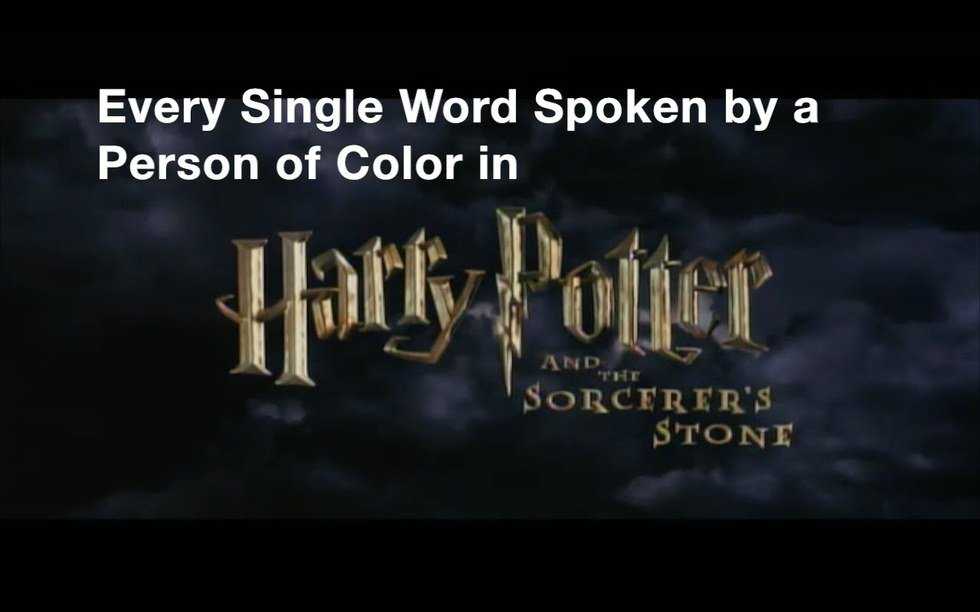
Hollywood has an image problem. Or, rather, it has a representation problem. The lack of diversity in Hollywood films has always been significant, but now, others are attempting to shed more light on the subject. The Tumblr project "Every Single Word" brings awareness to this issue in a shocking way. The project tallies every word spoken by a person of color in popular and academy-award winning films. These are presented as YouTube videos, and most only last 30-40 seconds, with one or two people of color featured as minor characters.
The "Harry Potter" series is heavily featured in this project, with a different video for each film and a comprehensive video for the entire series. Below the video featuring the entire series, the full statistics about people of color in the films are listed:
Total POC talk time: 5 minutes and 40 seconds.
Total run time of all films: 1,207 minutes.
That comes out to 0.47 percent of screen time in which POCs speak throughout the entire series.
This is split among 12 characters and 13 actors.
Of these 12 actors, 2 were CGI bodies voiced by POC actors.
On average, each POC character speaks for 28.33 seconds.
These numbers themselves are shocking, but watching the video and seeing the entire series through only the words spoken by people of color is even more so. "Harry Potter" is an important series, beloved by children and adults alike. This project makes it easy to see just how prevalent the lack of diversity in films actually is. Although, as shown by this project, "Harry Potter" is obviously not the only film series that demonstrates the lack of diversity in films. However, it is a pop culture phenomenon, and its relevance can lead to more discussions about representation in the media.
Since "Harry Potter" is based on a book series, it is important to look to the books when regarding the races of the characters. While in certain cases J.K. Rowling makes a character’s race clear, in other cases, race is more ambiguous or open to interpretation. This points to the fact that unless a character is specifically mentioned as being a different race, the default for main characters in films is white. There are likely many factors that play a part in this, but the tendency of white people to imagine characters as white unless otherwise specified is a significant one.
The implications of representation are also important when considering a need for diversity. Representation provides a sense of pride and validity. Using whiteness as “the norm” in film and pop culture not only excludes people of color, but could also lead to feelings of inadequacy and self-doubt. There are many prominent white protagonists and film stars for young people to look up to, but what about for young people of color? Since it is more rare for TV shows and movies to feature people of color as main characters and heroes, it makes it more difficult for them to picture themselves in leadership roles. Representation matters, and in order for the standards of Hollywood to change, it is important to bring awareness to it through projects like this. Check out the project here.