


I remember the first time I watched "American Idol." I had wandered into our family room to find my father reclining on the couch, eyes transfixed on our small, square television; the pixilated screen featured a plump man with a wide, bright smile belting into a microphone. I crawled up onto the couch next to my dad, who explained what he was watching and introduced me to names like Ruben Studdard, Ryan Seacrest, and Simon Cowell. At the time, these names were unfamiliar, but they soon acquired meaning as my interest in "American Idol" grew.
I was disappointed to hear of the reality show’s final season finale this past Thursday, April 7. Since its ending, I have spent a fair amount of time reminiscing about my "Idol"-influenced child hood, and my favorite parts of the show came rushing back to mind.
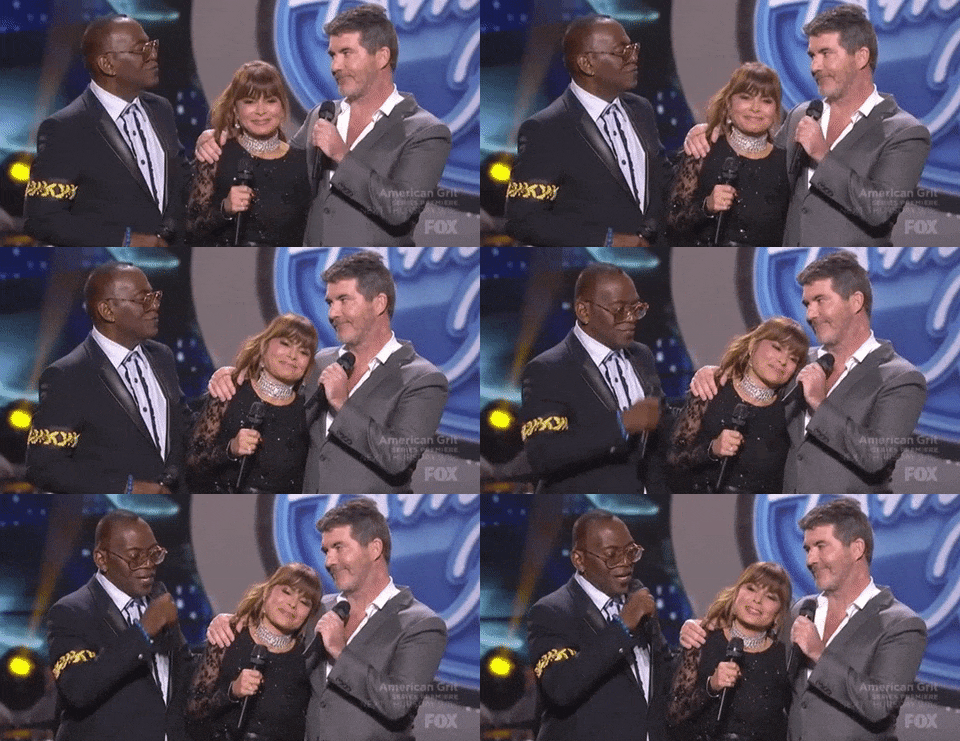
To me, the most iconic part of "American Idol" was the triumvirate that made up the original judge panel: Randy Jackson, Paula Abdul, and Simon Cowell. I loved Randy for his down-to-earth, go-with-the-flow demeanor. I appreciated Paula’s kindness and constant praises on everyone’s appearances (“That may not have been your best performance, but you look beautiful tonight!”). I was not so keen on Simon, who stood out with his strong accent, harsh criticism, evil closed-mouth smile, and oddly middle-parted hair; however, he was more of a character whom I loved to hate rather than actually hated.
Because I have no talent for singing, I relied heavily on the judges’ commentary to decide whose performances failed and whose succeeded. Paula tended to praise everyone, so I knew if she said someone had done poorly, they must have done really poorly. Similarly, I knew if compliment-stingy Simon offered praise, they must have done extraordinarily well. Randy was somewhere in between, but his excitement was infectious and at the least he could always be counted on to introduce me to new slang (“Yo, dude, that was hot! I’ll be seein’ you in the dawg pound tonight!”).
As well as the original iconic trio, "American Idol" hosted an array of additional judges, only two of which made a lasting impression on me: Ellen DeGeneres and Nicki Minaj. I remember my mom harboring strong opinions of these judges; she adored Ellen’s humorous commentary but hated Nicki for her bubblegum-pink hairdo. I frequently defended Nicki’s hair with “It doesn’t matter if it looks good; it’s supposed to make a statement!” while she repeatedly warned me that I “better never dye my hair that color!” (Don’t worry, Mom, I’m still not planning on it.)
I can’t discuss hairstyles without mentioning Sanjaya Malakar, the Season 6 contestant known probably more for his wild mane than for his singing ability. While my mom was strongly opposed to Nicki’s pink hair, my dad seemed more concerned over Sanjaya’s seven ponytails (again, don’t worry, I don’t plan to adopt any eccentric hairstyles anytime soon).
In addition to Sanjaya, there was a wide spectrum of contestants whom I found memorable. Especially as a younger child, I discovered role models in "American Idol’s" talented performers. First was Carrie Underwood, the curly-haired blonde with an endearing southern charm. I remember cheering when she won and asking for her CD the following Christmas.
Later came Jordin Sparks, whom I admired for her bubbly personality and powerful voice. Soon after, I recall swooning over baby-faced David Archuleta just as much as the next 12-year-old girl, and I played his first single “Crush” on repeat for months. However, I’m a country music kind of girl at heart, and I also adored 18-year-old Scotty McCreery. My sister used to taunt me, saying, “He’s just a few years older than you, Kaitlyn; why haven’t you accomplished as much as him?”
Little did she know, at one point I did have plans to accomplish as much as him. During my elementary school years, I counted down the days until I would turn 15 and could audition myself. I planned to sing a mash-up of my two favorite childhood songs: Avril Lavigne’s “Complicated” and Vanessa Carlton’s “A Thousand Miles," and I had nearly daily practice sessions in the shower. Fortunately for my self-confidence, I recognized my utter lack of singing ability way before I was 15, and my once-anticipated audition day never came.
I don’t remember a specific time at which the show declined in popularity, but at some point I must have stopped watching; I was shocked to hear just a few weeks ago that its final episode was about to air. Although no longer emotionally invested, I was still displeased to hear it was ending once and for all. "Idol" gave all five members of my family a reason to crowd onto the couch and spend a few hours together, it sparked good-natured competitions between my friends and I, and it gave me role models and something to forward to each week. After all this time and these memories, I am sad to see it go. Thank you, "American Idol," for filling my childhood with 15 seasons of quality entertainment.

















