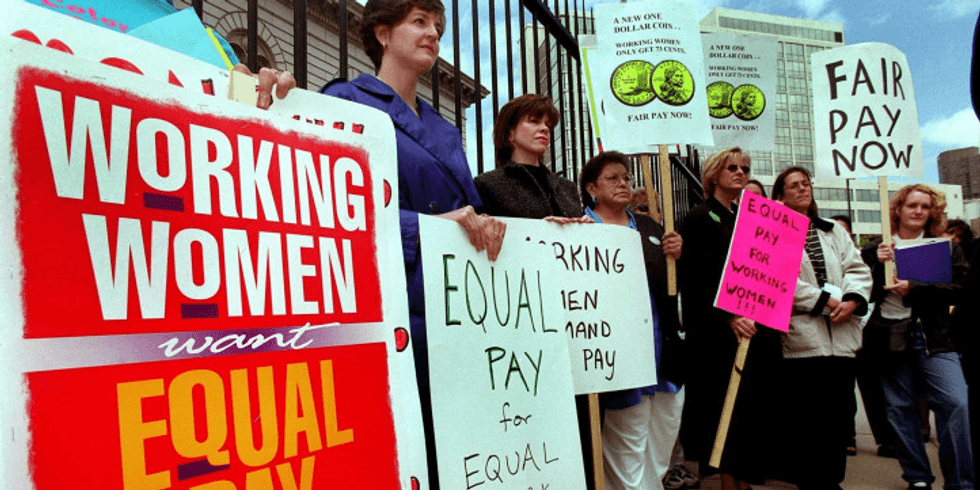
The fact that we do not have equal pay legislation already established across this country is one of those examples of where our laws have failed to keep up with ensuring equality for citizens. Equal pay legislation, like transgender nondiscrimination protection legislations, is another example of commonsense legislative reforms that has not been able to be passed, and I fail to understand why.
Over 50 years ago, the Equal Pay Act was passed by the U.S. Equal Employment Opportunity Commission, which set in writing the requirement that: “men and women in the same workplace be given equal pay for equal work. The jobs need not be identical, but they must be substantially equal. Job content (not job titles) determines whether jobs are substantially equal.” This is pretty commonsense: no one should be making different amounts of money for similar or equal work. However gender discrimination and inequities continue to pervade society systems and influence treatment, behavior, and yes also the workplace.
The Massachusetts Senate has been instrumental in passing equal pay legislation through their State Senate, and the bill is on its way to be voted on in the Massachusetts House of Representatives. So yes, progress is being made, especially in Massachusetts, but what about with other states across the nation? The time is now for equal pay legislation, and we need to make sure all workers are never barred from receiving equal compensation for the work they are doing.
Women Earn 23-21 percent Less than Men for the Same Work
The Bureau of Labor Statistics have shown based on analysis of the U.S. Census data, that women are consistently earning $0.79-$0.82 for every dollar that a man earns. However, this can then become $10,000 per year that a woman is not earning while her male co-workers are earning the full worth of their salary and work. The White House cited that over the course of a women’s career, a typical woman working full time will lose $431,000 because the gender pay gap is so devastating.
Numerous conservatives then attack this argument, citing that numerous factors have yielded different salary outputs. However, looking at the first year out of college will show you women making less than their male counterparts when various grade/major/school variables are removed from the equation.
Women Earn Less than Men in Male-Dominated Environments:
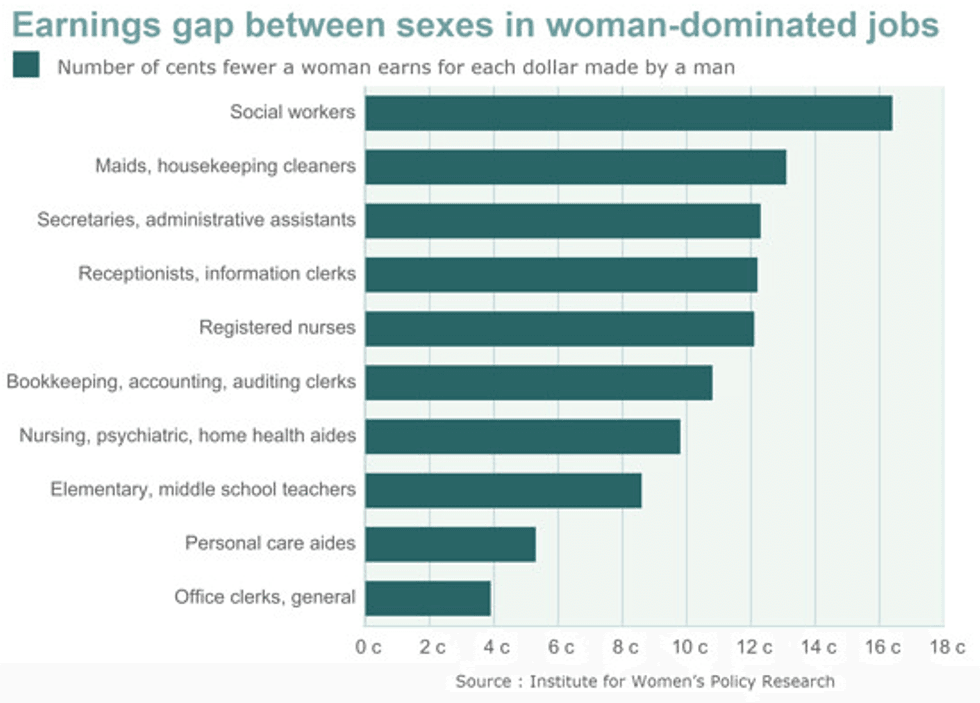
The Institute for Women’s Policy Research, among the 20 most common occupations for women in 2013: “women’s median weekly earnings for full-time work were less than weekly earnings for men. Within those top 20 jobs, that relationship holds true for occupations with the largest shares of women.”
However, The Bottom Line is: Eliminating the Wage Gap Helps the Economy
The guarantee of equal pay for equal work encourages more women in the workplace. More women in the workplace allows for more jobs to be filled and a more representational workplace.
Think Progress notes that even for low-paid jobs that are typically dominated by women, men earn more, and in male-dominated industries, women earn less.
However, the United States is uniquely difficult in providing maternity leave and pregnant working accommodations for pregnant mothers. The majority of working mothers want to keep their job, and want to do their job well. But, numerous mothers are forced by their employer to either choose between doing their job or their child’s health (or their own health). This burden disproportionately falls upon the mother, and other developed countries continue to move ahead of the US by accommodating for their working mothers in the workforce.
Yes, Pay Equity Is Real
For women of color, the gender-wage gap is even more crippling. The National Partnership for Women and Families conducted a student and found that: “African American women and Latinas in the United States are paid $18,817 and $23,298 less than non-Hispanic white men yearly, respectively. That’s 64 cents and 55 cents for every dollar a man earns.”
Given the disparity, economists fail to explain 40 percent of the wage gap between men and women. Possibly due to the fact that the US has failed to offer support or structures for working families, the long-term and long-lasting effects of the gender wage gap continues to negatively affect working women and families.
What Will It Take to Get Pay Equity?
Women across the country are waiting for the answer.
Let’s make sure a more comprehensive Pay Equity Bill is passed in 2016.
The time is now!