


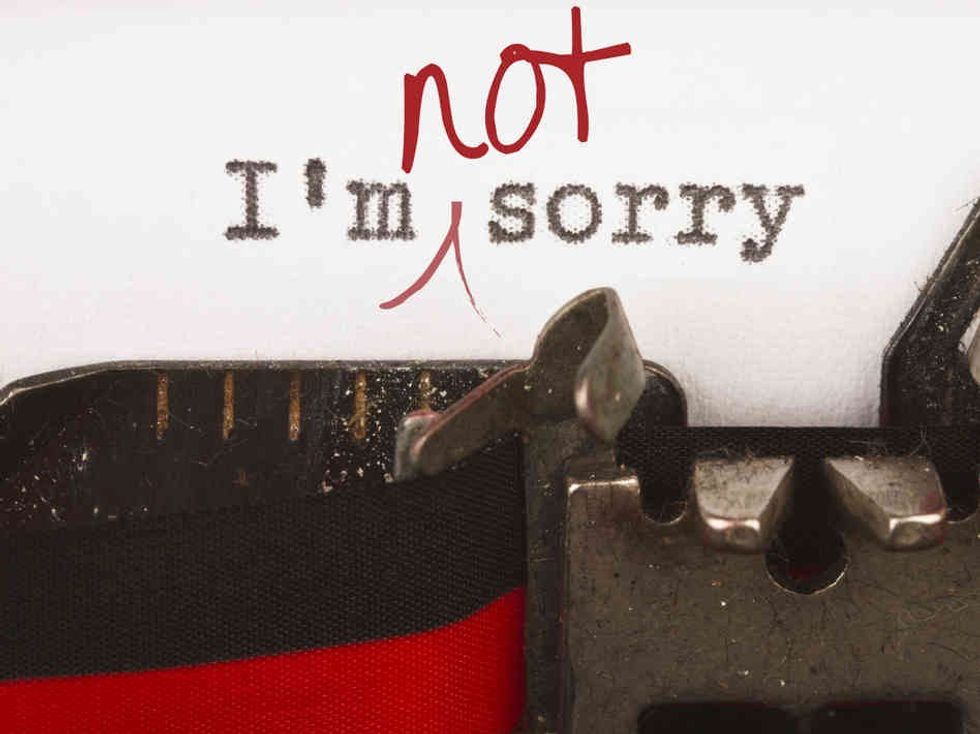
One day over winter break, I was riding in the car with my mom. Something happened and I said "sorry," even though it had clearly not been my fault. Then my mom proceeded to tell me that women say "I'm sorry" many more times than men do.
And it's true. Studies show that women say sorry for many trivial things, and even when they are clearly aware that it's not their own fault. Actually, most of the time, it's the other person's fault. It's not to say that men don't say they're sorry, it's just that when they do, they're actually in the wrong. Sloane Crosley wrote an article in the New York Times about this very topic and told the story of her going to a restaurant and ordering a salad that tasted like dirt. She called over the waiter and apologized, asking to see the menu again. As the new meal arrived, she realized that it was covered in bacon, and she is a vegetarian. Once again, she proceeded to say "I'm sorry." Nothing in this situation was her fault. If anything, it was the restaurant's fault for not making the food taste good in the first place.
Crosley goes on to say that saying sorry seems to be how women express frustration or anger. The word is used when a situation is so clearly not our fault that we think saying sorry will somehow incite an apology from the person who's fault it is and "who should be apologizing."
Some examples of this include "Sorry, but can you move?" "Sorry, can you turn the music down?" and "Sorry but I didn't like this food". All of these situations are obviously not the person who is apologizing's fault, yet it comes so naturally to say sorry in these situations. And so often, we don't think much of it.
What happens when you say sorry so much, is that the person who is at fault often doesn't have to apologize and gets off the hook. This isn't okay for either party, where the person who is at fault feels bad and the other person might not. It also creates a "Boy Who Cried Wolf" effect in that because you say sorry so much, it begins to lose meaning. Then when you actually mean it, the word can lose effect. So what we as women need to do is stop saying sorry when it's clearly not our fault. When something is your fault, it's okay to apologize. Let's not belittle ourselves by saying sorry when we know we're not to blame. Let's be more assertive. We've got this.















