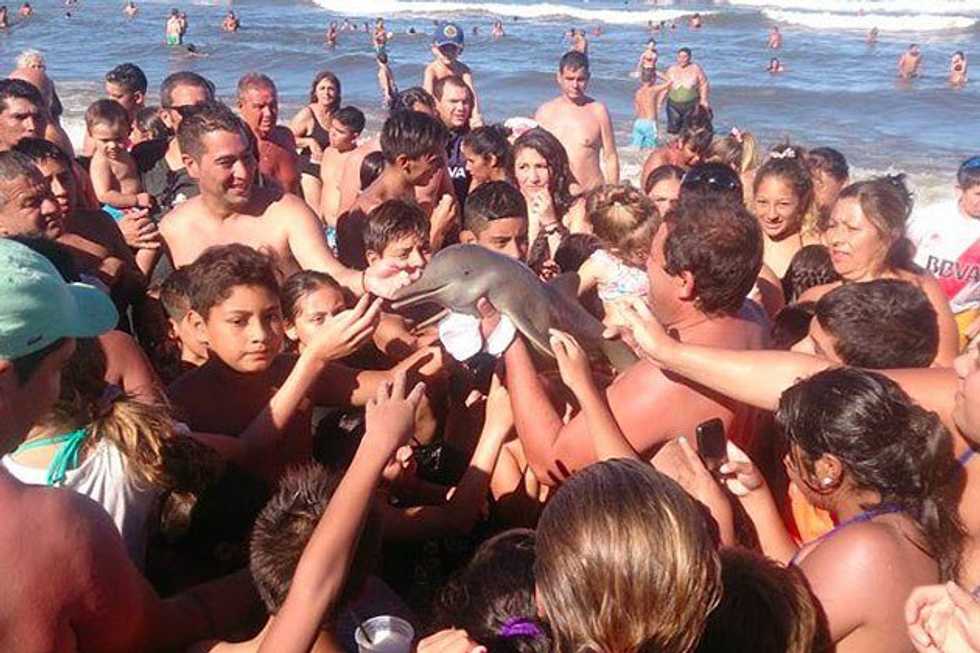
Last week, a young dolphin was killed after a group of beachgoers removed it from the water and passed it around to take photographs. Photos of the event posted to facebook show dozens of people surrounding the dolphin with phones in hand, and the story has sparked a number of comments by both reporters and readers on its implications as a direct product of “selfie culture.”
The urge to photograph oneself with a wild animal or at the occurrence of any other exciting event is a reasonable one. Live shows and plays have had to ask patrons to refrain from camera use for decades. Earlier this year, a woman in Yellowstone was thrown into the air by a wild bison after getting close in an effort to pose for the perfect picture. Animal-related negligence, however, ranges far outside the realm of unmalicious photographs, and much further into the past than do camera phones and social media platforms like Instagram. This fatality, though an exceptionally devastating one, is rooted in a much deeper problem than that of a not-so-newfound culture of taking photos of oneself. “Selfie culture” is not to blame for human egotism and its ecological consequences; that blame falls on the human race itself.
The dolphin killed in the incident has been identified as a La Plata river dolphin, a small species which was officially given the status of “vulnerable” in 2001. The International Union for Conservation of Nature (IUCN)’s “redlist” website lists 11029 animals under the “Vulnerable” category, in addition to 7323 officially “Endangered” animals, and 4898 species ranked “Critically Endangered.” Among these, 1093 marine animals are considered at risk of extinction, with assessments ranking back as far as 1996. The Oxford English dictionary didn't officially recognize the word “selfie” until 2013.
La Plata dolphins are the only species of river dolphin to live in saltwater, swimming in shallow water along the coastline of South America, from Brazil to Argentina. Because of the dolphins' size and proximity to shore, these animals are at risk from habitat depletion, pollution via agricultural runoff and untreated sewage, coastal traffic including destruction by motor boats and people, and fishing nets, which are generally believed to be the species' biggest threat. Through analysis of current trends, it's been estimated that the population will decline by 70 percent in the next twenty years if there is no forward action in conservation efforts. If this is the case, then why is there little attempt to save the species?
The answer is, of course, the same as it is for any of the other threatened or endangered species in the world: we just don’t care enough.
This isn’t to say that there aren’t individuals and organizations actively working towards conservation efforts. A variety of national and international protectionary institutions have been set up across the world, but such action simply isn’t enough, as evidenced by the hundreds of species that human society has already killed off for good. Many people take enjoyment out of the rush of killing other living things, whether this be legal deer hunting in the United States, or the continued poaching of endangered species as a part of the fur or ivory trade in other countries.
Others want to help, but don’t know how, and don’t have the time, money or motivation to find a trustworthy organization to donate to or volunteer for; with our primary information resource now being google, the task of wading through seventeen million search results is daunting and discouraging, especially for those who have never even seen the animals they're being encouraged to protect.. Many people in the world prioritize their own convenience over the lives of endangered animals without even considering it. Wvery time you throw away the plastic from a six-pack of beer, for example, you put an already endangered Sea Turtle further at risk. Every time you buy a plastic bottle of water rather than drinking from the tap, an albatross may die from starvation after thinking the non-digestible cap was food.
The urge to take photos isn't what's causing us to abuse animals. The source falls on a deeper egotism, laziness and correlated ignorance to what kind of treatment wild animals need, and what role we play in their survival. At worst, selfie culture is feeding this pre-established egotism, at least when it comes to taking invasive and illegal snapshots of wild animals. At best, selfie culture is a direct result of such egotism, and is the 'final straw' in this greater culture of indifference, allowing us to finally realize what steps we need to take next.
The photos of this incident, uploaded to Facebook, were the first form of media to raise worldwide awareness of the horrors of the situation and, as a result, of the La Plata species itself. Social media has been a powerful medium for communication since its origination, spreading information easily and efficiently and reaching a much wider audience than would a more niche-style website or opinion journal.
The trend of going “viral,” is a new one which allows media to reach a much vaster range of people across the world than has ever been possible before. So why don't we use social media for the sake of animals, instead? Share information about resources, initiatives, and programs to help out wildlife. Discuss protection and share facts on social media platforms. Call out the bad to express your concerns, but contribute to conservation efforts by also sharing and inspiring the good.
One headline regarding the La Plata dolphin death read "We Should Stop Taking Selfies and Start Looking in the Mirror." Instead, why not start using selfie culture as a means of looking in the mirror –– and at the wider world –– instead?