


70,000.
This is how many thoughts bounce between the walls of our minds each and every day. From sensory recognition to conscious decision-making, the power of thought is the very thing that separates us from our distant cousins in the animal kingdom. It is the bedrock that supports all of human achievement: math, science, religion, art, language, engineering -- civilization itself! Without our advanced cognitive abilities, we would produce nothing greater than the works of chimpanzees. It has allowed us to transform the face of our planet into troves of agricultural and industrial regions, thus altering our once-migratory lifestyle into a sedentary one. It has allowed us to become economical, philosophical and political animals, thus parlaying our future on negotiated agreements and written pacts. It has allowed us to fundamentally understand the world in which we live. It has allowed us to dream of new worlds, perhaps trillions of lightyears away, deep in the farthest reaches of the cosmos. It has allowed us to explore, expand, and discover. It has allowed us to build great skylines that mark the shorelines of the vast oceans that surround us on every side. It is has allowed us to develop complex systems of representative symbols that denote meaning without the need for spoken word. Our cognitive ability is the single most integral part of what makes us human. Without it, we are nothing.
Yet with the rise of the digital world, humans have been tasked with consciously doing less and less. The development of computers has automated many functions within society. In factories, computers build and frame products to a percent accuracy far better than humans. In the financial marketplace, computers calculate and tally currency far more precisely than humans. They do not need wages nor sleep. They do not demand bonuses and are usually extremely efficient in a cost-return analysis. You may be thinking that these specific examples sound like great things, for with less physically demanding work, humans can shift their focus to further advancing our society technologically. I will cede this point. But the problem arises when our digital creations begin to think comprehensively for us. Within the past 15 years, computers have gradually taken over human thought processes. No longer do you have to open a book and find the exact method for solving a problem, for nowadays, powerful search engines, such as Google, have abolished this need for learning. Moreover, with the advent of smartphones, the answer to virtually any problem can be fabricated in seconds within the palm of your hand. Albeit the endless amounts of information in the digital space around us may prove advantageous for the select few who take advantage of it, the majority of people seem to be comfortable with “doing less” in the realm of thought. The latter majority no longer need to think deeply about specific issues that confront us, for we now hover in a seemingly endless field of differing (and oftentimes poorly-researched) opinions on just about every affair. They no longer need to know the full methodologies for problem solving, for the Internet expedites the process to a few keywords.
Although these thoughts are not being allocated towards the interests of true knowledge and development, they are still occurring with similar frequencies. Humans have developed to become deep-thinking creatures. Our thoughts do not simply cease to exist, but rather, are simply allotted to cater to varying subjects that are dependent upon circumstantial environments. Whether our thoughts are productive or destructive, they occur at roughly the same rate of 70,000 per day.
Furthermore, while spending a few moments contemplating the nature of thought, one can easily deduce that as conscious beings, we have developed the remarkable ability to deliberately choose our thoughts. With relatively little practice, we can quite literally shape the pictures we hold in our mind. These “chosen” thoughts are referred to as “conscious thoughts,” while the thoughts we cannot instantaneously choose are referred to as “subconscious thoughts.” The latter sort run rampant on autopilot every single second of every single day and culminate in your perceptive mental experience. In simplistic terms, they are derived from your belief system, which has developed and festered by the events experienced throughout your lifetime. But even though we cannot perceive these thoughts easily, they too can be changed by hacking our conscious thought stream and inputting whatever we may so choose.
It is rather curious then to consider the role digital technology has had upon our belief systems and conscious/subconscious thought patterns. The vast majority of us, especially the so-called “digital natives,” have been fully indoctrinated into a culture entirely dependent upon our digital creations. We cannot move from A to B without our smartphones in our hands. Personally, I know many people who even feel “separation anxiety” when their phones are not with them -- something I can relate only to addictive insanity. The millennial generation has become so accustomed to their digital devices that many feel the impulsion to “post” every mundane happening of their lives onto social media in dim hopes of achieving a sense of satisfaction derived from the attention of others. Many send hundreds, even thousands, of text messages a day. As humans, we crave the consideration of those around us, and I propose that this is the fundamental logic behind our addiction. While at one time face-to-face conversations could be limited to the number of people in the given area, today we can reach millions upon millions of people at the touch of a button. Subscribing to the notion that we are social beings, our craving for social technology only makes logical sense. But why should emotional impulsions dictate the way in which we live our lives?
Every moment we look at our phones, we become lost in an alternate reality of social connections, games, and other spurious existences. What may feel like five minutes turns into 30. We are all victims of this. But what is rather intriguing is the fact that it is nearly impossible to remember the exact nature of our thoughts within these lost thirty minutes. Our thoughts that could have been otherwise used for productivity are lost forever. This is what I refer to as “wasted potential of thought,” for every time we lose ourselves in our fabricated digital worlds, we lose the potential for productivity mentally, physically, and even spiritually. The 70,000 potential productive thoughts we may have on any given day are quickly deteriorated and forced into extinction.
Moreover, each time we dally on our phones, our thought patterns dynamically change. Studies have shown that the excessive use of digital devices have thoroughly diminished our cognitive ability to focus. The hyper-use of computers for newer digital natives has also been a root cause for the rise of ADD and ADHD.
Each and every day our minds and thought patterns are conditioned by our experiences. A toddler who touches a hot stove learns to avoid doing so in the future. A student who learns a new mathematical formula will learn to comprehend its meaning through practice. A salesman who fails at a certain sales technique will avoid using the technique in the future. A golfer who takes the wrong club will be less likely to do so again. This is conditioning: the very psychological basis that describes the way in which we behave. But, perhaps even more importantly, is the fact that social conditioning (developed through social interactions with others) directly alters our moral belief systems. Think of Charles Dickens’ "A Christmas Carol." At first, Scrooge is a hateful, baleful man whose greed knows no bounds. But after his social experiences with the three ghosts, his belief system practically polarizes. He becomes filled with love for others.
But by excessively using our digital devices, what are we learning? And how are we being conditioned?
Whether we chose to realize it or not, our minds are being rewired by computerized machines every time we use them. This is what I call “digital conditioning.” It exaggerates our social needs and propels us into an eternal trance of delusional reality. It places the social hierarchy high atop a pedestal previously unknown in size. It diminishes our propensity to show affection for those around us and increases our inclination to seek the cyber-care of those half a world away. It has left us victim to unadulterated bigotry by unqualified sources. It has numbed us to curiosity and education. It has caused a heavy surge in labeled psychological diseases such as “depression” and “anxiety.” It has given us the ability to read the “tone” of a text, but has robbed us of the once-necessary skill of reading facial expressions during an actual conversation. It has given us the ability to find shortcuts to problems instantaneously without fundamentally understanding its true nature. But perhaps worst of all, it has made these abnormalities the norm.
70,000.
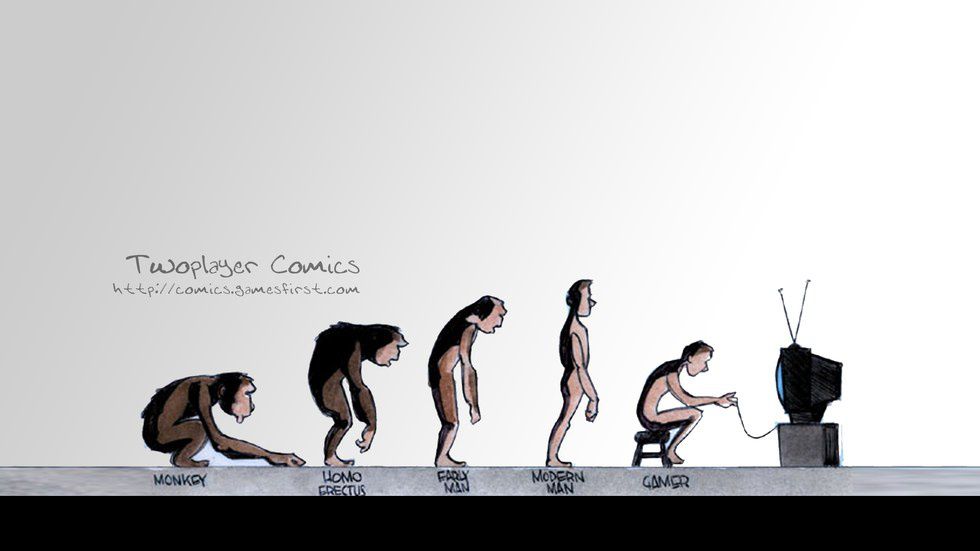
This is the average number of potential thoughts we have per day. Translated literally, Homo sapiens means “thinking/wise man.” But, if we are no longer thinking in a more complex manner than animals, do we truly deserve this self-given title? Like an animal reacts to a predator, we simply react to the stimuli emerging from the rectangular device in our hands. Impulsion is not deep thinking. While technology may be beneficial when used properly, if we are not careful the potential of our 70,000 thoughts will be wasted through the grisly means of digital conditioning.