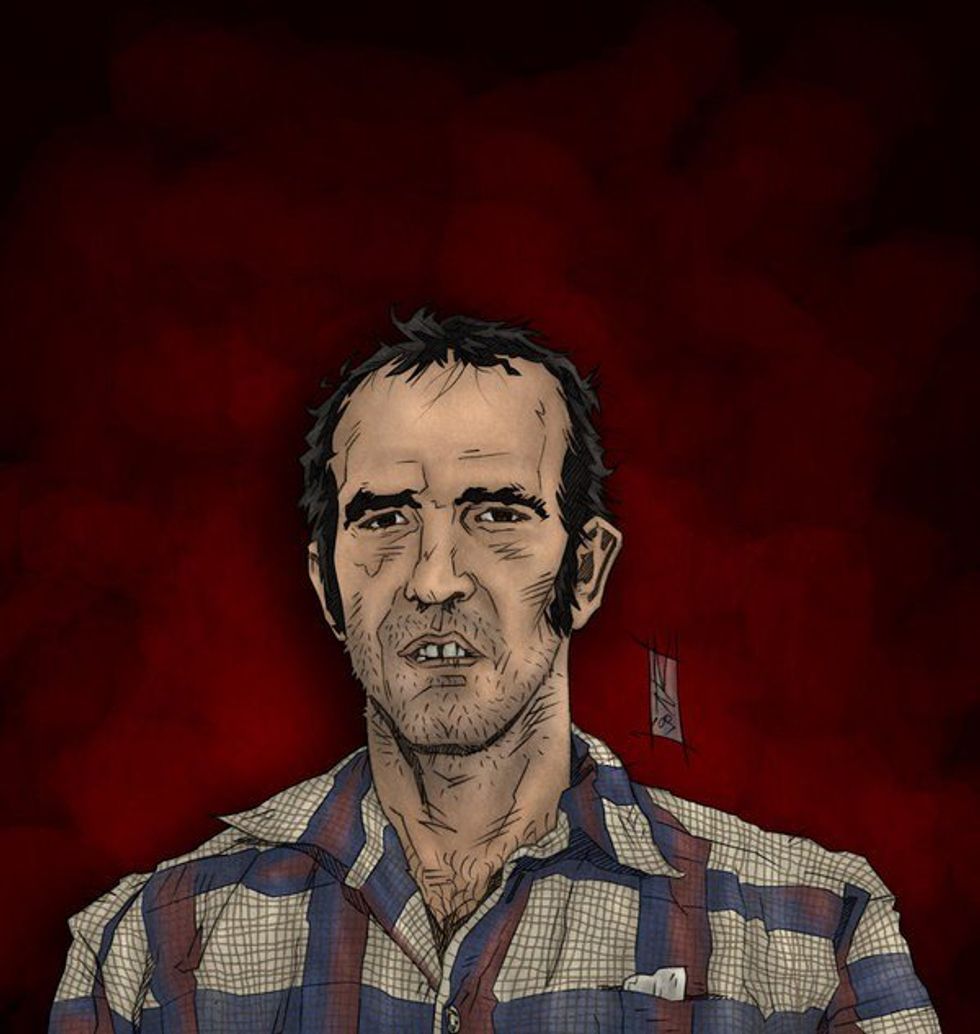
Ottis Toole was a serial killer who was convicted of at least 6 murders in the United States in the mid to late 1900’s. While he admitted to many more, along with his partner in crime Henry Lee Lucas, his involvement in more than 6 has not been proven. Toole was a cannibal, a murderer, a rapist, an arsonist, and absolutely deranged. Theories of socialization are a way to find the reasoning behind the atrocities Ottis Toole participated in. In his case, the symbolic interactionism theory explains why such horrendous crimes were perpetrated. Toole had a very harsh upbringing and constant bad company which can be accredited for his eventual deviance. The differential association theory, and the control theory (which both fall under the symbolic interactionism theory) work together to create the perfect storm to conceive this monster.
As a child, Toole was raised in a malicious family, with an abusive mother who forced him to cross dress, an alcoholic father who beat him and constantly belittled him, and multiple close relatives who performed acts of incest with him, against his will. Toole was very close to his grandmother, who participated in satanism, and introduced a young Toole to grave robbing and self mutilation.His grandmother even dubbed him as a “Devil’s child.” The differential association theory basically states that a person is influenced by the company he keeps, and for Toole, simply because of where he was born, he was surrounded by a group of abusive lunatics. Beatings, rape, and pain in general defined life for a young Toole. This obviously had a very lasting impact on his psyche and caused him to start deviating from a very tender age. By the age of 14, Toole had dropped out of school, frequented gay bars, was a serial arsonist who was sexually aroused by fire, and a self proclaimed murderer. Toole claimed that his first victim was a car salesman that propositioned him for sex, and in return Toole claimed to have ran him over with his own car.
Soon Toole ran away from home and became a drifter, engaging in sexual relationships with a multitude of men, and supported himself through prostitution and panhandling. The man was obviously very disturbed, but he found the perfect fuel to his fire when he found his soul mate in Henry Lee Lucas, a fellow drifter with a similar messed up past. The two met in a soup kitchen in 1976, and were soon inseparable. The two embarked on a killing spree, and the total number of crimes they committed is unknown, because they both confessed to over hundreds of crimes, some of which they couldn’t possibly have done. Another theory that applies to the later stages of Toole’s life and the start of his murder spree is the control theory which relates to self control.
The control theory states that everybody has their inner and outer control, the former stemming from morals and ingrained values, while the latter is influenced by the people surrounding the individual. In Toole’s case, starting with his very close relationship with his mother, and finding his perfect friendship with Henry Lee Lucas, he was constantly pushed towards paths of deviance. In fact, as a young child Toole was declared mentally retarded. Psychiatrists labeled Toole schizophrenic, psychopathic and retarded. One said, "To him, life itself is so unmeaning, and the distinction between living and dead people so blurred, that killing is no more than swatting an annoying fly.... He trivializes the distinction between living and dead, believing himself to be dead. Retarded and illiterate, he has been out of control since early childhood. A severely drug-dependent individual, he is unsafe under any conditions outside of a secure prison, and perhaps unsafe there." (Schechter). This lack of touch with reality meant that his inner control was barely existent if even that, and the majority of his decisions were based simply off of the outer control.
Because of Toole’s I.Q of 75, many criminologists have theorized that it was Henry Lee Lucas that called the majority of the shots in this relationship, and it was in an attempt to prove himself worthy to Lucas, Toole happily went along with every depraved incident. Lucas would be the greatest outer control to be present in Toole’s life. One dialogue between Henry Lee Lucas and Ottis Toole that exemplified the relationship between the two was recorded by Texas Rangers in 1983. In it Toole asks Lucas “Remember that one time I wanted me some ribs? Did that make me a cannibal?” Lucas replies with “You wasn’t a cannibal. It's the force of the devil. Something forced onto us that we can’t change” (Bio,1983). Lucas’ reasons for deviance are more widespread, and can be attributed to symbolic interactionism as well as labeling theory, in which he appeals to higher loyalties such as the devil. Toole would not fall under the labeling theory however, because he had no reason to justify his killings through labels, because as his psychiatrists said, he did not make any distinctions between life and death. This is further proven through Toole’s eagerness to confess to over 108 murders, many of them he could not have committed.
Although there are many reasons behind Toole’s atrocious deeds, and although none of them justify the killer he became, they do provide an inside look into the justification Toole must have given himself. Toole’s upbringing and mental incapabilities made him the perfect fit for both the control theory and the differential association theory. Ottis Toole was the gun that committed the crime, but symbolic interactionism explains that it was those who surrounded him from the day he was born to the day he died that pulled the trigger.