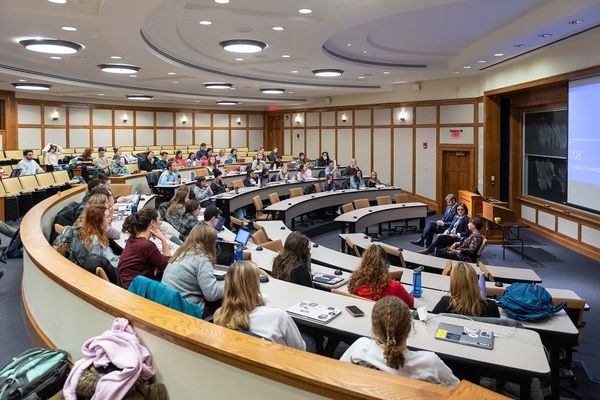


Whether you’re the first in the family to enroll in a post-secondary program or a legacy, there are a few observations to be made about the changing landscape of higher education. In 2009, the National Center for Higher Education Management Systems (NCHEMS) gathered data for the percentage of 18- to 24-year-olds enrolled in college, showing a 7.6 percent increase from 1991. From the bills we get each semester, we know education isn’t getting any cheaper year to year. The positive trend is encouraging but begs the question of affordability. NCHEMS also shows an increase of family income needed to pay for college from 15.7 (2007) to 17 (2009). Meanwhile, per capita income in this country had almost negligibly increased between those two years from $38,615 to $38,846, a mere half a percent.
Recognizing this economic hardship, students have been forced to borrow more and more money each year. Within the past couple of years, national student loan debt has hovered around a trillion dollars. With return on educational investment being at the foreground of a student’s decision, coupled with astronomical graduate unemployment, “…many teenagers feel forced to choose between…lectures and essays in a topic that may bore them but will hoist them up in their career ladders – or opting to study something they are passionate about while facing the fear of not being able to get a good job.” Concern is growing among academics about what is coming to be termed “career-oriented study." (Tobin, theguardian, 2015) Howard Hotson, an Oxford history professor, expresses his criticism of career-oriented study in Tobin’s article. He uses the term “university market” to describe the manner in which higher education has become such a monetary concern that it makes students neglect the university values. “Instead of sparking creativity and fanning open-ended curiousity,” he adds, “we are smothering them in debt.”
Both abroad and domestically, governments have adjusted for this dilemma with a couple of initiatives. This year, Japanese Prime Minister Shinzo Abe announced a plan to transform traditional higher education. His mission aims to orient the 86 national-level public universities to either scientific research or vocational training. Current critics of the traditional higher education system in Japan say the class sizes are too big with too many lecture sessions and not enough discussion sections. At the end of June, all of the national-level public universities in Japan had to submit plans in compliance with this mission while demonstrating educational reform; government funding, on which the universities depend for 70% of their operating income, will be granted according to alliance with Prime Minister Abe’s initiative. By 2050, the number of Japanese 18-year-olds is expected to be half its current number. Here’s hoping the career-oriented curriculum is effective for the next generation of professionals. (Obe, Wall Street Journal, 2015)
Domestically, President Obama has taken a different approach to job placement for young people. TechHire, a government initiative aimed to place young Americans in well-paying tech sector jobs, avoids the gauntlet of higher education entirely. The accelerated courses have been shown to effectively train prospective employees for mobile app, data analytics and cloud computing careers. Enrollment numbers are growing strong. Compared to last year’s TechHire’s national graduating class of 6,700, 16,000 will graduate from a variety of tech sector career placement programs this year; roughly one-third of all new computer science professionals. (Lohr, New York Times, 2015)
I am reminded of the Machiavellian principle after researching the changes in traditional higher education. Domestically and abroad, academics are realizing college students are becoming more pragmatists rather than humanistic. The path of education is becoming more and more about efficiency instead of a journey-as-destination type of schooling. What lies ahead is the determination of whether or not the current priorities of students, government, and academic institutions align to ultimately place future professionals in fulfilling careers.