I’m going to be honest here, very honest. This topic is something that keeps me on my toes. It’s something that makes me fired up at times and at other times will even make me question my choices.
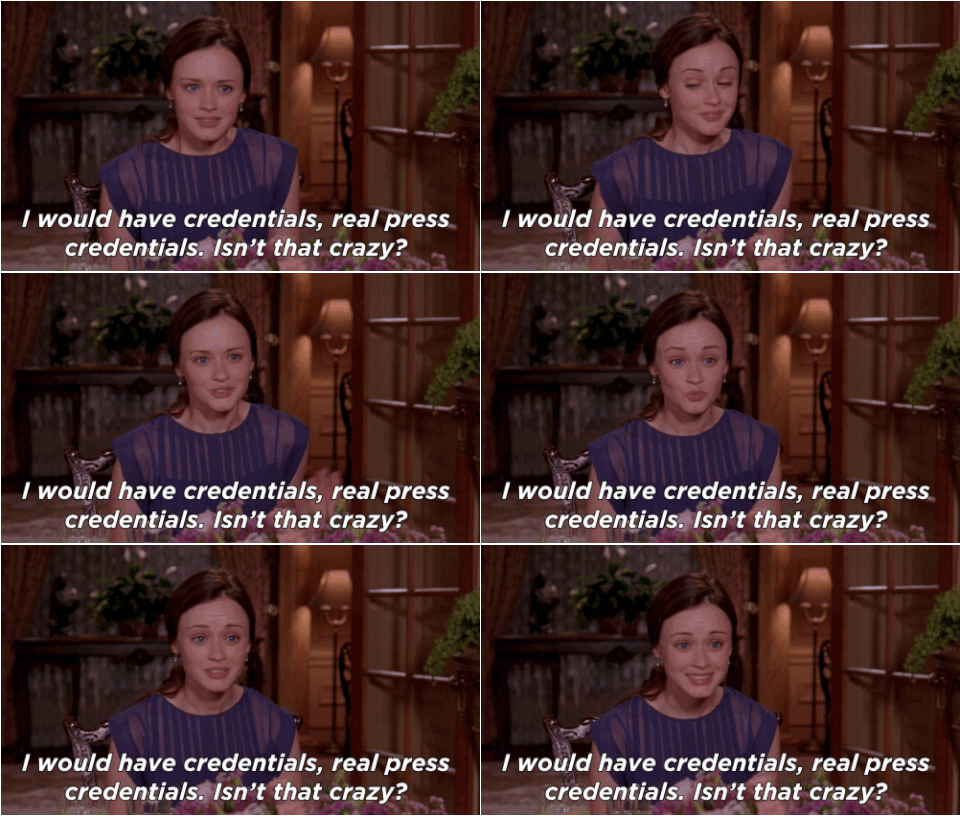
Growing up, I kind of wanted to be like Rory Gilmore. I grew up watching "Gilmore Girls" with my mom and I wanted to be professional and be concerned with coffee and writing for an exceptional newspaper. I already had two qualifications, I love coffee, and you could say I love writing.
You see, the only thing is that isn’t all there is to getting through five years of college for a journalism degree. It’s not always complaining to your friends about how much work you have to do, nor is it always acknowledgment for the spectacular work you do.
Yes, there is coffee. Too much coffee, actually. Yet, through it all, there are quite a few things I wish they would’ve told me before I got into my first Media Writing class.
1. Journalistic writing isn't poetry.
I’ll never forget when my first professor in college introduced the concept of journalistic writing to my class. He said, “I understand that some of you are into writing poetry and songs and short stories, but you’re going to have to forget that stuff in this class."
The fact is, if you’re going to be writing for news, there isn’t a whole lot of room for artsy writing. Of course, there is feature writing, but you will generally have to learn how to get to the point super quick. You’ll learn how hard it can be to filter through all the unnecessary words and material to make the information on the page easily digestible. If not, readers will quickly go to a different article, and your professors won’t be too enthused either.
Learning the style can be difficult at first, but after using it for a while, it becomes almost natural. When you learn about leads, nutgraphs, and the Inverted Pyramid, you gain a little confidence in writing an article in the way it should be written.
2. Finding sources can be a wild goose chase.
I can’t tell you how many times I’ve lost my mind because sources either bailed or were simply unavailable for an interview. From the assignments I was given back then to the articles I’m doing now, tracking down good sources can be hectic.
It is quite an experience to work a busy schedule with an interview during the week. If you have more than one source, you may find it even harder to balance your schoolwork, job, and everything else around that person. You may wind up having interviews via email or phone. Like I said, it can give you some anxiety.
Some sources are easy to work with and will even help you find other people to talk to. Even the ones who are ridiculously busy may lend you a hand over email or phone. You just need to be upfront and honest about your intentions. You meet a lot of really cool people this way.
3. Everybody will expect you to write for the school newspaper.
This comes with the territory of being a journalism major. I won’t discount it because it is the best way to get newsroom experience and every journalism major should try to aim for it. Yet, there can be a little bit of pushiness with it. Many internships will require you to write for your college’s paper or have at least some experience.
The time it takes for you to work on articles for your paper may take away time from other obligations, so be prepared for decisions regarding your time usage. I never wrote for my college’s paper out of lack of time and lack of interest, but I knew what I was capable of with my time allotments during the week. You should too.You can find many ways of budgeting your time.
It’s ultimately your decision but whatever you can do to get writing and find your voice, look into everything you can. It doesn’t necessarily have to be a paper, but just getting that experience is vital.
4. You will forget some math along the way.
I have a confession. Being in writing-intensive courses for the past three years of my five years of college did leave something to be improved with my mathematical abilities. If you spend too much time away from a subject like math, you are bound to lose certain skills.
Yet, if you are mathematically-inclined, the stuff you retain will be useful in the future. It turns out, that there are a lot of statistics that go into journalism, so that’s why it is so important to give yourself time to brush up on some basic math. It will come in handy.
There are resources all around for if you ever need some basic reminders. Don’t be too bashful if you find that doing math isn’t your strong suit. You’ll find that you are certainly not alone.
5. Journalism is quite the dog-eat-dog kind of business.
It’s scary to take note of what journalism in America currently looks like. There are politicians attacking your freedom to write the truth, and corporate juggernauts in the offices of the big-wig media conglomerates.
In the age of Snapchat news and Buzzfeed, it can be difficult to figure out what is news and what isn’t. The industry is moving so rapidly and we in it are pressured to be highly marketable for the sake of being hired. Some people are ruthlessly ambitious, others are timid and shy.
It’s ugly sometimes, but you learn how to take a step back and not let it get to you.
You’ll be in class and think to yourself, “Will I be competing with these guys in here for a job someday? What is this, the “Hunger Games” or something?”
You decide how you treat your environment. You have the power to take on the world of journalism without losing your identity. You don’t have to sacrifice your morals for the sake of a job or for success. You have the power to see through the corruption.
6. You don't need to write for a huge newspaper to be a journalist.
I think a lot of journalists can benefit from taking off on their own media adventure. The big-wigs might own the media we consume every day, but that does not take away our voice as journalists. I didn’t become a journalist to make money, I became a journalist to help people because my voice matters.
Their voices matter and your voice matters. We have the individual power to make our own careers in journalism. There are so many avenues. Podcasts, blogs, review sites, YouTube channels, etc. can really give you the confidence to take on the future you want to make for yourself.
Just because you’re not writing for some nationally-acclaimed newspaper doesn’t mean you’re doing something wrong.
You make your own destiny with journalism. The right to a free press is a relic that our ancestors in this country left us and we can use it for the bettering of this country, of others, and of ourselves.
Use your hobbies and interests to form your own venture, where you can see the power of a voice.