
Humor is best when it's snappy. Wit demands speed and attentiveness to small details. In my best attempts to be funny I often fail at off-the-cuff delivery. So, when I relate my one moment of wit, please know I have re-used the same line multiple times in an attempt to deceive people into thinking I have more than one original, witty thought. This joke consists of two words that, in the mind of my audience, are contradictory enough to inspire, at the very least, a chuckle. It first came up when my counselor asked me what religion I belonged to, and I told him I was "decidedly agnostic."
My counselor laughed, and we kept on talking about the mess I loosely refer to as my life. But the impact of the joke stuck with me, and since the mess we were discussing includes many forms of social anxiety, I decided to try this bit of wit on others. It's never failed to incite laughter, and, I hope, awe of my utter brilliance in the eyes of both peers and superiors.
It was only until recently that I realized the joy of the phrase was wearing off for me. I no longer considered it funny.
The idea of being decidedly agnostic was humorous because it was perceived as an oxymoron. However, the more I thought about my identity as an agnostic I realized it was not the same as an identity of indecision. To say that I am "decidedly agnostic" is still witty in the sense that many find it funny, but it is not an oxymoron. I am decidedly agnostic, whether it's chuckle-worthy or not.
Many people who are searching for truth, attempting to navigate between the intellectual, spiritual and communal merits that various descriptors of reality (i.e. atheism, Christianity, Islam, Buddhism etc.) may lend them, call themselves agnostic. I would argue such people are not agnostic. However, therein lies the reason most people find humorous the otherwise serious statement: "I am decidedly agnostic."
Agnosticism is not a state of seeking, it is a state of recognition of the limitations of humanity's ability to know. It is the most post-modern worldview available. Rationalists will role their eyes. All brands of theists will cling to hope of the agnostics' eventual conversion. The agnostic nods, smiles and continues to live life valuing, above all things, Socratic wisdom. The wisdom of those who recognize how foolish they are. That's what it means to be decidedly agnostic. It is to be decidedly humble in your own ability to state with any amount of certainty the nature of reality.
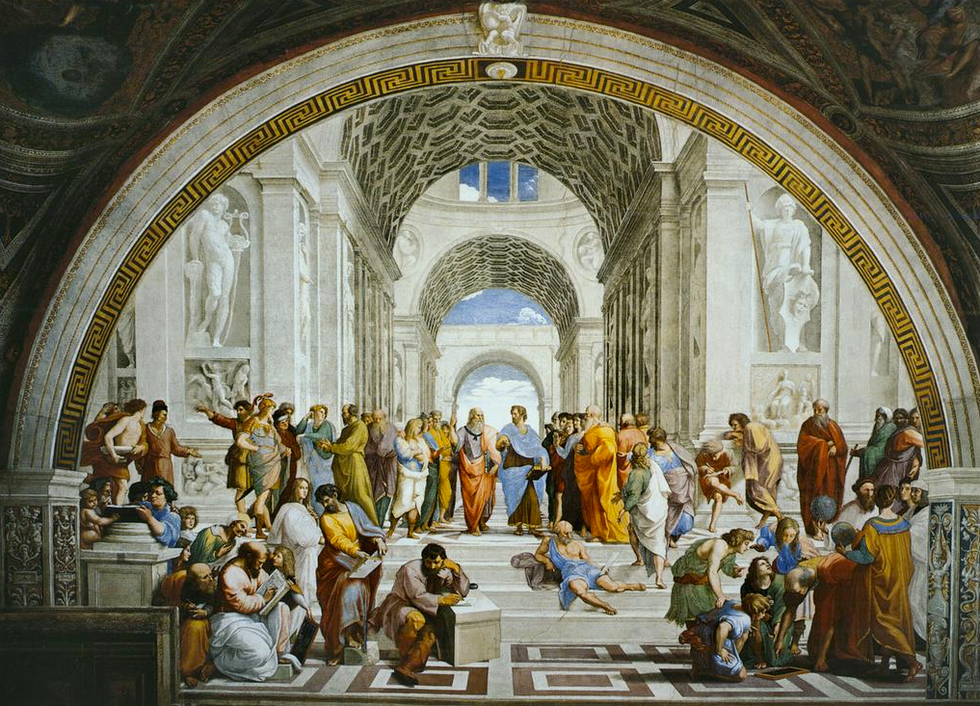
Consider Raphael's School of Athens, Plato points up and Aristotle holds his hand to the ground. And so philosophy and religion are broken into constant attempts to tease out the spiritual and earthly realms, or, as Augustine would later call them, the Earthly City and the City of God. Most concepts of reality deal with this contention in some way. Religion often views the Earthly City as a temporary state of being that will eventually fade as believers enter the City of God. Atheists view the City of God as fictitious in every sense. The agnostic decidedly recognizes that we cannot know the nature of the relationship of these two cities, and, with prudence, attempts to live every moment of life with an eye towards what is good.