


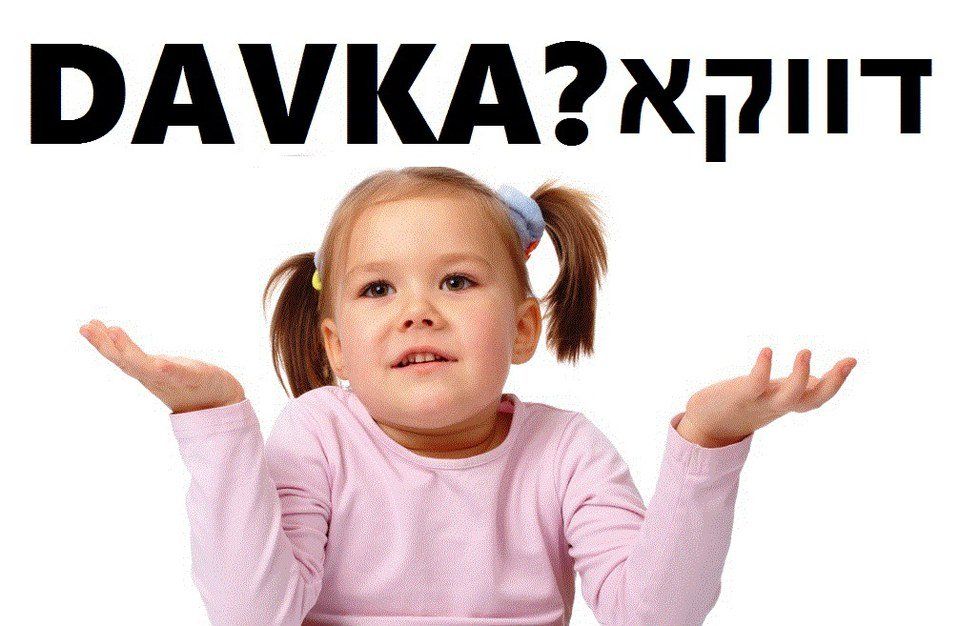
Davka?
Davka, spelled in Hebrew as “דווקא,” is an important word in colloquial Hebrew – even immigrants from Israel use it when they say something in English. As an Israeli, I can find many uses for the word off of the top of my head. It seems rather intrinsic to the language of my culture. Now arises the problem of defining the word in English to someone who did not grow up with the culture. Davka usually refers to something opposite to what was just suggested.
Often it embodies the questioning of a suggestion or outright judging the person who offered it in the first place. Though it depends on context, davka could be loosely associated with words like: specifically, deliberately, purposefully, actually, exactly, in counter, in spite of, etc. Yet, at the same time, davka is not really any of these words. In order to truly understand davka’s cryptic meaning, one must peel away the layers of its use to find what's lurking inside.
“Davka, Yes!”
People can manipulate the word davka in order to completely diminish a doubt, concern or assumption about the circumstances of a particular situation. For example, once I finish that ominous exam coming up, (which has been making me sweat buckets of anxiety over the past few days) I might proclaim: “This Hebrew exam was not hard at all, it was ‘davka’ easy.” Though I expected to leave the classroom sulking in the acknowledgment of my lacking skills, I davka left the class grinning with pride. Davka opposes what one thinks.
“Why Davka...”
This form of davka is used when someone proclaims something about themselves specifically. Sometimes davka is just not exactly what one is expecting.
Let’s explore the realm of romance for a moment. Picture a young woman with long black hair and a light complexion, the smell of a rather luxurious perfume stimulating the senses of a nearby bachelor. He approaches her suavely — attracted to her beauty. As he sends a wink in her direction, she takes notice of him igniting a light, almost floating feeling in her stomach. Fast-forward a few months into a blossomed relationship, and things begin to crumble as he turns out to not be the man the woman had hoped he'd be. It just so happens that he is leaving her soon, and that initial attraction they felt is fleeting.
She faces herself in the mirror and cries, “Lama, Davka Atah?” This would translate into: “Why, out of all the people that I would have started a relationship with, was it you who I actually fell in love with?” All of this minimized to three words with davka at its center, revealing everything about her situation without actually saying much at all.
“Why Davka ___?”
Davka comes from the Aramaic root deled, vav, koof – meaning to “study thoroughly.” This is related to the root daled, koof, koof which means “punctual” or “precise.” From the term "precisely", davka is transformed to mean “like this, and not in another way.” I always see davka as the option I am talking about as opposed to another, more expected one.
If an Israeli is substantially irritating me out of my skin for no apparent justified reason, I might approach him and say, “Lama, davka, lehargiz?” This translates to: “Why would you go out of your way just to make me angry?” To do a davka is just to do something out of spite. To do the complete opposite of a person’s desires intentionally and for no obvious reasons, as kids often do.














