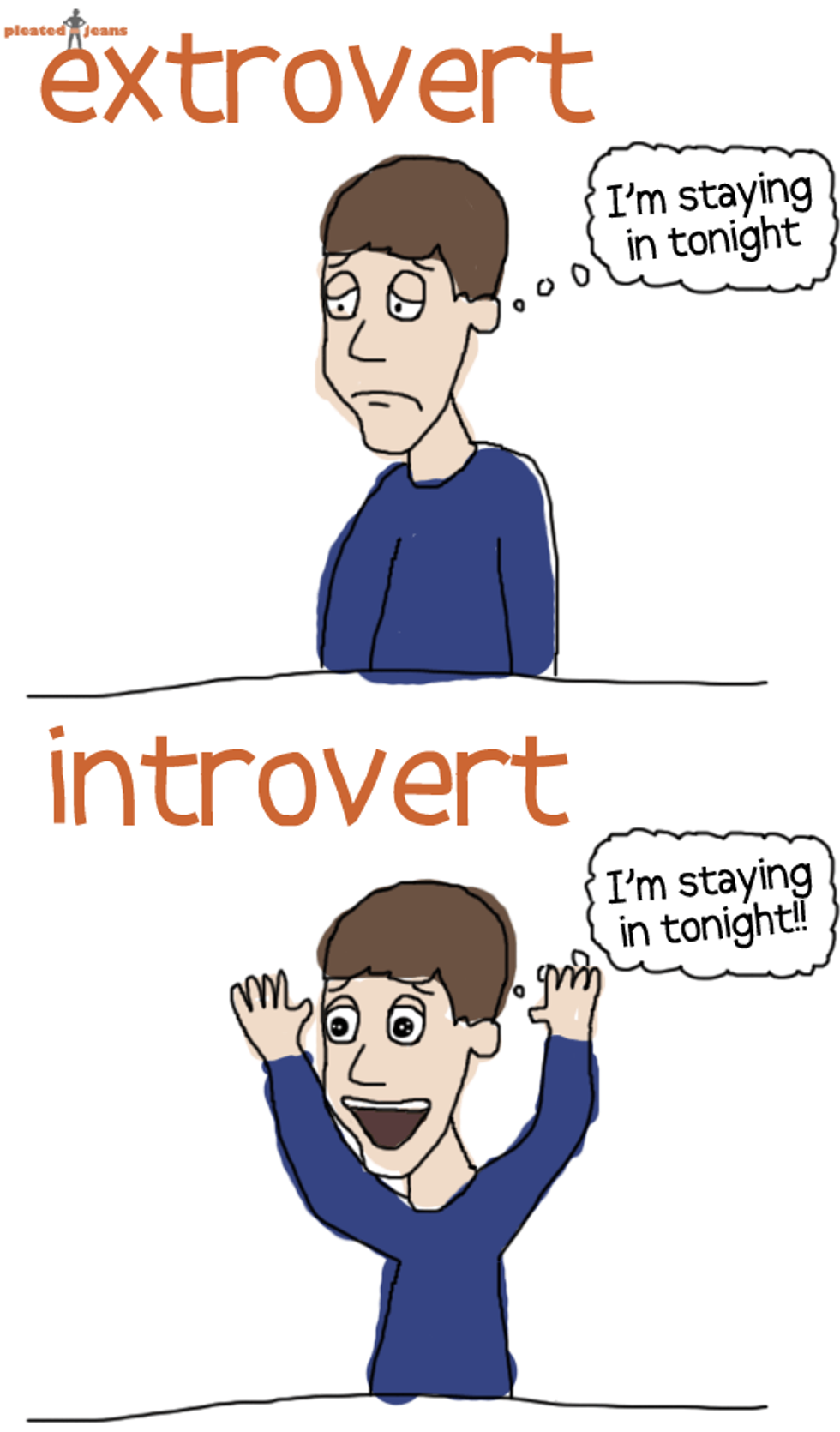
Here’s something I learned about myself freshman year: going out four times a week isn’t something I can do. I can just about muster the energy to drag myself into the world of frats and alcohol and hormones on a Saturday night, and halfway through it, I miss my bed, my people and my home. Accused of being unenthusiastic, selfish and, worst of all, boring, I become the bad guy in a world made for extroverts.
I never felt this way at home. Wanting to just stay in was never considered a feeble excuse for not having anything to do. It was just that everyone needs time alone. Solitude didn’t imply a lack of friends; quietness didn’t imply insipidity. Forward to today, and I find myself feeling embarrassed of my inability to make small talk — ashamed that I don’t always enjoy company. Every day here, I come closer to the realization that leadership, assertiveness, power, and all abilities the west so highly values, are just sly, roundabout terms for extroversion.
Why is extroversion so rooted in western culture? The west is inherently focused on the individual — on the idea that each person is a unit that must fend for itself. The east functions on a different assumption — the society itself is the unit, and every individual contributes to the betterment of the community as a whole. This divergence has shaped the cultures of both by skewing them to favor certain personalities more than others. The west, with its value on individual gain, values people who can “get ahead in the world,” who can shout down others until their voice is heard. The east, as a result of its focus on community, invests far more in those who can meld into a conversation, who are at their most productive in a conflict-free environment.
The extrovert bias in western culture is evident in the amount of time and money invested in group activities, leadership summits, ice breakers, the works. Mingling — that terrible, cringe-worthy activity — is the byword for any social gathering, regardless of whether one will ever speak to any of the other, equally reluctant participants again. As much time is spent teaching social mannerisms and marketing skills as is engaging in academic pursuits — perhaps explaining the “terrible GPA, fabulous job” phenomenon so unique to the American workplace. The more this happens, the more introverts are reminded that their abilities are irrelevant, pushing them into becoming pseudo- extroverts, into making themselves “likeable.”
The thing the west has yet to understand about introverts, is that our choosing not to engage in “networking” doesn’t make us incapable of conversation, or worse yet, boring. We just find it harder to engage in a conversation that we know will run out of steam or doesn’t seem to have any purpose. Often, this is why we choose to sit out social events: there is a constant, crippling fear of being trapped in a quagmire of awkward silences. When it comes to “real conversation” though, we can be as engaging, as comfortable as extroverts appear to be. While we don’t thrive on other people’s energy, give us a situation where conversation is meaningful and productive, and we’ll surprise you with our ability to contribute both to the dialogue, as well as to the energy of the room.
But this can only happen if this culture begins to recognize that introverts have our own, very distinct skills that are highly valuable, particularly in a culture where no one is taught to have them. I’ve never had a seminar on being perceptive, on how to make accurate assumptions about one’s surroundings, on how to exist in solitude without relying on the constant buzz of other people for positivity. These are skills too, and immensely useful ones at that. Instead of dismissing them and forcing us to “get out of our comfort zones,” why not make use of our inherent talents? This is particularly important in academic institutions and workplaces where so much more can be achieved by actually working instead of constantly attempting to create connections that are so often superficial and meaningless. For all its seeming inclusiveness, maybe it’s time the U.S., and, by extension, the west, started to value its introverts, benefiting both in the process.