

I don’t really remember what I was doing when I was three. If I think hard, I can recall flashes of my mom pushing me on the swing out front or my uncle showing me an interesting fossil he found. Looking through old pictures, I see myself grinning cheesily with my arms wrapped around my old dog Allie or waving from on my dad’s shoulders at some local parade.
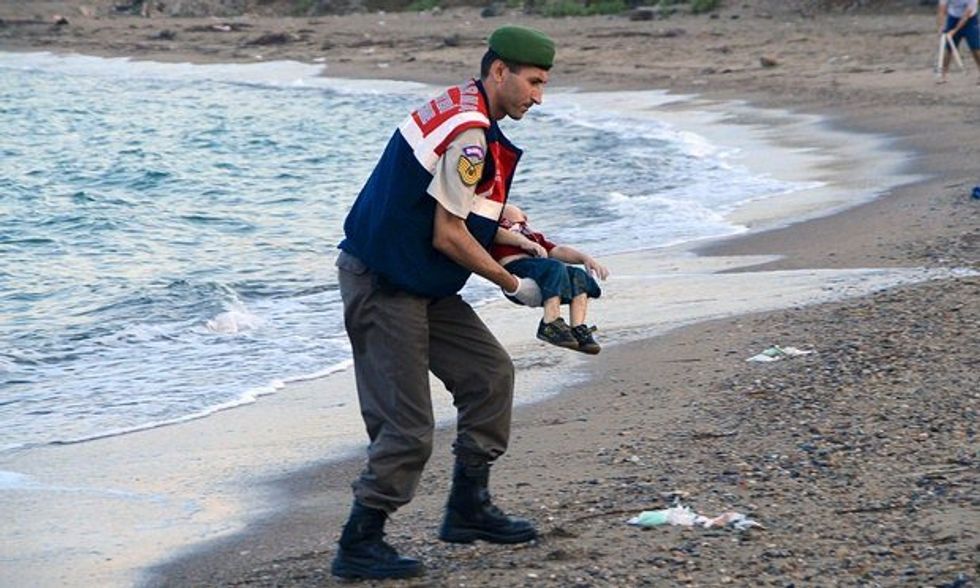
My childhood was a lot different than Aylan Kurdi’s. Aylan was only three when he fled war-torn Syria with his parents, Abdullah and Rehan, and older brother Galip – who was five. They journeyed first to Turkey, where his father paid thousands of dollars for a spot on a smuggler’s boat to Greece. They hoped that from Greece, whose immigration laws are more lax, they might eventually travel to Canada and begin a new life far from the ravages of civil war. Along with nineteen other refugees, they piled onto two small boats and set out to cross the Aegean Sea. Before they got too far, the boats capsized, throwing Aylan and his family into the waves. Despite his desperate struggles, Abdullah Kurdi was unable to save his family – Aylan drowned along with his brother and mother. It is believed that 12 of the 23 refugees on the boats died. The image accompanying this article is of Aylan, washed ashore and carried off by a Turkish official.
As absolutely heartbreaking as Aylan’s story is, it is just one of countless such tragedies. Millions of Syrians and Iraqis have fled their homes due to war and strife in those countries. Many attempt the perilous sea journey to Greece or other Mediterranean states, and the U.N. estimates that approximately 2,500 have met a similar fate when their overcrowded and unsafe boats sank or capsized. Others try to take a land route into Europe. Just recently, a train carrying several thousand refugees was stopped in Hungary. After a days-long standoff with Hungarian authorities, some 500 of the refugees began an attempt on the 110-mile trek into Austria, where they hope to find amnesty.
Europe is woefully unprepared to deal with this crisis, and some politicians are questioning whether or not the continent should even open its arms to so many. What refugee camps that do exist are desperately overcrowded and undersupplied. Such camps can’t provide for the flood of terrified refugees. Those refugees – worn down and desperate – become easy prey for human traffickers and other criminals who would take advantage of them.
There are legitimate questions as to whether Europe can handle all of these refugees. Many are calling on Syria and Iraq’s Arabian Peninsula neighbors to step up and shoulder some of the burden as well. But there is one thing that is beyond dispute. These people are human beings – same as you and me. They are desperate, they are scared and they are just seeking hope. Their countries are being torn apart with violence and warfare, and they have nowhere else to go. As a world, as a people, we must all do everything we can to help. Children like Aylan must have the opportunity to grow up in a world of peace, not of terror.

















